Senate GOP Looks to Navigate Gap Left by Lindsey Graham’s Passing
 Sen. Lindsey Graham (R-S.C.) on Capitol Hill in Washington on Jan. 7, 2026. Madalina Kilroy/The Epoch Times
WASHINGTON—On the first day back in the Senate after the sudden passing of Sen. Lindsey Graham (R-S.C.), legislative business continued—but the atmosphere was somber.
“I just walked past Lindsey’s desk,” Sen. Ron Johnson (R-Wis.), in line to inherit his Budget Committee chairmanship, told reporters on July 13. “I’ve gotta think one step at a time.”
Graham, 71, was known to many colleagues as a tireless dealmaker, emblematic of an older Washington where it was easier to work across the aisle. In recent years, the four-term senator and foreign policy hawk who ran against President Donald Trump in 2016 emerged as a key conduit between the president and an upper chamber that is sometimes at odds with him. Recent tensions have centered on the Safeguard American Voter Eligibility (SAVE) America Act, which aims to bolster election integrity.
“Graham spent decades building political capital across Republican factions while continuing lines of communication that many others could not,” Grayce McCormick, a publicist who has represented nonpartisan political organizations and city governments and worked with President Jimmy Carter and The Carter Center, told The Epoch Times.
Paul Dans, a Republican challenger of Graham this cycle who withdrew before the primary election, told The Epoch Times that Graham’s “political skills were second to none.”
“I don’t know if he’s going to have an equal,” the Project 2025 author said when asked whether anyone could replace Graham as a cross-branch negotiator.
Related Stories

That is not the only vacuum Graham leaves behind. In the short term, there are committee assignments and a key vote as the Senate scrambles to act ahead of its August recess. Over the long run, Graham’s hawkish stances on Russia, Iran, and other countries—priorities at odds with some elements of the Republican and America First base—have lost a crucial champion.
Graham’s new sanctions bill on Russia—one motivation for the trip to Ukraine shortly before the cardiac episode that ended his life—is on uneven footing in the upper chamber.
First elected in 2003, the third-longest-serving senator in South Carolina history has received posthumous praise from Democrats and Republicans alike, as well as from international leaders.
Sen. Elizabeth Warren (D-Mass.) wrote of her late colleague, “Even though we disagreed on much, he was always willing to negotiate, with humor and wit.”
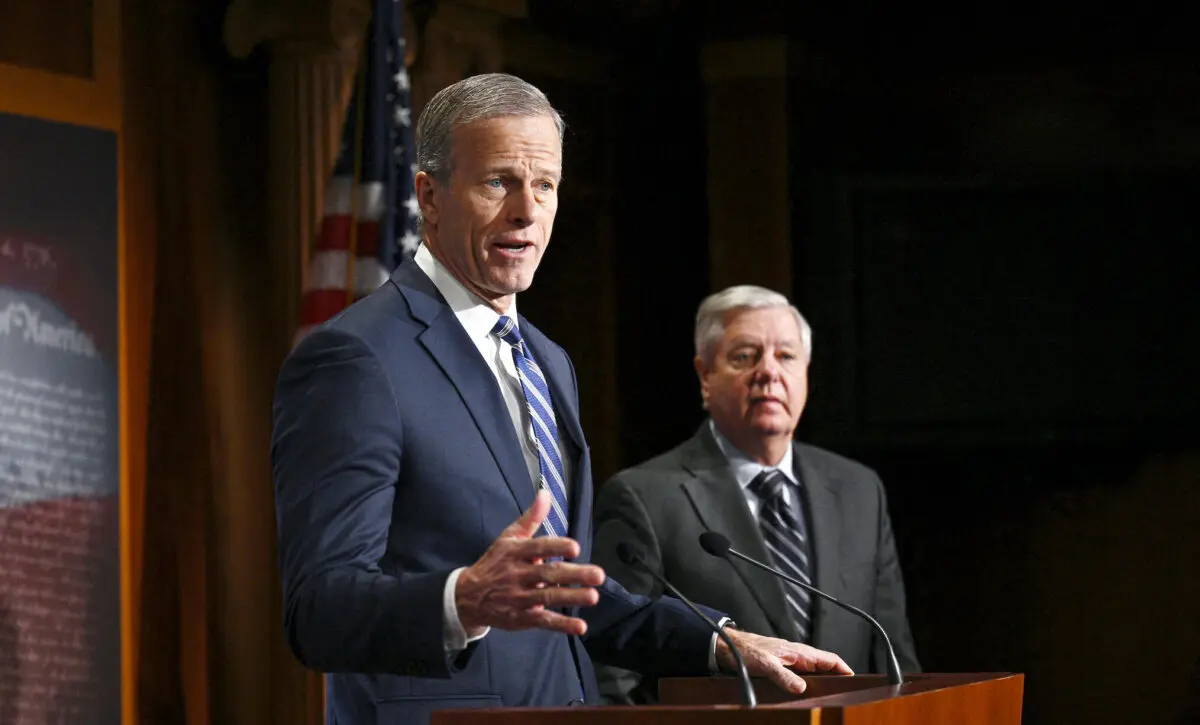 Sen. John Thune (R-S.D.) joins Senate Judiciary ranking member Lindsey Graham (R-S.C.) for a news conference on the Biden administration's "abuse of the immigration parole system" at the U.S. Capitol in Washington on Jan. 17, 2024. Brendan Smialowski/AFP
Senate Majority Leader John Thune (R-S.D.) wrote, “[Graham] was a trusted adviser, somebody I could go to for straight advice and counsel, and we spent a lot of time together over the years.”
Graham, known as one of the most pro-Israel members of the Senate, was also eulogized by Israeli Prime Minister Benjamin Netanyahu.
“Lindsey understood that the security of Israel and America are inseparable,” the foreign leader said in a statement, describing Graham as “a beloved friend.”
Loss of a DealmakerNot everyone credited Graham with a masterful touch as a negotiator.
Thom Hartmann, a progressive radio host, told The Epoch Times that “the dealmaker label was always a fiction, since Graham mostly followed power wherever it drifted.”
Yet others acknowledged the longtime senator’s political aptitude, even when they didn’t always like the results.
Dans, who did not shy away from heavy criticism of Graham during his primary run, said his past opponent “had the ability to cross the aisle,” sometimes too often for Dans’s taste.
Graham cosponsored numerous bills with Democrats during his time in office, ranging from sanctions on Russia to sanctions of the International Criminal Court—the latter in line with the Trump administration’s current efforts to isolate that court and reject its claimed jurisdiction over American servicemembers.
In 2023, the senator cosponsored the Dream Act, legislation that would have extended amnesty to illegal immigrants who entered the United States as children. Under the second Trump administration, the South Carolinian pivoted to a stronger stance against illegal immigration.
Dans said that “in today’s day and age, it is a lot of sharp elbows”—arguably a departure from the Senate that Graham first entered at the dawn of the 21st century.
McCormick described Graham as one of the Senate’s “relationship-driven operators, particularly on defense, judicial nominations, and foreign policy.”
Graham served on the Judiciary Committee as well as the Environment and Public Works Committee. In addition, the senator chaired a key subcommittee on the Senate Appropriations Committee, the spigot for funding to federal agencies, as well as supplemental spending.
As chairman of the Budget Committee, he guided the budget reconciliation efforts that yielded last year’s One Big, Beautiful Bill Act.
Graham’s passing comes as Republicans prepare to dig into a third party-line bill advanced along those lines. That goal, pursued just months ahead of the midterms and with the August recess looming, previously met with skepticism from Sens. Susan Collins (R-Maine) and Mitch McConnell (R-Ky.).
 President Donald Trump, Commerce Secretary Howard Lutnick (L), and Sen. Lindsey Graham (R-S.C.) (C) speak to the media aboard Air Force One en route to Washington on Jan. 4, 2026. Joe Raedle/Getty Images
Johnson has signaled his strong support for a third reconciliation bill.
Sen. John Kennedy (R-La.) told reporters he did not think Graham’s absence jeopardizes that legislation.
“The problem I see right now with the reconciliation bill is the chaos in the House,” he said.
After Graham’s passing, politicians have not shied away from calling to advance legislation in his name.
On Truth Social, Trump said senators should pass the Clarity Act, a cryptocurrency bill, in Graham’s honor.
Dans urged senators to advance the SAVE America legislation as a tribute to Graham, suggesting they should take a cue from the late senator’s work ethic.
Some senators want their chamber to move on the bipartisan Russia sanctions package that Graham helped lead.
“Nothing would be better than the president to call for passage and ratification this week,” Sen. Thom Tillis (R-N.C.) told reporters, saying it would do the most for Graham’s legacy “because that’s the thing he’s worked the most on.”
Kennedy, a supporter of those sanctions, agreed that Graham “cared about the sanctions bill.”
Yet he sounded skeptical of its prospects without clear buy-in from Trump.
“I just don’t know whether the White House supports it or not. I know some people at the White House have said they support it, but I haven’t seen the president yet,” he told The Epoch Times.
 Sen. John Kennedy (R-La.) speaks as Homeland Security Secretary Kristi Noem appears for an oversight hearing before the Senate Judiciary Committee at the Capitol in Washington on March 3, 2026. Madalina Kilroy/The Epoch Times
Graham’s departure also leaves the White House without a critical voice backing the Iran war as that conflict continues. The White House in a July 10 letter notified Congress that hostilities resumed on July 7.
A Sister in the GapAlthough Graham’s passing briefly narrowed a razor-thin GOP majority in the Senate, Republicans quickly regained the seat after South Carolina Gov. Henry McMaster announced that he would appoint Graham’s sister, Darline Graham Nordone, to serve out the late senator’s term. Trump recommended her for the post.Graham helped raise Nordone after their parents died when Nordone was still a young teenager.
Nordone did not say whether she would run for a full term.
South Carolina Republicans, from Rep. Russell Fry (R-S.C.) to businessman Mark Lynch, are among those who could replace him if they win a general election against Democratic candidate Dr. Annie Andrews. Although South Carolina is typically a safe Senate seat for the GOP, Graham’s passing may have made it just a little more competitive.
Hartmann, the author of the soon-to-be-released book “Who Killed the American Dream?: The Greatest Political Crime Ever Told,” told The Epoch Times that “the timing is brutal for the right, landing in a hair-thin majority in a midterm year.”
 U.S. Sen. Lindsey Graham (R-SC) hugs his sister Darline Graham Nordone on stage as he announces his candidacy for United States President during an outdoor event for supporters, in Central, S.C., on June 1, 2015. Graham is the ninth Republican to join the race for president in 2016. Jessica McGowan/Getty Images
In McCormick’s view, the void has left “a temporary gap in institutional knowledge and dealmaking at a time when Republicans hold only a narrow majority.”
The weeks and months to come will reveal just how significant that gap is.
We had a problem loading this article. Please enable javascript or use a different browser. If the issue persists, please visit our help center.