Why centrists can’t win the Democratic presidential primary
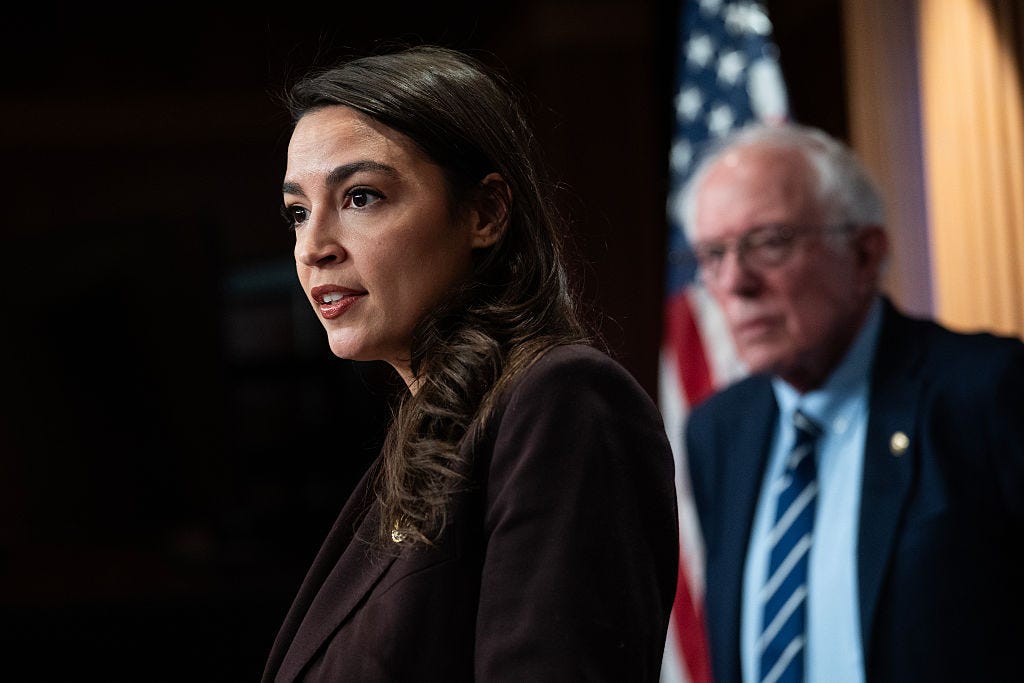 It’s Alexandria Ocasio-Cortez and Bernie Sanders’ party now. We’re just living in it. (Tom Williams/CQ-Roll Call, Inc via Getty Images)
On Wednesday, I went to WelcomeFest, the annual gathering of centrist Democratic operatives and D.C. types. The purpose of the conference is to advocate for moderation in order to flip Trump districts in the House and ultimately to nominate a moderate candidate for president in 2028.
Unfortunately for them, that second part is probably not going to happen.
When the Democratic Leadership Council (DLC) came to prominence in the 1990s with the goal of shoring up the party’s moderate faction, the party’s liberal wing was the minority. But today, the liberal wing of the party is the majority, and that means that the DLC strategy of simply bulldozing the left won’t bear fruit in 2028.
If centrists want one of their own as the nominee, they will need to do something that seems anathema to them: Find common ground with the organized progressive movement.
Over the last three decades or so, the share of Americans who self-identify as “very liberal” or “liberal” has risen from 17% in 1992 to 25% in 2024, according to Gallup’s polling. Over the same period, the share calling itself moderate has fallen from 43% to 34%, while the share calling itself conservative has stayed essentially the same.
In other words, public opinion has shifted to the left, especially relative to the baseline of the 1990s. In 1991, just 48% of Americans approved of interracial marriage. In 1996, less than half of Americans thought that same-sex relationships should be legal, and only a quarter believed that same-sex marriages should be legal. People were much more likely to favor the death penalty, to oppose abortion and legal marijuana, and to favor decreasing immigration levels than they are today. Views of corporations were much more favorable, while views of labor unions were somewhat less so.
Truly, the past is a foreign country.
Part of this massive shift in public opinion can be chalked up to generational replacement, as older people with more right-wing views died and were replaced by younger people with different beliefs. Part of it was caused by persuasion; there is no other way to explain the massive shifts in opinion on same-sex marriage or marijuana than some people changing their minds.
Still, it’s important to contextualize the magnitude of this shift. Liberals are still a minority of the population, and on a number of issues, such as crime and immigration, voters have basically conservative views.
But within the Democratic Party, the leftward shift was much larger.
In 1994, self-identified liberals made up just a quarter of Democrats. But sometime between 2018 and 2022, liberals became a majority of the Democratic Party.
In The Argument’s polling, we see the same thing. Across all of our 2026 surveys, 61% of Democrats identify as liberal or very liberal, rising to 67% when you drop Democratic-leaning independents. On social issues, 69% of Democrats call themselves liberal; on economic issues, it’s 61%.
Some people will quibble that describing oneself as liberal doesn’t actually mean that voters necessarily hold left-wing views on the issues. Frankly, I think that’s a cope; there’s robust evidence that self-identified liberals have more left-wing policy positions.

David Shor@davidshor
@rp_griffin @gelliottmorris @jon_m_rob Every dot here is a progressive policy that we've polled (subgroup estimates are unweighted, no MRP). Ideological identification is clearly very meaningful for young/old, though young conservatives being ~ half-way between old moderates/old conservatives is interesting.

3:08 PM · Aug 30, 2021
13 Replies · 5 Reposts · 70 Likes
It’s time for moderates to face the facts. The Democratic Party of Bill Clinton is dead and gone. The age of James Carville is over. It’s AOC’s party now, and we’re all just living in it.
Many of the WelcomeFest participants seemed sincere in their convictions. Reps. Tom Suozzi and Adam Gray announced a new centrist pledge called Promise to America. The first item on the pledge is: “We are capitalist, not socialist.”
That bullet point serves two purposes: to differentiate Promise to America signatories from Democratic Socialists of America (DSA) members like Zohran Mamdani and Bernie Sanders and to serve as a signal that signatories are generally pro-business in their economic positions. But that positioning is increasingly out of touch with the Democratic Party rank and file.
That is another way of saying that the crowd at WelcomeFest is genuinely more conservative on economic and social issues than the average Democratic primary voter. And that makes it hard for them to build trust with the progressives who now make up the majority of the party’s voters, to say nothing of elite political institutions.
It’s one thing to tell progressives that, while you share their ultimate goals, your reading of the evidence suggests that the scope of what’s politically possible is narrower than they think, and therefore the best strategy is to moderate on select issues to maximize the odds of beating Republicans and push policy to the left.
That’s not an easy sell. Progressive political spaces are filled with well-meaning people who tend to have strong ideological views, so there is a natural tendency to engage in a little motivated reasoning.
But it’s even harder to convince people to compromise on their deeply held principles and hopes when you don’t actually share the same end goals. Bernie Sanders and Zohran Mamdani want to create social democracy in America. I don’t think that Tom Suozzi and Adam Gray do.
Ironically, this argument about how to win intraparty factional disputes is symmetrical to the one that moderates often make when discussing how to appeal to swing voters: People won’t back you if they think you don’t like them and don’t respect the values that matter to them.
The moderate wing of the party is used to calling the shots. When Lyndon Johnson was Senate majority leader, he liked to tell Hubert Humphrey and Paul Douglas that the problem with the liberal wing of the Democratic caucus was that it couldn’t count. What he meant is that southern senators had the votes and the organization to beat the liberals every time.
For a long time, that was true of the Democratic Party as a whole. No longer. The liberal wing of the party has the voters and the institutional clout and the support of the old guard of elected officials.
Today, it’s the moderate faction that is the junior coalition partner, which is a position it has not yet reconciled itself to. Now, it’s the centrists who need to learn to count — at least when they’re trying to win intra-party factional battles.
It is still true that, when it comes to national politics, the math doesn’t favor progressives.
Back in the 1950s, political scientists were worried that the two parties were too ideologically similar. Today, we have achieved their dream of having two, big, ideologically distinct parties. The problem for progressives is that liberals are a minority of the population. In The Argument’s aggregated polling, just 29% of registered voters identified as liberals; 35% each identified as moderate or conservative.
So, even though the Republican Party has become thoroughly right-wing, Republicans still have a baked-in edge. Conservatives outnumber liberals in the electorate — and always have — so a left-wing coalition needs to win over a bunch of moderates in order to get to 50% plus one.
When you’re in the minority of your own party, your optimal strategy changes. You become the supplicant. You can’t run roughshod over your factional rivals anymore. You have to meet them where they are — not where you wish they were.
The hypocrisy of abundance
Contemporary advocacy organizations exert political influence on the basis of representational claims they haven’t earned.