Blood-swapping, oxygen tanks & WiFi blockers – inside the ‘immortality Olympics’ where biohackers race to live FOREVER
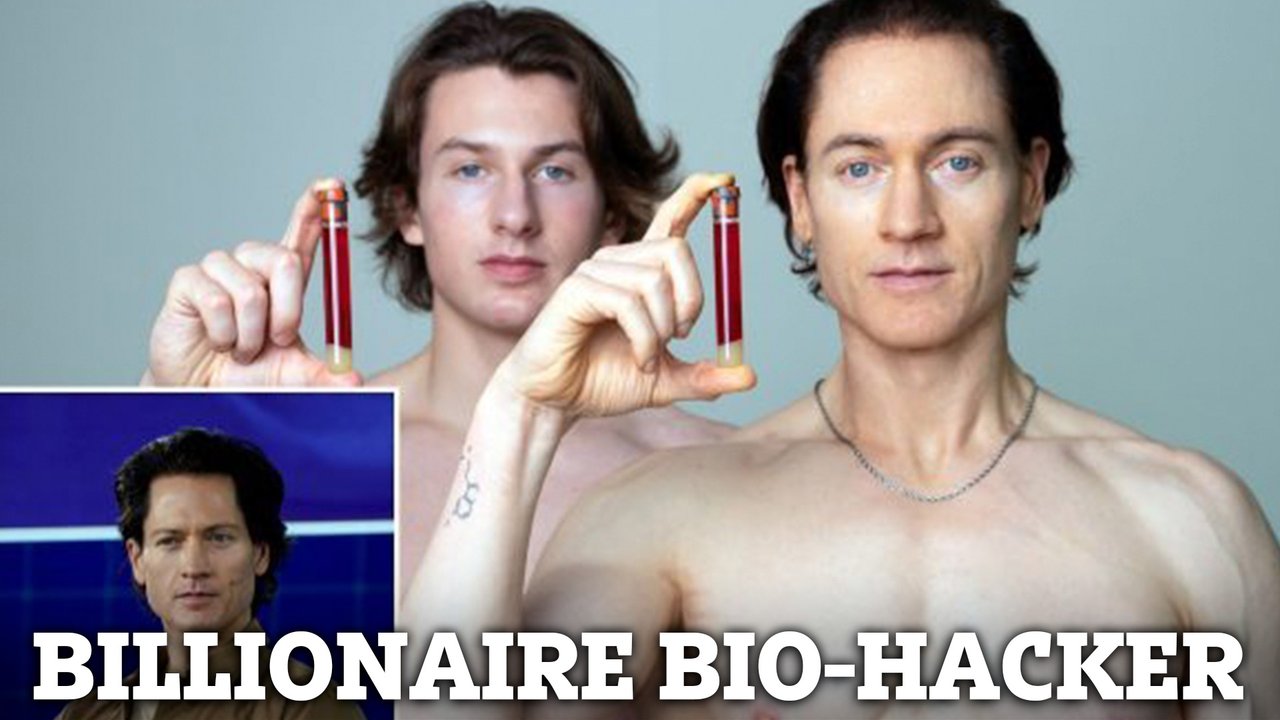
Tycoon bio-hacker vows ‘I will never die’ after injecting son’s blood
KEY TO IMMORTALITY
Video Player is loading.

Current Time 0:00
Duration 1:11
Loaded: 0.00%
Remaining Time 1:11
1x
- 2x
- 1.75x
- 1.5x
- 1.25x
- 1x, selected
- 0.75x
- 0.5x
Up Next
-
Andy Burnham is announced as Labour’s new leader at a special Labour Party leadership conference
THEY have gruelling gym regimes and rigid routines that monitor food, sleep and nutritional intake – but unlike other athletes, these ‘Olympians’ aren’t trying to cross the finish line first.
That is because the Rejuvenation Olympics is a competition to live for as long as possible, and some fork out astronomical amounts doing it, including one man who spent £1.5million in a year and even had blood plasma transfusions from his own son.


This wacky world is championed by ‘biohacker’ Bryan Johnson, whose motto “don’t die” has seen him splurge the aforementioned sum on everything from experimental gene therapy to 100-plus pills a day and non-stop MRIs, ultrasounds, colonoscopies and gene tracking.
Believers say the lifestyle tweaks are in the name of ‘science’ and attempting to find ways to prolong human life, but a longevity scientist tells The Sun many of Bryan’s ‘fixes’ are “crazy biohacking nonsense” and fears “he’s actually shortening his lifespan”.
Sign up for The US Sun newsletter
Thank you!

The 48-year-old tops the Rejuvenation Olympics (RO) leaderboard with an average ageing pace of 0.503 – which, according to their DNA analysis through blood and saliva tests, means his body is deteriorating half as quickly, roughly six months every year.
In recent weeks, Bryan revealed he was diagnosed with autoimmune disease, gastritis – an inflammation of the stomach lining.
He speculated it was due to consuming sugary cereal and fizzy drinks and having “gobbled down fast food” as a kid or gaining 2st 12lb while battling “the stress and grind” and “deep, chronic depression” in adulthood.
Yet Bryan remains at the top of the RO Longevity Leaders rankings, which currently has 14,747 entrants – including 81 from the UK.
Among them is the highest-ranking Brit, Dean Frost, 36, from Surrey, who spends nearly £8,500 a year on it and once placed seventh in the world. He wrote online: “Some people buy Rolexes, I’m trying to buy more years”.
His daily routine includes taking 20 supplements a day, intermittent fasting, 1hour 30minutes at the gym followed by the sauna, filtered water, organic and free-range food and 20 minutes mediation on a PEMF mat, which is believed to help with inflammation, muscle soreness and grounding.
Most read in The US Sun
Business coach Dean tells The Sun: “People think you’re crazy until you encourage them to take the test themselves because what your blood shows you is undeniable evidence.
“It shows your genetic predispositions, how your genes, lifestyle and diet affect the way your body performs, and if you’re not satisfied with that, you can change it.


“Let’s say if you score 0.5, you only technically age six months every year.
“That compounds over time. By my 70s, I could be functioning at the age of a 50-year-old, which is insane.
“When I talk about the cost of testing and supplements, people joke that I’m part of a cult; there’s a stigma.
“But look at when Mounjaro came out, it was the beginning of a turning tide and has dramatically changed lives”.
To qualify for the RO, which features contestants from 40 countries, you must have undergone three tests by Bryan’s company TruDiagnostic, the last of which can be no longer than two years old.
Each test costs between £372 and £633 a time. They measure up to 180 biomarkers and 11 key organs – including the heart, brain and liver – for current age and speed of ageing, as well as recommending supplements.
Believers monitor the differences between tests to see if pills, lifestyle changes and other hacks have altered their ageing scores.
Dean forks out for two of the “very, very extensive” tests a year, £600 a month on supplements and up to £100 on Peptides.


He considers it vital for combating his body’s natural deficiencies – for him, his brain health needed improvement, and after making changes his “scores improved massively”.
“This is real s***, not woo woo stuff,” he adds.
Dean, who jokingly dubs himself a “health freak”, started changing his diet a decade ago but has subscribed to the RO for the last three years.
Now ranked 17th with a 0.64 score, he’s hoping to be like his great-grandmother, who died aged 106, which he puts down to “very good genes in the family” that he “dares not waste”.
Dean adds: “Bryan Johnson talks about living forever. I don’t know if I want that, but I want to be in the best optimum health to see my kids grow and spend time with my grandkids.”
New York-based Annie Nosh, 35, once ranked second in the world – only behind Bryan – with an ageing score of 0.46.
She spends up to £ 7,500 a year, including on 16 supplements a day and three tests a year, which she uses as a “personal feedback tool” to monitor her health.
“That metric in real time to me is fascinating,” Annie tells us. “It’s the next frontier and very exciting.”
Her routine includes resistance training and a daily 10k treadmill walk in front of a Red Light Therapy lamp, which is believed to stimulate energy production and accelerate tissue healing and cellular repair.
Annie eats organically, avoiding ultra-processed food, and has most meals on “a massive bed of lettuce”.
Before her 9.30pm bedtime, in a 20C room under fabric that blocks electromagnetic, WiFi and radio signals, she unwinds with comedies like The Office to lower her stress levels.
“Individuals looking from the outside may think it’s restrictive, but we are all individuals and have different goals in life.
“I’m trying to live the best possible life that I can now and optimise my life and health span for the future.
“I want my last 10 to 20 years to be healthy ones and to avoid frailty and arthritis. I’m aware I will die, and that’s ok, but I want to feel the best I can before that.
“You have to think, do you want to be running after your grandchildren or sitting back? If it’s the first, what do you have to do today to be at that point?”
Some on the RO leaderboard have at one point beaten multimillionaire tech-founder Bryan.
Chicago-based Brooke Paulin, 35, once bested him with a 0.52 months score, 0.05 months lower than his, by “avoiding toxins” and “preventing cell damage” in her body.
Her tweaks, which followed being treated for thyroid cancer aged 27 in 2017, include one hour every afternoon in a hyperbaric oxygen chamber and air filters in every room.
Some RO entrants fork out thousands attempting to defy their biological age, and in Bryan’s case, millions, but others pay modest amounts.
Self-described “reluctant biohacker” Julie Gibson Clark, 57, of Arizona, spends just £81 ($100) per month on her regime, which includes a vegetable-rich diet, gym workouts, meditation and supplements.
But not everyone shares their RO entrants’ excitement. Longevity scientist Andrew Steele, 40, from Shropshire, is concerned their ‘remedies’ are devoid of scientific evidence.
The Oxford graduate describes some measures as “biohacking nonsense” and “pie in the sky, snake oil fantasies”. He says they “are not very scientific” in their approach, which is “counterproductive”.
Andrew explains: “Imagine if Bryan Johnson lives until 120 – firstly, was he biologically blessed and going to do it anyway, or was it due to the 150 to 200 things he does?


“With the supplements, saunas, oxygen therapy, gene therapy and everything else? How could you attribute it to the one thing that helped him live longer?
“My guess is he’s actually shortening his lifespan. We know different medications interact and their effects cancel each other out, or sometimes have adverse effects.
“With 100 supplements, I guarantee there will easily be interactions that worsen Bryan’s human biology rather than help it. I believe the supplements could be reducing any benefits.”
Andrew adds that even in school science experiments, you change one thing at a time, not multiple, so you can monitor changes.
Instead of the RO-encouraged hacks, Andrew is adamant that the real long-term results will come from the medical field that studies longevity.
He claims there are at least 10 to 20 drugs already on the market that could slow down human ageing again, after successful trials in mice.
The obstacle, Andrews explains, is that many of the drugs are out of patent – meaning they can be mass-produced for pennies, thus ruling out profits for pharmaceutical companies. He’s calling for government-funded research.
It would be targeting senescent ‘zombie’ cells, which degrade tissue and drive chronic inflammation – accelerating ageing and disease – and the older we get, the more we have.


Andrew, who is director of thinktank The Longevity Initiative, adds: “What kills you is disease, frailty or a lack of resilience – for example, to something like the flu – but slow down the ageing process, and you can extend the lifespan.”
He insists it’s “not implausible science fiction” and if invested in, the average human could live to 100, while keeping independence.
“Currently, we treat the disease once the fire is raging and fight it from there. But longevity science stops the fire from forming in the first place,” Andrew adds.
Andrew says even a small increase in funding could mean massive scientific leaps that would “save the NHS millions and millions” and “benefit billions of people”.
He has “mixed feelings” about Bryan and the RO, believing it has raised the profile of ageing “not being a fixed fact of life”, but doubts their scientific rigour.
Andrew adds: “People have heard of Bryan transferring his son’s blood plasma, taking 100 supplements a day and all of the other crazy biohacking nonsense.
RECOMMENDED STORIES
“You don’t hear about what we do – the boring but serious science, because it’s not as sexy and there’s no Instagram followers to gain from it.
“Longevity science is probably the most impactful scientific field, but more people today are occupied with wellness nonsense.”