Trump and the Authoritarians
A chilling form of authoritarianism has taken deep root across America. Its purveyors claim their high positions make them uniquely qualified to guide the nation. Rejecting the give-and-take of traditional politics, they cast their work as an unassailable sacred trust, delegitimizing those who challenge their views through fearmongering and naked dishonesty.
That’s how legions of President Trump’s critics would describe the administration’s widespread efforts aimed at rooting out DEI in the telling of America’s history in agencies ranging from the Pentagon to the Smithsonian.
It is, however, an even better description of what Trump is pushing back against; namely, a cadre of unelected and largely unaccountable bureaucrats and power brokers who have transformed the nation in recent decades from their perches in the legacy media and academia.
It is an uphill battle. Whatever changes Trump has wrought pale in comparison to their achievements. He is a reactionary in the very best sense of the word, opposing a revolution no one voted for.
Their success – which hinges on their authority and capacity to advance ideas – is clear. They have radically changed perceptions of America’s past and present and future through Marxist-infused ideologies that see the U.S. through a lens of “oppression” rather than opportunity. Instead of trumpeting the fact that huddled masses have long flocked to our country (and still do) because we are the most open and prosperous free nation on Earth, they obsess like drug addicts on the ways America has failed to live up to the soaring ideals of the Founding.
Their argument was epitomized by the New York Times’ factually shoddy 1619 Project, which declared that the country’s true founding date was not 1776 but the year enslaved people were first brought to these shores. In their telling, bondage, inequality and state violence have been the key engines of our society – America is exceptional because of the wickedness it has embraced at home and spread abroad. That is why, they suggest, we need to disavow the past and wipe the slate clean to create a new society as envisioned by the left.
Anyone who reads newspapers and books and follows our political debates can see how successful progressives have been in undermining long-held assumptions and changing the terms of debate. To take one example, consider how much time we spent arguing over the biological fact that there are just two sexes.
It is no coincidence that as their power and influence have grown, socialism has risen as love of country has declined.
Here’s the hard part for those who recoil at their efforts. America’s commitment to democracy and free speech is precisely why they must be allowed to make their case. Our system has flourished because it allows broad room for argument about our singular project. These leftists don’t just have the right but the obligation to express their point of view. Even if one shudders to think what might happen if they convince a majority of people to embrace their ideas, that is how our system works.
The problem is that the famously intolerant and illiberal left – the crowd that brought us cancel culture and compares anyone who disagrees with them to Hitler – sees free speech as a vulnerability of the system they oppose, one they can use to silence dissent. Hence, they cast speech which criticizes their claims as an assault on free speech and challenges to their authority as authoritarianism.
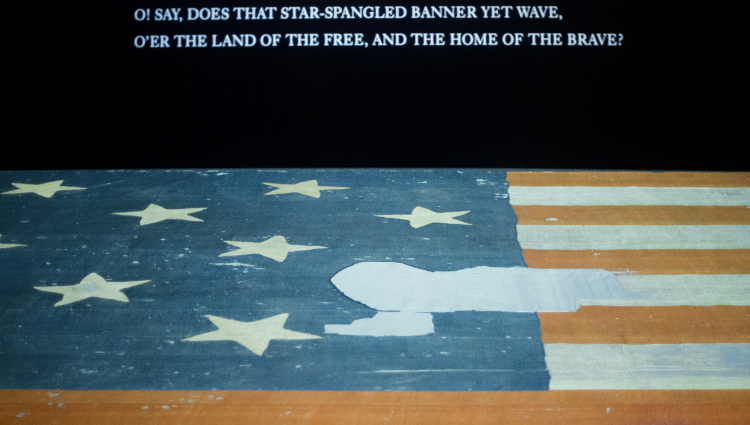
Consider the recent controversy over the Trump administration’s scathing new critique of what it sees as the far-left’s capture of the Smithsonian’s National Museum of American History.
The White House’s 162-page report titled “Saving America’s Story” argues that “The Museum confronts visitors with materials intended to undermine faith in American institutions and the longstanding shared ideals of the American people. … [it] purposely presents America as a problematic country irredeemably conceived, founded by deeply flawed men, and still operating today as an instrument of systemic racism and oppression.”
Even if one finds the report spot on, it is also just a point of view. The museum’s directors have a different take on our history. In a healthy democracy, these conflicting interpretations would spark a wide-ranging debate over how we should tell our story, inspiring thoughtful and respectful arguments about the proper weight that should be given to our triumphs and shortcomings.
Smithsonian officials and many historians, however, have responded with obfuscation and demagoguery. In congressional hearings this week, the museum’s director, Anthea Hartig, refused to engage the White House’s well-documented critiques. She never explained why she has described history as a “prime tool of social justice” or why she feels it is necessary to “dismantle” the narratives of history long presented at the museum and shed light on the “national horror and pain.” Instead she offered only platitudes, saying that “examining the harder chapters of our history is not the same as hostility toward America,” while insisting that the museum is “nonpartisan.”
That last claim is especially problematic in today’s intellectual climate. Perhaps the most potent idea that the left has advanced is that the idea that there is no truth, only competing versions of reality; concepts such as objectivity and neutrality are impossible fantasies. In their telling, all political discourse is shaping a narrative that rewards one group over another in a never-ending battle for power. Which is to say that everything is partisan. This places a premium on making and defending their case.
Instead, Yale University historian David Blight launched a cynical attack. This esteemed scholar, who has won every major award in his field, invoked the anti-communist Sen. Joe McCarthy and Nazi propagandist Joseph Goebbels to castigate the White House for daring to criticize his craft. The “profane” White House report, he said, “is nothing less than a declaration of war on the historian’s profession as well as on the freedom and curiosity of anyone who reads, or visits museums. In other words, President Trump has declared war on free minds and free education.”
Blight painted the White House report as a form of mind control by declaring “with such certainty what forms of ‘heritage,’ ‘destiny,’ ‘settled truths,’ and indeed ‘stories’ that the Smithsonian should ‘instill’ (a favorite verb) in the minds of the public.”
And yet, he later said the historian’s mission is to convince people to see the world in a particular way. We aim, he said, “to inspire and take our audience somewhere. And once we get them there we are bound by our craft to make an argument for why all this happened and why it matters. … We do not write woke history, whatever that is, but we do try to awaken citizens.”
At a time when our national discourse is almost exclusively focused on elected leaders, the Smithsonian controversy is a reminder that the government is only one seat of power in America. One of the great strengths of our system is the room it provides people in various spheres – including the media, academia, business, religion and so much more – to shape the culture. But those brakes on state power can become another form of authoritarianism without a robust commitment to free speech and open debate. If you want to change the world, make your case.
J. Peder Zane is an editor for RealClearInvestigations and a columnist for RealClearPolitics. Follow him on X @jpederzane.