The Navy's State of the Straits
We are – along with the rest of the world – keenly watching operations unfold in the U.S.-led conflict with Iran. At press time, the conflict appears to have settled into a new phase, where escalation ramps up and down periodically. There is – from the sidelines – no unilateral action that will bring this conflict to termination, and while both sides are incentivized in their own ways to keep the conflict going, neither appears to have the appetite to escalate into a fundamentally different type of conflict.
The point of this piece is not to armchair quarterback or critique the war from the U.S. Point of view, but rather to think about China; specifically, what observations and lessons they are gleaning from the conflict, and how observations here may impact their current and future plans and strategy. While the United States has interests all over the world, this author remains singly focused on China because they have both the means as well as cultural and population incentives for conflict that would truly put the United States at risk. We have considered the near-term objectives and case why China is a threat previously in these pages[i].
Why would China care?
The Chinese care for a number of reasons. First, their expanding foreign policy interests, specifically ‘one-belt, one road’ (BRI) economic / soft-power includes Iran, as well as most of their neighbors[ii]. In some ways, this conflict is a hard-power, stark contrast to the BRI. Both China and the U.S. (and their allies) wish to have influence if not outright control over the strategic resources and sea lanes. Increasing influence without the use of (expensive) military power is a winning strategy for the Chinese. In some ways, this conflict has given China an opportunity to declare themselves the ‘grownups in the room’ to their own advantage[iii]. While China’s view is becoming world-wide, Taiwan remains their top priority[iv].
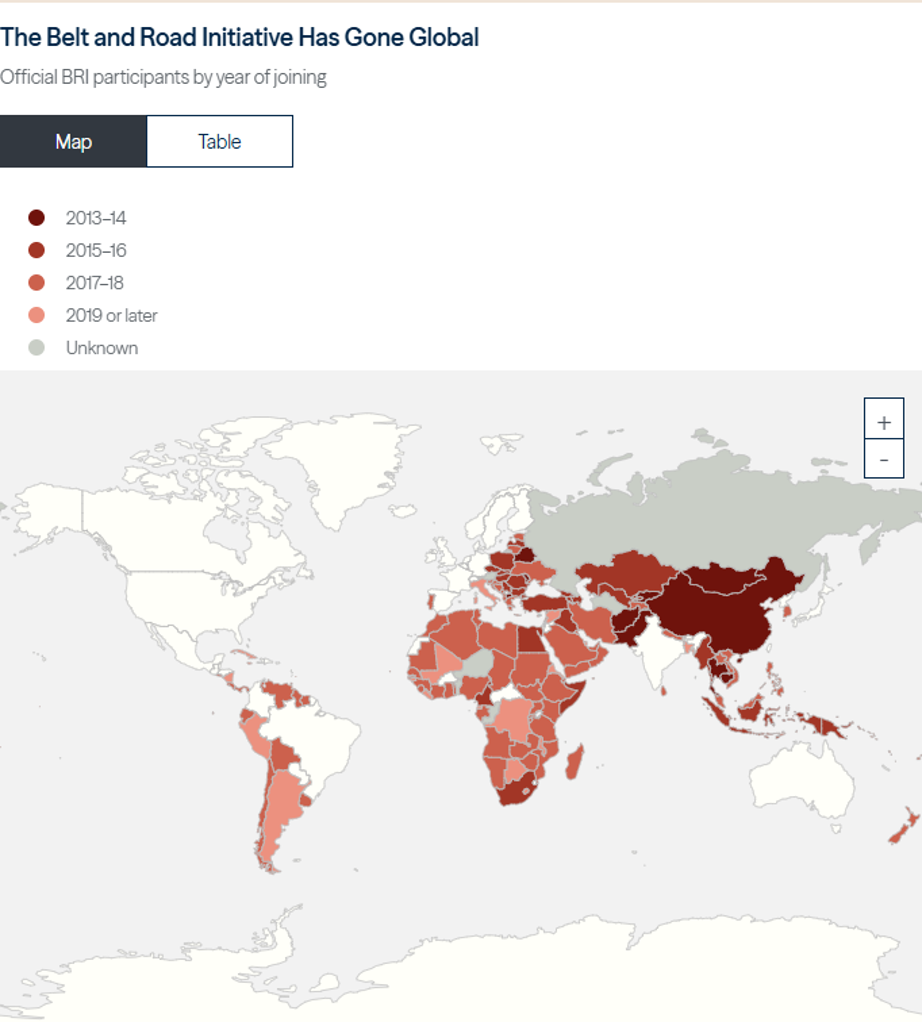
Figure 1: Belt and Road initiative countries. Original graphic from Council on Foreign Relations.
Many Navalists and students of military history (including this one!) expected that conflict between the United States and Iran would go down one of two bifurcated paths; the first being an overwhelming assault by the U.S. that would lead to an Iraq style ground campaign leading to a U.S. victory, or a conflict that would escalate ‘out of the plane’, and become entangled with asymmetric threats such as terrorism and cyber, leading to an indeterminate resolution that would likely be to Iran’s advantage. At press time, neither of these have occurred; the Straits of Hormuz have settled into an uneasy place where escalation has limited increases and cyclical decreases. This is an unpredicted outcome.
China’s perspectives are going to be shaped through their own unique ‘lens’; first, their military despite reform initiatives remains ‘Soviet style’ both in construct and thought, with focus remaining on land and so-called ‘strategic’ rocket forces. Second, they have been students of the U.S. Military since at least the wars in Iraq and remain impressed (some would say terrified) of the precision-strike complexes and Integrated Air and Missile Defense capabilities that remain cornerstones of the U.S. ‘Way of War.’ With this in mind, we propose the following considerations when viewing the Straits of Hormuz through a Chinese lens:
China has its’ own Straits Problem. The Strait of Hormuz is not the Taiwan Straits; still, some similarities exist. In both cases, the North is controlled by a state that is opposed to the United States (Iran, China). The southern part of the Strait of Hormuz is occupied by the U.A.E. (and Oman), the Emiratis have had low levels of involvement on the U.S. side of the conflict[v]. In contrast, the southeastern part of the Taiwan Strait is occupied by Taiwan, who would be one of the main belligerents in a cross-straits invasion. The actions by both the U.S. and Iran have shown that either side can restrict the straits more or less ‘at will.’ Here the parallels cease; the U.S. has advocated ‘hellscape[vi]’ – using denial by drones, submarines, and mines to effectively close the Taiwan Straits – as a cornerstone for the defense of Taiwan. This is a far more aggressive stance than what we are seeing in the Straits of Hormuz currently. In the Iran conflict, the U.S. is (mostly) on the side of keeping the Straits of Hormuz open. The Iranians are demonstrating that with modest means and dogged resolve, they can close the Straits more or less at will.
The Chinese will be keenly observing this problem; in the Taiwan scenario, China is the one who wants to keep the Strait open for their invasion fleet. They will be taking note at the effectiveness that the Iranians are having and perhaps reconsidering their own tactics. This conflict is a definitive proof that in the current day – and for some days to come – straits management favors the ‘closing’ team. China would rightly conclude that keeping the Taiwan Straits open will be a monumental task.
Air and Missile Defense remains key. The U.S. and Israel have been remarkably successful at defending targets against incoming ballistic missiles[vii]. China’s leaders are keenly aware of the U.S. effectiveness in missile defense. As China considers strategic rocket forces (read: offensive ballistic and cruise missiles) to be key enablers, any threat to the efficacy of their strategy will make them pause. Chinese leaders will be carefully considering how the continued, demonstrated capabilities of U.S. and Allied Air Defenses changes their strategies. China is certainly keeping track of how America’s interceptor stockpiles are being expended in the current conflict; the U.S. is keeping tabs on it as well[viii]. It is unclear what the deterrent effect of missile defenses successes – and by any reasonable measure, they have been successful – will have on the China’s thinking. It is likely that the Chinese will look upon their stockpiles of missiles and conclude that they need ‘more.’
For a parallel, look to WWI. While American strategists always have the Second World War close to their thinking, perhaps here is a case that requires harkening back to the first. The First World War[ix] was characterized by forces who found their defensive capability far outstripped their offensive potential. Thus, it quickly languished into a stalemate, with neither side able to gain advantage or territory. We do not generally think of ‘holding territory’ in Naval warfare, as it is fundamentally attrition based[x]; warships (and submarines) count their effectiveness by how many adversary warships they sink or, failing that, force them to remain in port.
However, straits present an interesting edge case, because while they are ‘at sea,’ they are close to seats of purpose on land and are by definition close to land. Therefore, both the current Iran conflict and a possible future China conflict may both be defined by a naval stalemate; One in which either side can unilaterally deny shipping, but neither side can force passage; at least, not at a cost they are willing to accept.
Should either of these Straits conflicts become a naval version of WWI, there is no easy way out. Many modern historians blame exhaustion among the German Army to be the cause of the end of the War[xi]. It is unclear, had the war not ended in November of 1918, if technological advances such as the Tank and aviation would have become decisive.
One thing is clear; should either Straits conflict devolve into a Naval version of WWI, there will be no easy way out of it.
Harrison Schramm is a professional statistician. A retired Navy Pilot, he focuses on building the smallest, most useful AI. He is a Fellow of MORS.
image: U.S. Navy Arleigh Burke-class guided-missile destroyer USS Rafael Peralta (DDG 115) transits the Strait of Malacca, March 31, 2026. Rafael Peralta is forward-deployed and assigned to Destroyer Squadron (DESRON) 15, the Navy's largest DESRON and the U.S. 7th Fleet's principal surface force. (U.S. Navy photo by Mass Communication Specialist 1st Class Ryre Arciaga)
note:
Support RealClear, Independent Journalism

 Carl Cannon, RCP Executive Editor
“Information wants to be free!” was a rallying cry at the dawn of the Internet Age. The paradox is that information also “wants to be expensive.”
At RealClearPolitics, we provide news and information spanning the ideological spectrum—without a paywall. That’s the “free” part.
But producing quality journalism means paying reporters, editors, aggregators, tech team, and the analysts who curate RCP’s renowned polling averages. That’s the expensive part.
If you value independent news and seeing a diversity of viewpoints, please consider making a tax-deductible donation to RealClear Media Fund. Every dollar you donate is an investment in an informed public discourse and holding government and other key institutions accountable. Your support helps us put First Amendment theory into real-world practice.
Sincerely,
Carl Cannon
Executive Editor
RealClearPolitics