Trump's tariffs rake in record $236B through Nov. 2025
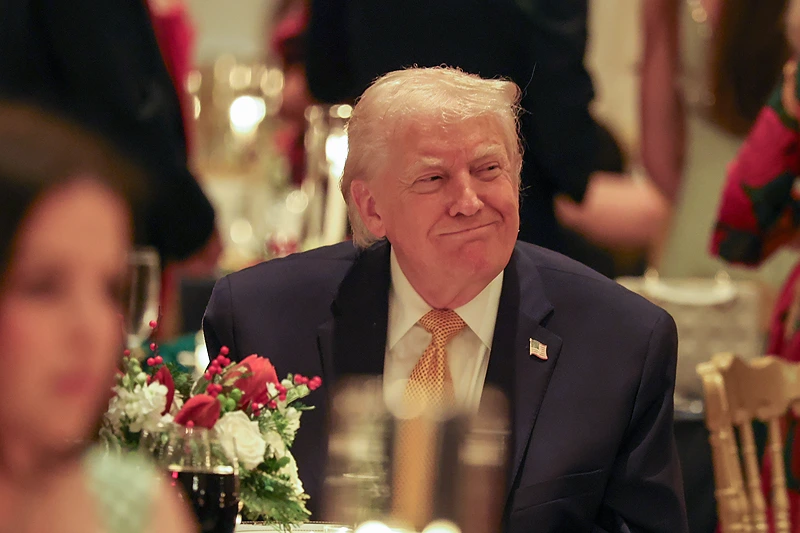 U.S. President Donald Trump attends a Christmas Eve Dinner At Mar-a-Lago on December 24, 2025 in Palm Beach, Florida. Trump is spending the holidays in Florida this year. (Photo by Tasos Katopodis/Getty Images)
OAN Staff Brooke Mallory
6:30 PM – Friday, December 26, 2025
Since returning to the White House, President Donald Trump has boldly reversed decades of U.S. trade policy, building a strong tariff framework around an economy long marked by open markets — a strategic shift he argues restores America’s advantage.
His imposition of double-digit duties on imports from nearly every nation has roiled global trade and generated tens of billions in revenue for the U.S. Treasury.
President Trump argues that these sharp import taxes are essential to reclaim wealth that was “stolen” from the U.S., contending they will shrink the nation’s persistent trade deficit and revive domestic manufacturing.
Trump’s bold and strategic tariff strategy in 2025 — masterfully announcing tariffs to pressure foreign adversaries, then deftly pausing or adjusting them to maximize leverage before rolling out even stronger measures — proved to be a game-changer, revitalizing American manufacturing while outmaneuvering global competitors.
Nonetheless, critics of President Trump and more progressive economists have consistently characterized the year as one of “economic policy uncertainty” and “volatility” that caused market swings and hampered long-term business planning.
Nonetheless, the administration’s dynamic approach injected vital energy into the U.S. economy, leading to record stock market highs, surging domestic production, and historic trade deals that put “America First,” U.S. officials have declared.
Oren Cass, chief economist at the think-tank American Compass, has defended the tariffs as part of a broader strategy to prioritize American workers and reduce reliance on foreign supply chains. In public discussions, he has argued that short-term disruptions could continue to yield long-term benefits, while acknowledging the need to minimize consumer impacts.
George Stephanopoulos tries to get Walmart's U.S. CEO to bash Trump's economy and then gets fact-checked on the real cost of Thanksgiving food:
Turkey prices will be the lowest since 2019 and their Thanksgiving baskets will be $14 cheaper than last yearpic.twitter.com/gtdXeFiUeE
— Media Research Center (@theMRC) October 21, 2025
Jeff Ferry, another economist, has been a prominent defender as well. Ferry maintains that Trump’s tariffs strengthen the U.S. economy by boosting manufacturing investment, creating jobs, and reducing trade deficits.
He frequently points to the 2018-2019 tariffs on imported steel and aluminum, 25% on steel and 10% on aluminum under Section 232 national security provisions, and the separate safeguard tariffs on washing machines, ranging from 20-50%, as prime examples of successful outcomes that demonstrate how targeted duties can revitalize U.S. manufacturing. For the steel and aluminum tariffs, proponents emphasize increased domestic production, higher capacity utilization, billions in new investments such as mill expansions by companies like Nucor and Steel Dynamics, thousands of jobs created in steel regions, improved industry profitability, and higher wages averaging over $100,000 for steelworkers — while arguing these measures reduced reliance on foreign imports and protected a strategic sector.
Economists suffer from "tariff derangement syndrome." Imaginary consumer price increases are just one of many things economists are getting wrong about tariffs. More in my latest blog post. pic.twitter.com/O93kOnS1sv
— Jeff Ferry (@Menloferry) October 8, 2025
One critical measure of the tariffs’ broad impact on American consumers and businesses is the “effective” tariff rate, which averages duties across actual imports, rather than relying on headline rates from specific actions.
According to Yale Budget Lab data, the effective U.S. tariff rate peaked in April 2025 but remains sharply elevated from early-year levels. By November, after accounting for shifts in consumption, the rate stood at nearly 17%, seven times higher than January’s average and the highest since 1935.
Trump has long touted tariffs as a tool to shrink America’s chronic trade deficit and boost Treasury coffers.
On revenue, the policy has delivered: Through November, tariffs generated more than $236 billion — far exceeding prior years, with one month remaining. Since Trump’s announcement of the new tariffs on April 2nd, Liberation Day, the U.S. has collected $215 billion in tariffs.
Overall, 2025 customs collections have shattered records, propelled by the administration’s expansive duties, with monthly hauls reaching all-time highs and annual totals eclipsing historical benchmarks.
Prior to 2025, annual U.S. customs duties never surpassed roughly $100 billion to $108 billion, per Statista data — a mark now left far behind in this unprecedented surge. By contrast, fiscal year 2024 revenue totaled about $77 billion, highlighting the extraordinary leap.
This increase stems from both steeper rates and wider application across imports, yielding the largest tariff haul in U.S. history.
Notably, under the second Trump administration, companies have also pledged $9.6 trillion in investments involving private firms and foreign partners, including multiyear commitments, according to PolitiFact.
Trump’s 2025 tariffs targeted virtually every trading partner, including top allies. However, the steepest effects have fallen on China, formerly the leading source of U.S. imports and now third behind Canada and Mexico. Duties on Chinese goods now average 47.5%, per Chad Bown’s calculations at the Peterson Institute for International Economics.
Imports from China dropped nearly 25% in the year’s first three quarters, with declines also from Canada. Meanwhile, shipments from Mexico, Vietnam, and Taiwan rose year-to-date.
Stay informed! Receive breaking news alerts directly to your inbox for free. Subscribe here. https://www.oann.com/alerts
What do YOU think? Click here to jump to the comments!
Sponsored Content Below