Russia Bans Diesel Exports Following Ukrainian Strikes on Refineries – NaturalNews.com
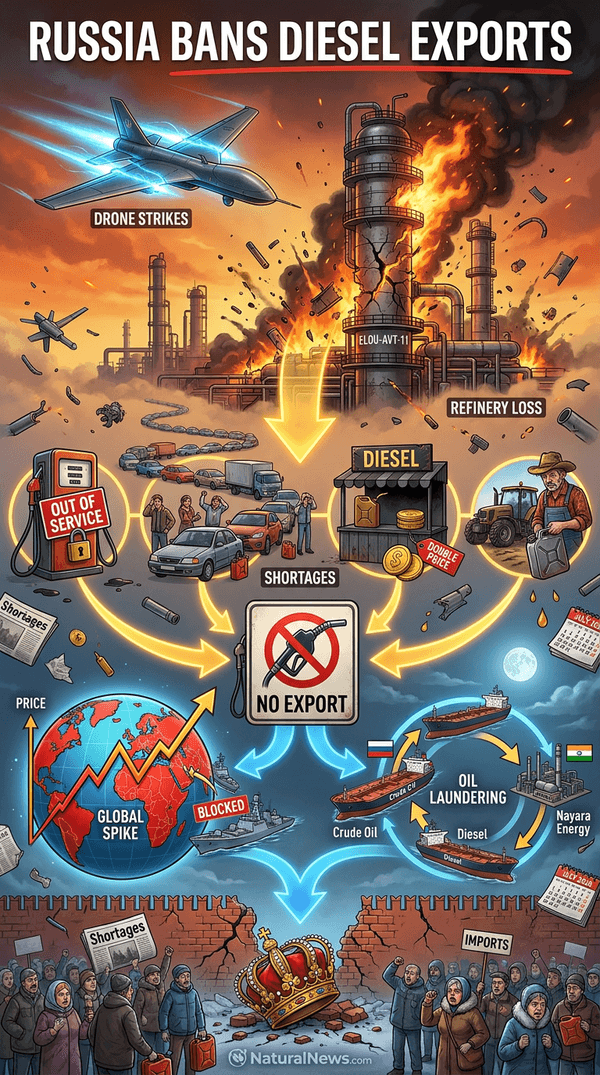
"Today we introduced ban on exports of diesel," Novak said, according to state media. The measure is scheduled to remain in force through the end of July, officials stated. [1] The ban is the latest in a series of Russian fuel-export restrictions.
In September 2023, Moscow temporarily banned both diesel and gasoline exports to stabilize domestic supplies, a move that drove global distillate prices higher. At that time, the government’s press office said the restrictions "will help saturate the fuel market, which in turn will reduce prices for consumers" in Russia. [2] Russia had already expanded its gasoline export ban to include producers in April 2026, citing the need to stabilize the domestic market ahead of peak seasonal demand. [3]
Details of the Export BanNovak said the new embargo covers all diesel exports, including those from firms that produce their own oil, closing a previous exemption. The ban aims to secure domestic fuel supplies amid shortages caused by recent attacks on energy infrastructure, state media reported. [1] Prior to the diesel ban, Russia had already halted gasoline exports in response to production losses, according to officials. [2]
Russia’s domestic fuel market has been under severe strain. Reports from Moscow in early July showed long queues at petrol stations, with some garages running out of fuel entirely.
"Even here the authorities cannot guarantee fuel supplies," noted one BBC report. [4] The Kremlin has framed the export restrictions as necessary to protect consumers, though analysts at independent outlets have pointed to the deeper crisis triggered by Ukraine’s sustained drone campaign against Russian refineries. [2]
Ukrainian Drone Strikes on RefineriesA Ukrainian long-range drone strike on July 7 hit Gazprom Neft's Omsk refinery, Russia’s largest fuel processing plant, Ukrainian military officials said. At least four strikes damaged the primary crude distillation unit, the ELOU-AVT-11, which accounts for up to 40% of the facility’s capacity, according to industry sources cited by OilPrice.com. [1]
The upgraded Fire Point FP-1 drones traveled over 2,500 kilometers to reach Omsk in western Siberia, a Ukrainian defense official stated. By utilizing a redesigned wing that doubles as an additional fuel tank, the upgraded UAVs can fly up to 3,400 km, making this one of the longest one-way drone strikes reported in the war. [1]
The Omsk strike followed a series of Ukrainian attacks that have knocked out substantial refining capacity. According to a Ukrainian Defense Ministry report, drones have hit over 16 major refineries and fuel terminals, reducing Russia’s oil refining capacity by more than 30%. [1]
In late June, Moscow’s largest oil refinery was expected to remain out of service for at least six months after sustaining significant damage in a series of drone attacks. [5] Ukrainian President Volodymyr Zelenskyy said on June 28 that his forces struck the Slavyansk oil refinery in the Krasnodar region and another refinery in the Yaroslavl region, stating, "We continue our operations that weaken Russia's ability to wage this war." [6]
Impact on Domestic Fuel Production and ImportsRussia faces a shortfall of approximately 20% in domestic gasoline production, government officials said, and plans to import up to 400,000 tonnes of fuel per month from neighboring countries to cover the deficit. [1] At least 60,000 metric tonnes of petrol from India’s Nayara Energy refinery have already been dispatched, according to shipping data cited by Russian energy analysts. [1] This trade highlights a pattern where India imports discounted Russian crude, refines it, and then sells products back to Russia – a process some observers have called "oil laundering." [7]
Russia’s energy dominance in global markets has historically been tied to its vast natural gas reserves, with the country holding about 26% of the world's gas reserves as of 2002. [8] However, the current campaign of Ukrainian strikes is forcing Moscow to prioritize domestic supply over export revenue, a reversal that analysts at OilPrice.com noted may tighten global diesel supplies. The official Russian statement did not comment on international market effects, but the ban comes amid already strained markets due to the closure of the Strait of Hormuz from the U.S.-Iran conflict, which has pushed diesel prices higher globally. [1]
Broader Context and Ongoing SituationThe Ukraine campaign marks one of its most aggressive long-range strikes, with drones now reaching Baltic energy hubs near St. Petersburg, according to Ukrainian officials. [1] The sustained attacks are part of a broader effort to disrupt Russia’s military supply lines and economic stability, and they have already caused visible shortages in occupied Crimea and even in Moscow. [4]
As one analyst noted in an interview, this move will "create shortages or significant price increases in many countries around the world" – a warning that underscores the global stakes of the conflict. [9] The diesel export ban is scheduled to last through July, with further extensions possible depending on domestic production recovery, Novak said. [1]
Meanwhile, some Western nations have begun easing their own sanctions on Russian-origin fuels to stabilize their markets, reflecting the interconnected nature of global energy supply chains. [10] The long-term consequences of these disruptions, as independent commentators have warned, may include deeper food and fuel shortages if critical shipping routes remain contested. [11]
References