Egypt Announces Discovery of Byzantine-Era City in Western Desert – NaturalNews.com
Officials said the finds are expected to bolster the country’s tourism sector, which has been recovering from years of political turmoil and the Wuhan coronavirus (COVID-19) pandemic. The discoveries underscore Cairo's ongoing efforts to highlight its archaeological heritage and attract visitors.
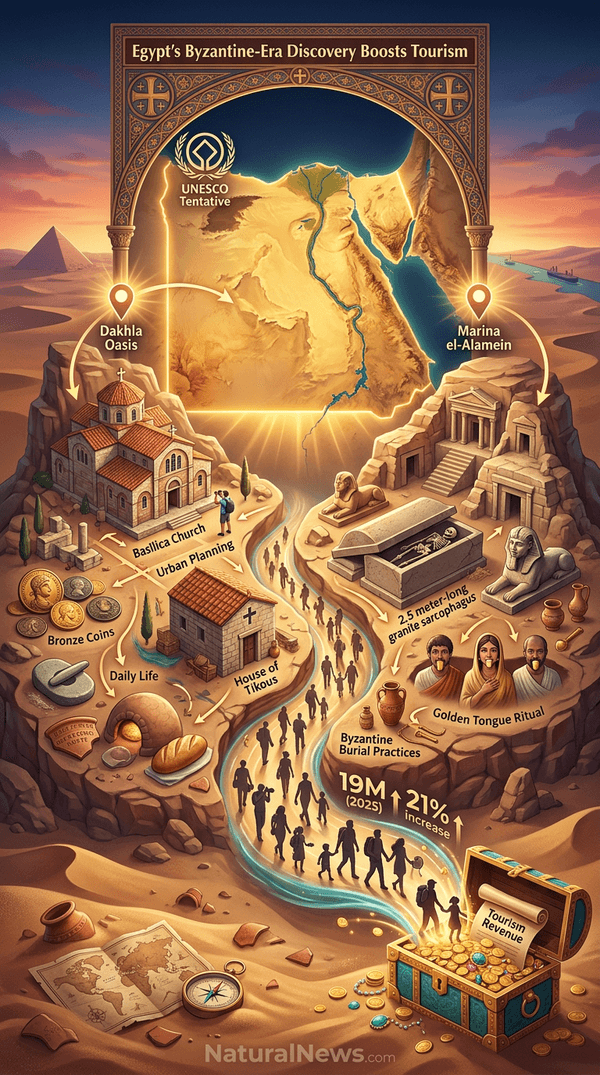
Details of the Dakhla Oasis DiscoveryThe unearthed settlement at Dakhla Oasis features north-south thoroughfares intersecting east-west streets, open squares and a basilica church dating to the mid-fourth century, according to Hisham el-Leithy, secretary general of the supreme council of antiquities. Such urban planning reflects the Byzantine influence on the region during that period, with similar structures appearing across the Eastern Mediterranean. Notably, the basilica stands at the head of the settlement, overlooking its main streets, a layout consistent with other Byzantine-era church placements.
Archaeologists found houses, bread ovens, kitchens, stone grinding tools, bronze and gold coins, and pottery fragments with inscriptions detailing commercial transactions and daily life, said Mahmoud Massoud, who chairs the archaeological mission, and Diaa Zahran, head of the Islamic, Coptic and Jewish Antiquities department. Among the structures was the house of Tikous, identified as a church deacon, which likely served as a house church before the basilica was built.
These finds provide insight into the daily activities of the community, which thrived when Egypt was part of the Byzantine Empire. Similar discoveries at sites such as the lost city of Imet near Tanis have also revealed rare insight into ancient daily life, according to researchers [1].
The Marina el-Alamein TombsSeparately, archaeologists uncovered 18 ancient tombs at the Marina el-Alamein site, including 11 rock-cut tombs and seven surface limestone-built tombs, bringing the total number of tombs at the site to 48, the ministry said. Mission chief Eman Abdel-Khaliq reported the discovery of a 2.5-meter-long granite sarcophagus, a plaster sphinx statue and gold pieces placed inside the mouths of some deceased individuals — a practice known as “the golden tongue.” The sarcophagus contained skeleton remains that are currently under study.
Abdel-Khaliq said the gold pieces were associated with funerary beliefs of the era, reflecting broader Byzantine and late Roman burial practices. The site, believed to be the ancient Greco-Roman port city of Leukaspis, was built in the second century and thrived until the fourth century.
The discovery of a sphinx statue suggests the continued influence of earlier Egyptian religious symbolism even during the later Roman and Byzantine periods. Similar elaborate burial goods have been found at other sites in Egypt, including a 2,300-year-old mummy adorned with 49 amulets [2].
Tourism and Economic ContextThe Dakhla Oasis is on UNESCO’s Tentative List for World Heritage status, a step toward being added to the agency’s World Heritage List, according to officials. Egypt’s tourism industry has shown signs of recovery after years of political upheaval following the 2011 uprising and the pandemic. Official figures cited by the Associated Press show that a record 19 million tourists visited Egypt in 2025, a 21% increase from 2024, with 6.1 million in the first four months of 2026.
Tourism remains a vital source of foreign currency for Egypt, along with revenue from the Suez Canal. The recent discoveries are expected to draw more visitors interested in antiquities. The Byzantine-era city and the tombs at Marina el-Alamein offer new attractions for travelers, especially those interested in the country’s Christian and Roman heritage. The ministry has emphasized that further excavations and studies will continue at both sites.
ConclusionThe discoveries provide new insights into daily life, urban development, and economic activities in Byzantine-era Egypt, officials said. The unearthed residential city at Dakhla and the tombs at Marina el-Alamein offer a window into a period when Egypt was part of a vast empire that blended Roman, Greek, and Christian traditions.
Further scientific study of the artifacts, human remains, and structures is ongoing, according to the Ministry of Tourism and Antiquities. These findings add to a growing body of archaeological work that continues to reshape understanding of Egypt’s multicultural past.
References