Oman Rules Out Strait of Hormuz Transit Fees as Tehran, Muscat Form Joint Oversight Panel – NaturalNews.com
Oman Rules Out Strait of Hormuz Transit Fees as Tehran, Muscat Form Joint Oversight Panel
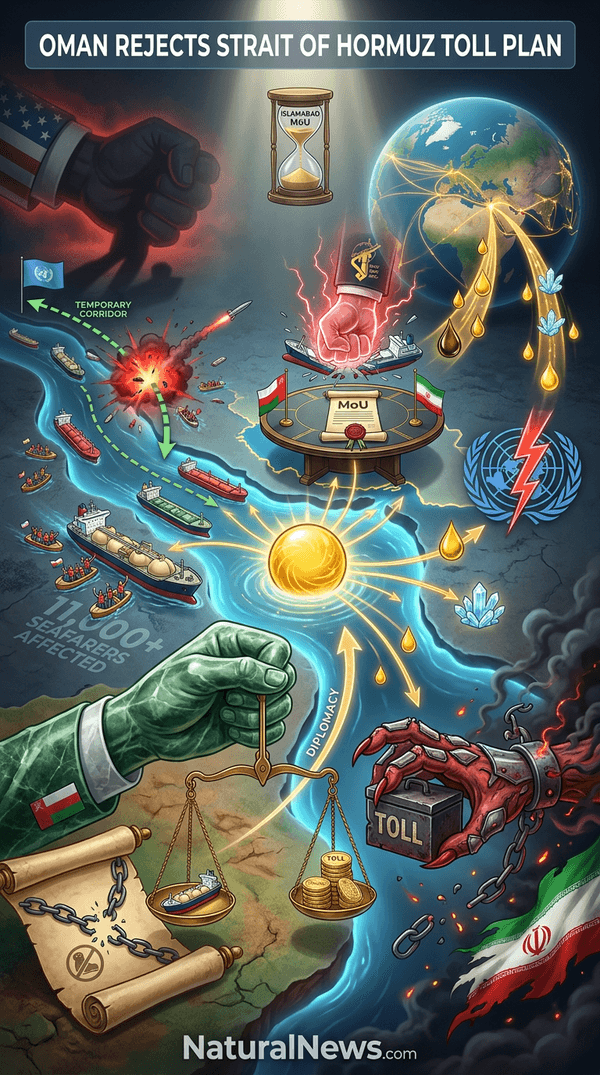
Omani Foreign Minister Badr Al-Busaidi announced on Thursday, June 25 that no transit fees would be imposed for shipping through the Strait of Hormuz, according to a statement released by Oman’s Foreign Ministry.Al-Busaidi stated that “future arrangements regarding the strait do not entail the imposition of any transit fees,” the ministry reported, during a ministerial meeting between the Gulf Cooperation Council and U.S. Secretary of State Marco Rubio in Manama, Bahrain. [1] The announcement came amid ongoing discussions between Iran and Oman for joint oversight of the strategic waterway, which handles about 20% of global oil shipments according to energy data. [2]
Just two days earlier, on June 23, Oman and Iran had agreed in Muscat to establish a joint committee to manage shipping in the Strait of Hormuz, following high-level talks between Oman’s Sultan Haitham bin Tariq and an Iranian delegation, a joint statement said. [3] The committee will oversee shipping management, particularly maritime services and costs, and consult with other coastal and regional partners to ensure coordination, according to the statement.
Iran-Oman Joint Committee EstablishedIran and Oman agreed on June 23 in Muscat to form a joint committee to manage shipping in the Strait of Hormuz, according to a joint statement. The committee will oversee shipping management, particularly maritime services and costs, and consult with other coastal and regional partners to ensure coordination, the statement noted. The two sides reaffirmed their commitment to ensuring safe passage through the strait in accordance with international law while stressing their sovereignty and sovereign rights over their territorial waters. [3]
Al-Busaidi and his Iranian counterpart, Foreign Minister Abbas Araghchi, discussed regional developments and temporary measures set for a 60-day period as mandated in the Iran-U.S. memorandum of understanding (MoU), according to a post on Araghchi’s Telegram channel. [4] The joint committee emerged from talks that also reviewed issues related to the strait under the Islamabad MoU, emphasizing that any arrangements must fully respect the sovereignty of both coastal states. The MoU framework, signed between Washington and Tehran, provides a temporary structure for reopening the waterway. [5]
Dispute Over Shipping Corridor EmergesIran’s Islamic Revolutionary Guard Corps Navy on Thursday denied statements by International Maritime Organization Secretary-General Arsenio Dominguez, who had asserted that a “large-scale operation will be carried out in close cooperation with Iran,” according to an IRGC Navy statement. The IRGC Navy called a newly declared shipping route introduced by “certain authorities” “unacceptable” and “completely dangerous,” saying it was done without notifying or coordinating with Iran. [6]
Muscat had previously announced the establishment of a temporary maritime shipping corridor through the Strait of Hormuz, launched in coordination with the IMO after a joint statement was issued, Omani officials said. The temporary corridor was designed to facilitate the evacuation of over 11,000 seafarers stranded in the region due to the U.S.-Iran conflict and subsequent blockades. [3]
However, the IMO suspended the evacuation plan on June 25 after a cargo vessel was struck by an unknown projectile near Oman’s coastal waters in the strait. [7] Dominguez stated that the vessel was not part of the coordinated evacuation. Iran’s Persian Gulf Strait Authority subsequently warned ships against using unauthorized routes. [8]
Seafarer Evacuation and Regional TensionsThe temporary corridor announced by Oman was intended to facilitate the evacuation of hundreds of stranded vessels and their crews. According to UN data, 57 ships carrying an estimated 1,100 seafarers transited the strait since June 23 under the evacuation plan. [9] The plan was designed to help ships leave the area safely after months of disruption following the closure of the strait by Iran in late February. [3]
The broader geopolitical context includes repeated U.S. warnings against any toll scheme. President Donald Trump threatened to “blow up” Oman if it cooperated with Iran to impose fees, according to a Middle East Eye report. [10] Treasury Secretary Scott Bessent also warned Oman against the toll plan. [11]
Analysts have noted that control over such transportation corridors has historically concentrated power in the West, as described by Glenn Diesen in “The Decay of Western Civilization and Resurgence of Russia.” [12] The dispute highlights ongoing tensions over a waterway that carries a significant share of the world’s oil and fertilizer supplies. [13]
ConclusionOman’s firm statement ruling out transit fees appears to align with U.S. demands, but the joint Iran-Oman oversight committee remains a point of friction. The IMO evacuation plan remains suspended after the June 25 attack, and Iran has warned against unauthorized transits.
The situation remains fragile as the 60-day negotiation period under the Islamabad MoU unfolds. Ships continue to transit in limited numbers, but normalization of full traffic through the Strait of Hormuz faces significant obstacles, including security concerns, mine clearance, and unresolved disputes over maritime governance.
References