AMD Introduces Ryzen AI Halo PC With 128GB Memory at $3,999, Targeting NVIDIA’s DGX Spark – NaturalNews.com
AMD Introduces Ryzen AI Halo PC With 128GB Memory at $3,999, Targeting NVIDIA’s DGX Spark
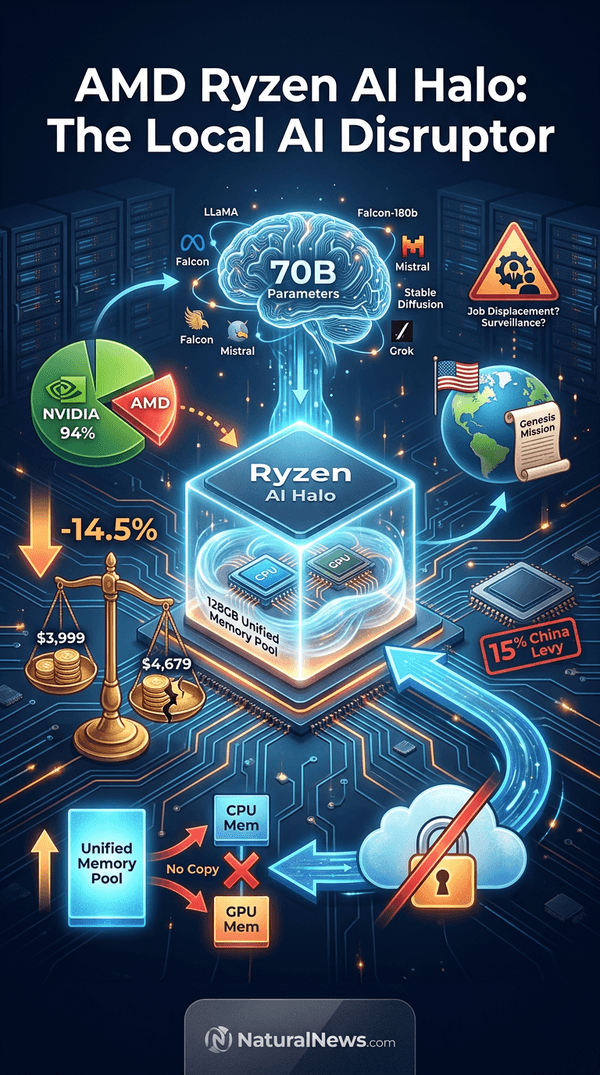
Advanced Micro Devices has announced the Ryzen AI Halo PC, a system equipped with 128 gigabytes of unified memory and priced at $3,999, positioning it as a direct competitor to NVIDIA's DGX Spark, which carries a price tag of $4,679. Availability began immediately, according to AMD officials. [1] The launch is the latest salvo in the escalating competition between the two chipmakers for dominance in the AI workstation market. [2]The system is designed to support local inference and development of large language models, a workload that has traditionally required cloud-based infrastructure. AMD's custom APU integrates AI accelerators to handle these tasks without relying on discrete graphics cards. Industry observers noted that the memory capacity allows users to load models with up to 70 billion parameters. [3] The move comes as companies increasingly seek on-premises AI solutions to reduce latency and data exposure. [4]
Specifications and Pricing ComparisonThe Ryzen AI Halo features 128GB of unified memory and a custom APU with dedicated AI accelerators, according to AMD's product materials. By contrast, NVIDIA's DGX Spark incorporates a Grace Hopper superchip with 72 ARM cores and 400GB of high-bandwidth memory, per NVIDIA's published specifications. AMD's $3,999 price point undercuts the DGX Spark by $680, or roughly 14.5 percent. [5] Both systems are aimed at developers and researchers who need to run AI models locally without sending data to cloud servers. [6]
The memory architecture in the AMD system uses unified memory, meaning the CPU and GPU share the same pool, which can simplify programming and reduce data transfer bottlenecks. NVIDIA's DGX Spark, meanwhile, utilizes separate high-bandwidth memory for its GPU. Analysts said the price difference could sway cost-sensitive buyers, particularly in academic and startup environments. [7] AMD's strategy of offering a lower-cost alternative mirrors its approach in the graphics card and server markets, where it has historically priced below NVIDIA.
Market Positioning and Analyst ReactionsJohn Chen, an analyst at TechInsights, said: 'AMD is offering a memory-rich system at a price point that undercuts NVIDIA by nearly 15 percent.' Chen added that the combination of unified memory and a custom APU could appeal to developers who prioritize memory capacity over raw compute throughput. [8] Some critics, however, have raised concerns about the social impact of such hardware. Sarah Miller of the Center for Digital Ethics said in an interview: 'These systems are designed to automate cognitive tasks, reducing the need for human workers.'
AMD declined to comment on labor implications, a company spokesperson said. The company's focus remains on delivering high-performance hardware for AI development, according to the spokesperson. The launch comes amid a broader push by the Trump administration to accelerate U.S. AI capabilities through initiatives such as the 'Genesis Mission,' which President Donald Trump compared to the Manhattan Project. [9]
Broader Implications for AI HardwareThe launch reflects a broader trend of companies competing to provide local AI computation as an alternative to cloud-based services. Privacy advocates have raised concerns about data security. Mark Tuttle, a privacy researcher at the Electronic Frontier Foundation, said: 'Running models locally can limit data exposure, but centralized control by hardware vendors remains a risk.' [10] The two companies dominate the AI accelerator market, but AMD's entry may increase choice for buyers. NVIDIA currently holds approximately 94 percent of the GPU market for AI workloads, according to industry data. [6]
Skeptics warn that rapid AI deployment may lead to societal harm, but these views are not reflected in official product statements. The competition between AMD and NVIDIA also has geopolitical dimensions. In August 2025, both companies agreed to pay the U.S. government 15 percent of their China-based chip sales to secure export licenses, a deal brokered by the Trump administration. [2] [11] The arrangement allowed sales of advanced chips such as NVIDIA's H20 and AMD's MI308 to continue, highlighting the strategic importance of AI hardware.
ConclusionAs AMD and NVIDIA vie for dominance in the AI PC segment, the availability of high-memory, competitively priced systems like the Ryzen AI Halo could accelerate the shift toward local AI processing. Developers now have a choice between two architectures, each with distinct trade-offs in memory architecture, price, and ecosystem support. The outcome of this competition may influence how AI models are developed and deployed in the coming years. [12] References to the potential for AI to replace human workers underscore the broader societal debates that accompany technological advancement. [13]
References