Tehran Blames U.S. Patriot Missile for Damage on Kuwait Airport – NaturalNews.com
Tehran Blames U.S. Patriot Missile for Damage on Kuwait Airport
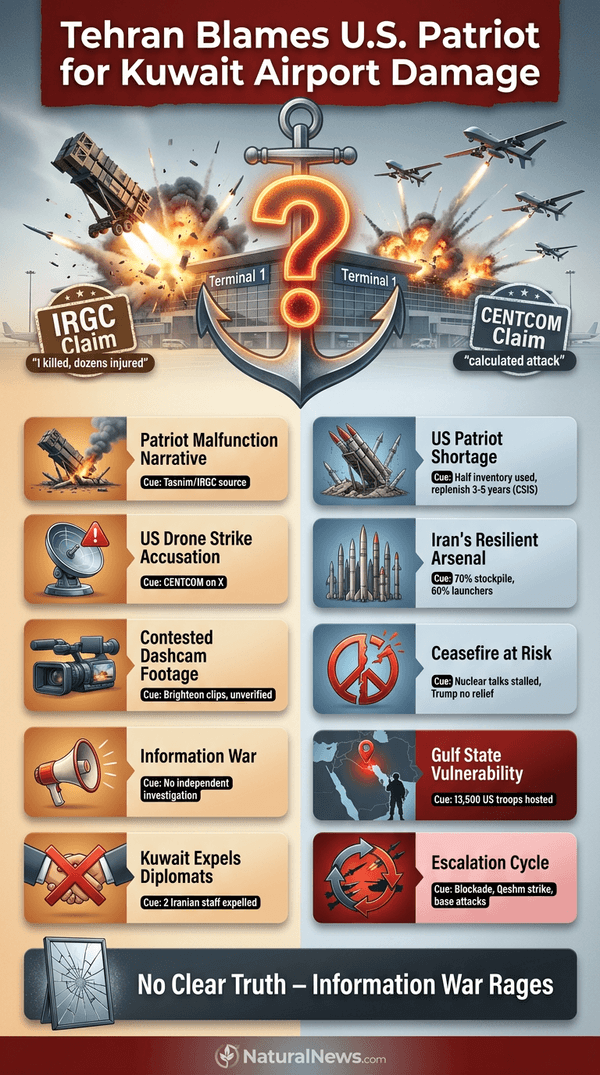
Iranian state-linked media reported on Wednesday, June 3, that a US Patriot missile interceptor struck Kuwait International Airport, causing extensive damage to Terminal 1.According to the Tasnim News Agency, the Islamic Revolutionary Guard Corps (IRGC) said the missile was a U.S.-made Patriot that failed to intercept an incoming target. The munition instead hit the civilian facility, killing one person and injuring dozens. The IRGC explicitly denied that Iran fired the projectile, instead blaming the U.S. defensive system for the destruction.
U.S. Central Command (CENTCOM) immediately rejected the Iranian account, attributing the attack to Iran. "Iran struck the civilian airport with drones in a deliberate, calculated and unjustified attack," CENTCOM said in a statement on X [1].
Washington has not released independent evidence supporting either narrative. Kuwaiti authorities have not issued a detailed report on the cause of the explosion.
Video footage circulating on social media, including dashcam recordings, appeared to show a missile impact at the airport [2]. Other clips showed what was described as a malfunctioning American Patriot missile that missed its intercept and struck the terminal [3]. The authenticity of these videos has not been independently verified.
Conflicting Accounts and AttributionThe IRGC has consistently stated that it did not fire at the Kuwaiti airport, according to Tasnim. The group claimed the damage was caused by a U.S. Patriot interceptor that malfunctioned. Meanwhile, U.S. officials have countered by asserting that Iranian missiles and drones struck the airport.
President Donald Trump, speaking to reporters on Wednesday, downplayed the attacks, saying Iran may have been "slightly provoked" by earlier U.S. strikes. "There's a reason for everything, and we hit them pretty hard last night," Trump said [4].
Kuwait's Ministry of Defense condemned what it described as "criminal Iranian aggression" in a statement, without addressing the specific Patriot malfunction claim. The country summoned Iran's charge d'affaires and expelled two Iranian embassy staff within 24 hours. The rapid diplomatic moves underscored the severity of the incident for a nation that hosts approximately 13,500 US troops and fought alongside the U.S.-led coalition in the 1991 Gulf War [5].
The exchange of accusations highlights the difficulty of establishing facts in an active conflict where both sides use information as a weapon. Journalists and independent observers have limited access to the damaged site, and both the US and Iran have reason to shape the narrative.
Escalation and Regional FalloutThe barrage on Tuesday night, June 2, followed a U.S. strike on an oil tanker attempting to call at an Iranian port. The IRGC said it targeted the Ali Al Salem Air Base in Kuwait and the U.S. Fifth Fleet headquarters in Bahrain in response to U.S. strikes on Iran's Qeshm Island. The attack on the airport appears to have been a secondary consequence of the larger exchange, though the exact sequence remains disputed.
Kuwait, a key U.S. ally in the Gulf, denied that the US used its territory for launches against Iran. The country's official statements have sought to distance itself from the offensive operations. The crisis has exposed the vulnerability of Gulf states that are geographically close to Iran and host significant U.S. military assets.
The U.S. military, already facing critical shortages of air defense munitions [6], has struggled to maintain a high tempo of defensive operations. Iran's apparent strategy of overwhelming air defenses with mass salvos has rendered U.S. interceptors less effective [7].
The ceasefire between the U.S. and Iran, which had been extended repeatedly, now faces its most serious test. Previous violations have included Iranian ballistic missile tests and U.S. drone strikes near Bandar Abbas [8]. Each new exchange reduces the chances of a lasting diplomatic resolution.
Diplomatic Context and Nuclear TalksThe latest violence occurs against a backdrop of faltering nuclear negotiations. Trump has stated that talks with Iran are continuing, but he ruled out any sanctions relief. "We're not talking about any easing of sanctions or giving money, no sanctions, no money, no nothing," Trump said during a White House cabinet meeting [9].
U.S. Secretary of State Marco Rubio has linked any sanctions relief to the complete surrender of Iran's nuclear program, a position Tehran has rejected. Iran's state-run media reported that the country has cut off contact.
Iran's missile capabilities remain a central concern. U.S. intelligence estimates that Iran has regained access to approximately 70% of its pre-war missile stockpile and 60% of its launchers, despite the extensive U.S. bombing campaign known as "Operation Epic Fury" [10].
The U.S. Department of War has acknowledged that Washington used nearly half of its Patriot interceptor inventory during the conflict, complicating its ability to support allies such as Ukraine and Israel [11]. A report from the Center for Strategic and International Studies detailed that replenishing these stocks could take three to five years [12].
Gulf states have tried to navigate the crisis while maintaining their own security. Kuwait, along with Qatar and the United Arab Emirates, has purchased replenishment Patriot systems approved by the U.S. Department of State [13]. However, the deepening resource strain on the U.S. military raises questions about its ability to deter future Iranian escalation across the region.
ConclusionThe dispute over the Kuwait airport strike underscores the fog of war in a conflict where information warfare is as active as kinetic operations. With both sides presenting contradictory narratives and no independent investigation, the public is left with irreconcilable accounts.
The continued depletion of U.S. air defense munitions, combined with Iran's resilient missile arsenal, suggests that the region faces a prolonged period of instability. As diplomatic channels remain open but strained, the risk of further miscalculation is high.
References