West Africa Under Jihadist Threat: Africa's Sahel States Surrendering Sovereignty to Islamic Terrorist Groups
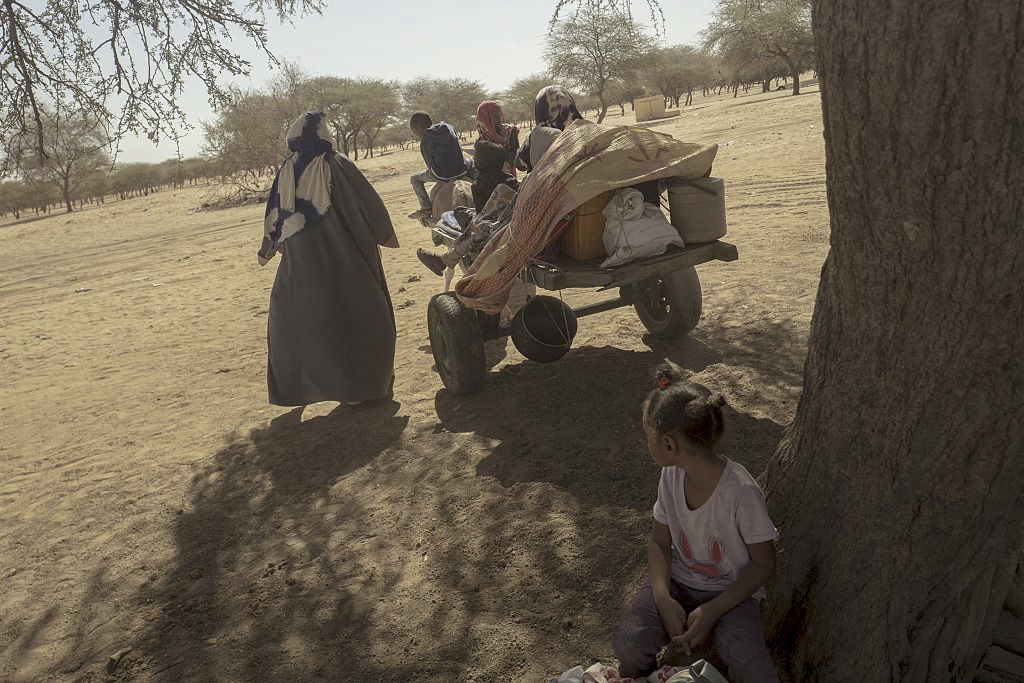 Al-Qaeda's branch in Africa's Sahel region has been laying siege to Mali's capital city, as well as other areas of the country. Pictured: A woman fleeing from the town of Leré, Mali, carries her children and belongings near Fassale, Mauritania, on November 4, 2025. Leré is one of the areas being blockaded by the Al-Qaeda-affiliated JNIM group. (Photo by Michele Cattani/AFP via Getty Images)
Al-Qaeda's branch in Africa's Sahel region has been laying siege to Mali's capital city, as well as other areas of the country. The Algerian-based Al-Qaeda in the Islamic Maghreb (AQIM) and its affiliated Jama'a Nusrat ul-Islam wa al-Muslimin (Support Group for Islam and Muslims, JNIM) are cutting a wide swath of terrorist operations across West Africa's Sahel region. This coalition of Jihadist groups now threatens the sovereignty of Mali and several other Sahelian states.
Islamist operatives now control all the main routes in and out of Bamako, Mali's capital city, cutting it off from fuel, food, and friendly neighbors. JNIM militants have also targeted Mali's transport, communications, educational network, and economic infrastructure in rural regions. Some towns in Mali are negotiating deals with Jihadist groups to secure some semblance of liberty and save their lives by agreeing to adopt Islamic Sharia law and pay "protection taxes" (jizyah) to Islamic officials.
Burkina Faso and Niger, two other Sahel states, landlocked like Mali, are also under severe pressure by the al-Qaeda affiliated JNIM to surrender their sovereignty to hardcore Sunni Islamic extremists. All three countries, once colonies of France's West African Empire, have in the past five years expelled French troops who had been assisting the host governments. All three are governed by non-democratic military juntas with little popular support, and thus have been unable to deal effectively with their common Jihadist threat.
These military regimes, which have formed the "Alliance of Sahel States," brought in mercenaries from Russia's Wagner Group and Africa Corps to replace French troops. Yet the Russians have been failing in their mission to shore up the juntas. Moscow's mercenaries suffered a major defeat in July 2024, near Mali's border with Algeria, at the hands of Tuareg rebels, who are also allied with the Al-Qaeda-linked Jihadists. Reportedly, dozens of Russian troops were killed during an ambush that occurred during a desert sandstorm.
Jihadist recruits in the Sahel are primarily ethnically Tuareg, some of whom desire to establish an independent state in what is now northern Mali. The region's other minorities, particularly in Mali, are also attracted to Islamist terrorist groups, including semi-nomadic Fulani tribesmen who populate the semi-deserts of the Sahel. Criminal networks have similarly thrown their lot in with the Jihadists, making money from kidnap ransoms and the sale of purloined gold shavings from Sahelian mines.
The Jihadist threat is not limited to the Sahel, but exists in the entirety of West Africa. For example, JNIM attacks now include assaults on the coastal African countries of Togo and Benin. There is even a report of a JNIM-sponsored foray across the border into Northwest Nigeria.
While most of the terrorist violence can be attributed to al-Qaeda-affiliated groups, Islamic State militants are also a predatory agent in the region. Fortunately, Al-Qaeda and the Islamic State jihadists also clash against one another.
Unless there is some urgent military assistance from the West, the success of the terrorists will continue. Logistical requirements of such external-based military aid would probably necessitate the establishment of a rescue corridor inside the territory of Ghana or the Ivory Coast. Alternatively, the juntas may be able to strike a temporary deal with either the Al-Qaeda or Islamic State proxies over sharing governmental powers -- further delegitimizing the junta regimes and deteriorating the future of West Africa. Unless there is an immediate Western intervention, one or more of these military regimes is likely to suffer a terrorist takeover in 2026.
Dr. Lawrence A. Franklin was the Iran Desk Officer for Secretary of Defense Rumsfeld. He also served on active duty with the U.S. Army and as a Colonel in the Air Force Reserve.