Why Israel and Trump Should Be Cautious About Pakistani Troops in Gaza
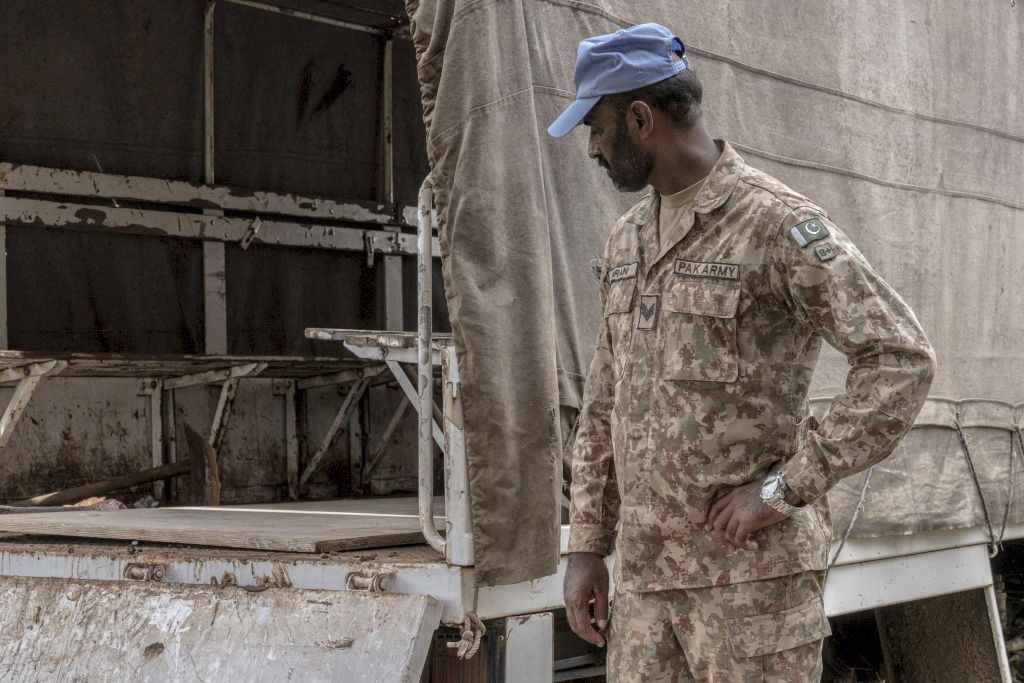 A Pakistani role in Gaza could undermine efforts to dismantle Hamas's military infrastructure. In a mission intended to stabilize Gaza and dismantle Hamas, entrusting security to a state that openly legitimizes the terror group risks transforming the stabilization force into a Trojan horse for Hamas's survival. Pictured: A Pakistani soldier on a UN peacekeeping force in Kamanyola, Democratic Republic of Congo on February 28, 2024. (Photo by Glody Murhabazi/AFP via Getty Images)
Israeli officials report that three countries have agreed to Washington's request to participate in a postwar Gaza "International Stabilization Force" (ISF). The identities of all three have not been disclosed, though Indonesia may be one of them. Earlier reports also identified Pakistan as a possible contributor to the ISF.
In addition, Pakistan does not officially recognize Israel, and has never designated Hamas as a terrorist organization. It may well have an interest in making sure that Hamas can continue its "resistance" -- meaning terrorism.
Given the sensitivity of any postwar security arrangement in Gaza, the credibility and neutrality of participating forces are critical. A closer examination of Pakistan's record raises serious concerns about whether it can play a constructive or impartial role in such a mission.
Pakistan's military and its primary intelligence agency, the Inter-Services Intelligence (ISI), have long been accused of maintaining relationships with Islamist militant organizations. For decades, the ISI helped nurture Pakistan-based groups such as Lashkar-e-Taiba (LeT) and Jaish-e-Mohammed (JeM), both of which espouse ideologies closely aligned with Hamas. These links cast doubt on Pakistan's ability to confront Hamas in a postwar Gaza environment.
Since the October 7, 2023 massacre, Pakistan's posture toward Hamas has become increasingly encouraging. Hamas representatives have been allowed to operate freely on Pakistani soil, participate in public events, and build alliances with Pakistan-based terror outfits. Such behavior directly undermines Western efforts to isolate Hamas and raises questions about whether the United States should continue to regard Pakistan as a "major non-NATO ally."
One figure illustrating this trend is Naji Zaheer, the current Hamas special representative in Pakistan. After October 7, Zaheer significantly intensified his political activity, working openly to build legitimacy and support for Hamas. He has appeared as a guest of honor at major events and has become a regular presence at anti-Israel rallies and conferences.
On December 8, 2024, Zaheer attended the inflammatory "Death to Israel" conference in Peshawar. Addressing the gathering, he framed the Gaza war as a "war of Islam" that would continue "until Israel is eliminated and the Jews flee."
While Zaheer's activities highlight Hamas's grassroots mobilization within Pakistan, the involvement of Khaled Qaddoumi — the Hamas special representative in Tehran — points to something even more troubling: institutional and political endorsement. Since October 2023, Qaddoumi has actively participated in rallies and events hosted by Pakistani institutions, signaling official tolerance and, at times, tacit support.
In January 2024, Pakistan's Upper House of Parliament hosted Qaddoumi in a formal session. Senator Mushahid Hussain of the Pakistan Muslim League (Nawaz), one of the three major mainstream political parties in Pakistan, emphasized the significance of welcoming Qaddoumi. Hussain stated that the Senate "takes pride" in hosting him, and praised Hamas as a "democratically elected organization," referring to Qaddoumi as a "mujahid" representing Palestinian aspirations. He further declared that Pakistan had been the first Muslim country to donate $1 million to the Hamas government and lauded the "Palestinian mujahideen of Hamas" for shattering "the myth of Israeli impregnability."
This level of parliamentary reverence reflects a deep ideological alignment with Hamas. Equally alarming are Pakistan's ties to jihadist groups that openly link their struggles to Hamas's cause. Organizations such as Pakistan-based JeM and LeT have explicitly framed their "jihad" against India as part of the same Islamist campaign Hamas wages against Israel.
That convergence became unmistakable in February 2025 at a conference in Pakistan-held Kashmir titled "Kashmir Solidarity and Hamas Operation Al-Aqsa Flood." Hamas representatives, including Qaddoumi, shared the stage with UN-designated terrorist leaders from JeM and LeT. Speakers publicly vowed to coordinate closely with Hamas, uniting their respective conflicts under a pan-Islamist banner.
These examples demonstrate how freely Hamas operatives function within Pakistan. Allowing Pakistani troops into Gaza would therefore pose serious infiltration and counterintelligence risks. Unlike a genuinely neutral peacekeeping force, Pakistani soldiers may be unwilling — or ideologically disinclined — to confront Hamas. In a worst-case scenario, some elements could covertly assist Hamas fighters in evading disarmament.
These concerns are not hypothetical. Pakistani media have reported that Islamabad does not wish to be perceived as a "B-team of the Israeli military focused solely on disarming Hamas." Such statements underscore the likelihood of operational friction and divided loyalties on the ground.
Another major risk involves intelligence leakage. If deployed in Gaza, Pakistani units could quietly pass sensitive information to Hamas or its regional backers under the guise of cooperation. Reports have previously alleged ISI involvement in facilitating Hamas outreach across South Asia, including visits to Bangladesh and Pakistan-occupied Jammu and Kashmir to energize jihadist networks.
For Israel, the implications are clear. A Pakistani role in Gaza could undermine efforts to dismantle Hamas's military infrastructure. In a mission intended to stabilize Gaza and dismantle Hamas, entrusting security to a state that openly legitimizes the terror group risks transforming the stabilization force into a Trojan horse for Hamas's survival.