The US or China? The Nation That Wins the Nuclear Fusion Race Wins Global Primacy
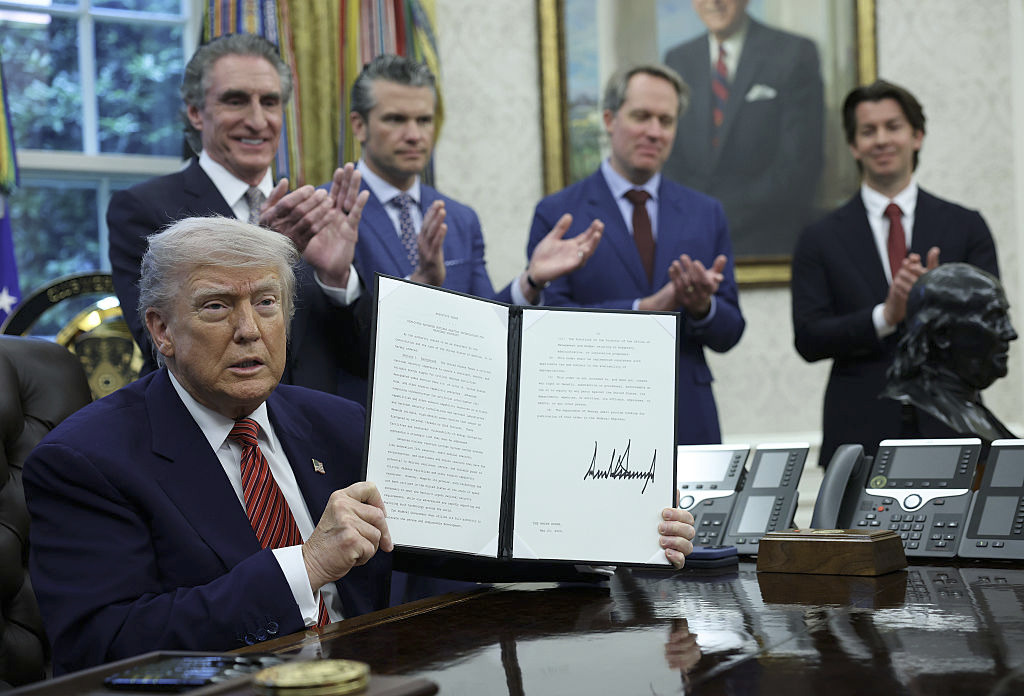 If there is any message that needs to be heard by China, it is that President Donald Trump recognizes that the winner of the fusion race will secure its nation's future and dictate whether democracy and freedom will flourish or the misery of communism will fall upon tens of millions of people. Pictured: Trump holds up an executive order on the rapid development, deployment and use of advanced nuclear technologies, on May 23, 2025, in the White House. (Photo by Win McNamee/Getty Images)
There continues to be a debate among global geopolitical analysts regarding whether the United States and China are engaged in a Cold War or a competition for global dominance.
The answer is irrelevant.
By anyone's observation, China seeks to dominate the 21st century, and they will do so by "any means necessary." In the process, they will use their military might to create a sphere of influence that is designed to cow nations that range from Japan to Australia to India.
Their invasion of Taiwan is almost a foregone conclusion among many military observers, who believe it is not a question of if but when. But "when or if" China launches its amphibious assault, it will have determined that the United States is not willing to risk its armed forces to defend an island that produces the majority of the world's computer chips, especially the most advanced ones.
China's eventual decision to deploy its military throughout the Pacific Rim will likely be preceded by confidence in its ability to harness extraordinary advances in AI resulting from its access to unlimited, clean, inexpensive electricity available from fusion power. It is an emerging technology currently the beneficiary of what is believed to be untold billions of Chinese yuan of investment. One executive at Brookhaven National Laboratory told me earlier this year:
"We have no idea how much they are truly spending because of the secrecy surrounding their efforts but we get the sense 'whatever it takes' to achieve a breakthrough in fusion."
The strategic linkage is clear and without question. Consider the facts: AI has the means to alter the course of a country's history. But to harness its full potential requires incredible amounts of energy. Create that energy, and AI becomes a 21st-century strategic weapon.
For far too long the United States failed to place its scientific and industrial might behind what might be called a 21st-century Manhattan Project, recalling the days of World War II when we won the race to create the atomic bomb.
That indifference has profoundly changed during the last quarter of 2025. The White House recently created an Office of Fusion within the Department of Energy, significantly elevating focus and urgency on this technology. Equally important is the announcement that President Donald J. Trump is getting into the fusion power business through a $6 billion merger between his social media company and the fusion research company TAE Technologies.
If there is any message that needs to be heard by China, it is that Trump recognizes that the winner of the fusion race will secure its nation's future and dictate whether democracy and freedom will flourish or the misery of communism will fall upon tens of millions of people. History may well view that out of all his accomplishments, the president's investment in fusion was the one upon which the fate of nations was determined.
Lawrence Kadish serves on the Board of Governors of Gatestone Institute.