The false messiah driving Iran
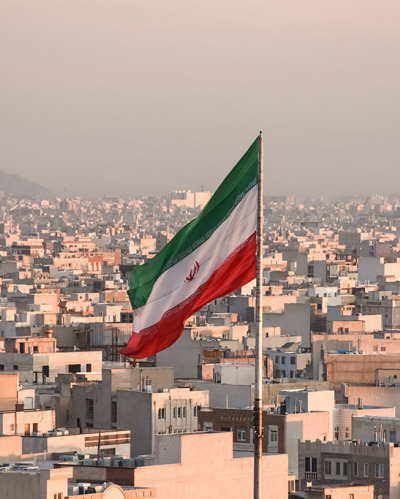 Iranian flag waving with cityscape on background in Tehran, Iran | Getty images/stock photo
The Bible uses many literary devices to communicate its message, one of them being repetition. Whenever you see statements repeated in Scripture (especially if they are close together in the same text), then the writer is emphasizing the message and telling us we really need to pay attention.
A good example is Jesus’ Olivet Discourse found in Matthew 24, which is prophetic in nature and covers the end times. It starts off with Jesus warning, “See to it that no one misleads you. For many will come in My name, saying, ‘I am the Christ,’ and will mislead many” (vv. 4–5). Then, just a few verses later, He says: “Many false prophets will arise and will mislead many” (vs. 11).
Skip down just a little more, and then there’s this: “Then if anyone says to you, ‘Behold, here is the Christ,’ or ‘There He is,’ do not believe him. For false Christs and false prophets will arise and will show great signs and wonders, so as to mislead, if possible, even the elect” (vv. 23–24).
I don’t know about you, but to me, it sure looks like Jesus wants us to be on the lookout for false messiahs and their mouthpieces. You might think such a thing is rare and only happens today with a handful of people who get snookered now and then by some religious charlatan, the events of which get portrayed on some Netflix documentary.
But you’d be wrong. For example, let me introduce you to the false messiah figure that’s influencing the nation of Iran’s actions towards the world at large, and especially at Israel and the United States.
Iran’s counterfeit savior
About 20 years ago, then-president of Iran, Mahmoud Ahmadinejad, stated in an interview that he experienced a supernatural experience during a speech he gave at the United Nations. Ahmadinejad claimed that he was bathed in a light from Heaven at the outset of his talk, with the light remaining on him for the full length of the speech.
Ahmadinejad made several references during that U.N. speech to a “mighty Lord” who will hasten the emergence of “the promised one,” a person who “will fill this world with justice and peace.” Any guesses as to who Ahmadinejad was referring to?
During that time, CNN national security analyst Peter Bergen pointed out that groups such as ISIS have similar hopes based on their belief in Islamic prophecy. Believing that their actions hasten a supposed final battle at a small, obscure Syrian town named Dabiq between “Rome” and Islam (where the forces of true Islam triumph), Bergan noted: “Members devoutly believe that they are fighting in a cosmic war in which they are on the side of good, which allows them to kill anyone they perceive to be standing in their way with no compunction. This is, of course, a serious delusion, but serious it is.”
An article by Graeme Wood in The Atlantic echoed Bergen’s conclusions on Iran and other groups’ prophetically driven ideology and put forward the idea that no threat will deter their current course of action: “That the Islamic State holds the imminent fulfillment of prophecy as a matter of dogma at least tells us the mettle of our opponent. It is ready to cheer its own near-obliteration, and to remain confident, even when surrounded, that it will receive divine succor if it stays true to the Prophetic model.”
And to Iran, that “model” includes a messianic-type figure known as the “Mahdi”; the “mighty lord” Ahmadinejad was referring to in his U.N. speech. During another talk Ahmadinejad gave that same year, he stated that his main mission was to “pave the path for the glorious reappearance of Imam Mahdi, may Allah hasten his reappearance.”
It’s a good bet you’ve never heard of the Mahdi, unless you’ve studied some of Islam’s prophetic literature. The figure is emphasized especially on the Shi’a side of the Islamic faith (the other side being Sunni), which makes up the vast majority of Iran’s practicing Muslims, including their Islamic Revolutionary Guard Corps (IRGC).
In fact, the IRGC’s worldview focuses on “Mahdism” and the return of the 12th divinely ordained Shi’a imam, Muhammad al-Mahdi (or the Hidden Imam). They believe the Mahdi was hidden by God into a miraculous state in 874 CE, and that he will one day return to rid the world of evil and injustice. His coming, they believe, will bring about “one final apocalyptic battle” between two armies, in which Shi’as say that the Mahdi and his forces will prevail over evil.
Twenty years ago, Ahmadinejad urged his countrymen to prepare for the coming of the Mahdi by turning the country into a mighty and advanced Islamic society, and by avoiding the corruption and excesses of the West. While sounding innocent, it’s important to understand that part of the preparation has to do with the elimination of Islam’s enemies and those who stand in the way of the Mahdi’s return. Topping the list is the United States, and the chief enemy of Islam, Israel.
In a report issued by the Middle East Institute just a few years ago, researchers Saeid Golkar and Kasra Aarabi noted that the IRGC’s leadership sees the world divided between the “will of the essence of transcendence” and “the arrogant powers.” The former is led by “the people and the leadership of Iran,” and the latter includes “Zionism, Wahhabi Zionism, and Christian Zionism.”
They go on to say:
“The IRGC is increasingly understanding and communicating its official policy of eradicating Israel and Zionism through the doctrine of Mahdism. While the destruction of Israel has been the IRGC’s working objective since its inception, like other Islamist groups this hostility was borne out of viewing the Jewish state an illegitimate, oppressive, and usurping entity for the West to achieve its supposed colonial goals across the Muslim world. More recently, however, the existence of Israel is being viewed and understood as the ‘greatest barrier’ to the reappearance of the 12th Imam. According to the doctrine of Mahdism, part of preparing for the reappearance of the 12th Imam is removing all obstacles and barriers to his return. Against this backdrop, Iran’s hardline clergy affiliated with the IRGC claim religious hadiths state that the ‘Jewish state will be destroyed before Mahdi’s arrival.’”
We shouldn’t be dismissive of such thinking. Golkar and Aarabi highlight the real danger of all this when they write: “At present the doctrine of Mahdism in the IRGC remains a complete blind spot for Western policymakers, yet it could have major implications for the Islamic Republic’s militia network, ballistic missile program, and even its nuclear program.”
That’s a bit concerning, wouldn’t you say?
At present, our governments spend enormous resources analyzing Iran's economy, military capabilities, and nuclear ambitions, all of that being good.
But maybe it’s time they devote equal attention to understanding the theological convictions that motivate many of the regime's politicians. History has repeatedly shown that leaders driven by deeply held religious beliefs cannot always be deterred by conventional assumptions and actions. Ignoring those beliefs doesn't make them disappear; it simply makes strategic miscalculation more likely.
Our leaders need to heed Jesus' warning about false messiahs and understand it wasn't merely a religious observation. It was a reminder that false hopes and false saviors have real-world consequences, both spiritually and politically.
What did Christ say again? “See to it that no one misleads you.” Listen up, America.
Robin Schumacher is an accomplished software executive and Christian apologist who has written many articles, authored and contributed to several Christian books, appeared on nationally syndicated radio programs, and presented at apologetic events. He holds a BS in Business, Master's in Christian apologetics and a Ph.D. in New Testament. His latest book is, A Confident Faith: Winning people to Christ with the apologetics of the Apostle Paul.