Venezuela earthquake death toll crosses 1,400, nearly 70,000 remain missing
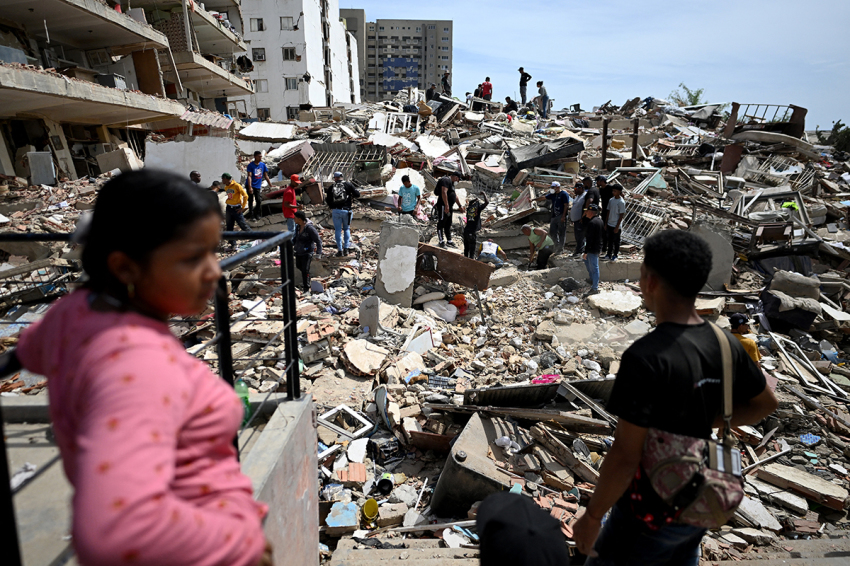 Residents search for victims through the rubble of a collapsed building in Catia La Mar, La Guaira state, about 30 km northwest of Caracas, on June 25, 2026, following an earthquake. A twin earthquake that was Venezuela's largest in over a century has killed at least 188 people and destroyed multiple buildings near the capital, where residents searched on June 25 for missing relatives. | Juan Barreto/AFP via Getty Images
The death toll from Venezuela’s twin earthquakes has risen to 1,430, with families reporting at least 68,900 people missing. The toll continued to climb even after the 72-hour window for rescuing survivors alive closed Saturday, while anger over the government’s response intensified in some of the hardest-hit areas.
Jorge Rodríguez, leader of Venezuela’s National Assembly and the brother of acting President Delcy Rodríguez, confirmed the toll Saturday.
More than 6 million people could be affected by the earthquakes, including around 2 million in the capital, Caracas, according to figures from the International Organization for Migration.
Satellite mapping analysis shows that nearly a third (31%) of buildings in Catia La Mar are damaged.
The state of La Guaira, on the Caribbean coast, bore the worst of the destruction. IOM Satellite mapping analysis shows that nearly a third (31%) of buildings in Catia La Mar are damaged.
Civilians and rescuers searched mounds of toppled concrete using shovels, ropes, heavy equipment and bare hands, The Associated Press reported. With no hard hats available, many searchers wore motorcycle helmets. Bodies were loaded onto white trucks from a hospital parking lot to be identified.
Aid agencies say the first 48 to 72 hours after a disaster are the most critical for recovering survivors alive — a window that passed on Saturday.
The United Nations’ top official in Venezuela, Gianluca Rampolla, said he could not determine exactly how many people remained buried, but he estimated that roughly 125 buildings collapsed, a figure that suggests the death toll may rise significantly beyond the official count.
Many Venezuelans reported security forces were underprepared and that officials prioritized appearances over rescue work. State workers were reportedly seen taking photographs in front of flattened buildings before leaving without assisting, AP reports, adding that crowd members blocked an excavator from departing a deadly collapse site and pulled the operator from the vehicle.
Delcy Rodríguez announced on state television that more than 14,000 military and police personnel were patrolling the area and that access to La Guaira required special permits. Her brother Jorge said only authorized workers would be admitted. Large groups of civilians allegedly crowded the roads carrying food, water and medical supplies, clogging the only highway into La Guaira and blocking ambulances and hundreds of international rescue workers.
Rescue teams from Mexico, U.S., Brazil, El Salvador, France and other countries were on the ground by Saturday. Venezuelan officials said 17 flights had delivered more than 1,600 rescue personnel. Nearly 250 Americans participated, including teams from Virginia, California and Florida.
American military personnel repaired one of the runways at Simón Bolívar International Airport, which serves Caracas, after it was damaged. A U.S. Navy transport ship, the USS Fort Lauderdale, was positioned off the coast to receive evacuated survivors requiring medical care.
Jeremy Lewin, a senior State Department official overseeing foreign assistance, told reporters it was a “race against the clock.”
The State Department was working on a relief package to follow the $150 million in aid already announced.
Meanwhile, more than 400 aftershocks have struck the region since Wednesday, including a 4.8-magnitude tremor on Saturday.
The disaster has increased pressure on Delcy Rodríguez, who took office in January after U.S. forces seized former President Nicolás Maduro, and on President Trump, who embraced her government while publicly saying the U.S. could potentially run and rebuild Venezuela for years.
Venezuela has been in economic disarray for more than a decade, and large segments of the population reject the legitimacy of the political movement she leads.