The enduring importance of NC's 'Mecklenburg Declaration'
When President Thomas Jefferson died 200 years ago, on July 4, 1826, he asked that he be remembered in his epitaph for three accomplishments: “Author of the Declaration of American Independence, of the Statute of Virginia for Religious Freedom, and Father of the University of Virginia.”
However, some North Carolina historians now argue that Jefferson would have been expelled from his own university for plagiarizing America’s founding document — and then lying about his authorship of it.
“You only have to look at the fact that George Mason published the line ‘life, liberty, and pursuit of happiness’ the same week in a Philadelphia newspaper that Thomas Jefferson wrote the first draft of the Declaration,” said Charlotte-based historian David Fleming, author of the book “Who’s Your Founding Father: One Man’s Epic Quest to Uncover the First, True Declaration of Independence.”
Fleming is one of a growing number of history enthusiasts convinced by the evidence that the Mecklenburg Declaration of Independence, a document declaring local residents “free and independent” from British rule, predated its Jeffersonian counterpart by a full 14 months.
Despite Jefferson having taken credit for the US Declaration — a detail now accepted by most elementary schoolchildren and scholars alike — the ambitious Virginia statesman allegedly cribbed significant portions of the document, and even the very idea of declaring independence, in order to boost public support and morale as the Revolutionary War raged into its second year.
“We were about to lose the war before we had even formally declared independence, and so it was kind of this rush job, and it was kind of a cut-and-paste,” Fleming said. “And it was only when Jefferson tried to claim, ‘No, no, I wrote the whole thing myself and I’m the author of this document’ — Yeah, that’s when he would have definitely gotten suspended, I think, by UVa.”
Or worse. UVa.’s vaunted honor code, established in 1842, long offered just a single sanction — expulsion — for offenses of moral turpitude, although it was reduced in 2022 to a two-semester suspension.
AMERICA’S FIRST GASLIGHTING?The story of Jefferson’s death and that of his longtime political rival, President John Adams, both 50 years to the date of the signing of the Declaration of Independence, has become the stuff of American legend, an anecdote passed down to convey, perhaps, the divine Providence in which the nation’s founding was rooted.
Meanwhile, Fleming and others argue, the actual story of how a North Carolina community declared its independence in 1775 has fallen victim to a propaganda campaign, led by Jefferson himself, to discredit the Mecklenburg Declaration.
“The Meck Dec is really the first victim of misinformation, and it just shows you how hard it is to combat that,” Fleming said.
While its broader relevance may now be moot, with July 4 enshrined as our national Independence Day holiday, the mystery of the Meck Dec’s provenance — and the ensuing controversy over its veracity — have made it a lingering point of fascination for US history buffs, and a point of particular pride for the people of Charlotte.
“It remains a historical curiosity and historical footnote that’s very interesting and cool,” said Scott Syfert, founder of the Charlotte-based May 20th Society and author of a 2013 book titled “The First Declaration of Independence?” about the Meck Dec debate.
“But what impact it had, true or not, is minimal, frankly, other than it’s very interesting and it’s very patriotic and so forth for the people that lived here at the time,” Syfert added.
THE HIDDEN HISTORYThe legend of the Meck Dec begins with a date familiar to most North Carolinians, even if they don’t realize it.
“One of the biggest things I learned was sometimes the greatest, most amazing stories in American history can be hiding in plain sight, right under all of our noses,” said Fleming, who stumbled upon the story after he noticed the date May 20, 1775, inscribed on the state flag one day while picking up his young daughter from school.
The mystery behind it “sent me down this incredible rabbit hole” that led to retracing the hidden history of Charlotte, he said.
According to the lore, 27 of Mecklenburg County’s civic leaders, led by Col. Thomas Polk (the great-uncle of future president James K. Polk), gathered on May 19 after receiving word of the colonial victories against the British in the battles of Lexington and Concord, in Massachusetts, a month earlier.
The signing of the document took place “in a rustic backwoods courthouse which stood nearby in the center of the intersection of Trade and Tryon Streets,” according to a plaque that now stands in the uptown Charlotte location, known as Independence Square.
The Declaration was read aloud on May 20 to a large crowd that had gathered at the courthouse steps, according to eyewitness accounts.
A young tavern owner, Capt. James Jack, then volunteered to deliver the document (along with a more toned-down version called the Mecklenburg Resolves) to the Continental Congress in Philadelphia, at great risk to his own life and livelihood.
But because America’s founding fathers were focused at the time on attempting a reconciliation with King George III, the North Carolina delegation never brought it before the full Congress.
PASSIVE‒AGGRESSIVE PRESIDENTSAfter falling off the radar, the original document and many of the accompanying materials were lost in an 1800 fire at the home of Meck Dec secretary John Alexander.
But in 1819, Alexander’s son, William, delivered a copy of the text, reportedly reconstructed from memory by his father, to US Sen. Nathaniel Macon, who urged the publication of it in the Raleigh Register.
That created a political firestorm that caught the attention of Adams and Jefferson, both of them now former presidents carrying on a personal correspondence in their august years.
Adams saw the opportunity for oneupmanship over his intellectual sparring partner in a letter to Jefferson dated June 22, 1819.
“Adams sees this paper account and says, you know, ‘Wow, the genuine sense of America at that moment has never so well been expressed before,” said Syfert, paraphrasing Adams.
He “sort of very passively aggressively asserts that Jefferson had probably seen this and may have copied from it, but in any event was aware of it,” Syfert added.
Jefferson responded to Adams in a July 9, 1819, letter, which was published posthumously in 1829, dismissing the Meck Dec as a hoax.
“He says, actually, no historians that we know had ever heard of this, [and] that some of the North Carolinians that are part of this story were some of the biggest Tories in America at the time, which sort of pisses off the local North Carolinians,” Syfert said. “But he has a very reasoned, sort of, ‘until more solid proof is produced about this story, I must remain a disbeliever,’ as he puts it.”
THE DEBATE THAT WON’T DIEJefferson’s skepticism notwithstanding, he stopped short of fully dismissing the possibility that the Meck Dec story was true, leaving it to simmer as a point of contention among North Carolinians.
Shortly after the publication of Jefferson’s letter, the state legislature established a committee to investigate the truth. It was led by state Rep. Thomas Polk, grandson and namesake of the Meck Dec’s original architect.
Among the eyewitnesses who offered testimony to verify the accounts were war heroes like Joseph Graham and the Rev. Humphrey Hunter.
“These are some of the sort of most respected men that North Carolina has ever produced,” Fleming said. “And it would just be impossible to think that they would lie or make this up or create some giant hoax.”
Polk went on to launch a failed bid for governor in 1832, but the Meck Dec issue once again faded into the background until 1907, when William Henry Hoyt — a 23-year-old, amateur historian who, by his own admission, had been “ignorant of North Carolina history” until three years prior — published a study that purported to use modern research methods to debunk the tale.
A year later, Samuel Ashe, the first publisher/editor of the consolidated Raleigh News & Observer, presented a more balanced account in his history of the state. However, he ultimately sided with Hoyt in discrediting the Meck Dec.
But residents of Charlotte and Mecklenburg County continued to celebrate the May 20 anniversary as a city and county holiday, even hosting a gathering of around 100,000 for its bicentennial in 1975, until around 40 years ago when “it just disappears off the map entirely,” Syfert said.
He speculated that the deliberate effort during the 1980s and ’90s to whitewash some of the more ignominious moments in Charlotte’s history ultimately had a double-edged effect.
“Charlotte branded itself — and we’re still a victim of this to some degree — as this New South city, so we’re liberating ourselves from all the historical controversies, particularly around the Civil War and civil rights,” Syfert said.
“We’re a finance-driven city, we’re a commercial city, a business city — all of which are positives on one level,” he added. “But … you don’t have any visibility of the history that people get attached to, so the history literally can just disappear unless people retell the story.”
MAKING LIGHT OF CONTROVERSYIronically, newcomers to North Carolina are helping to reignite interest in the Meck Dec, and many are swayed by the evidence that advocates like Fleming and Syfert have presented in its favor.
“When they get a little taste of this history, they go like, ‘Holy s**t, where did this come from? I didn’t know anything about this,” Syfert said. “And so, those people get radicalized, sort of, more than the native Charlotteans about this story, because they’re looking for something new and interesting — authentic — about Charlotte. And, you know, that’s hard to find sometimes.”
Shrewdly, Syfert and the May 20th Society have helped to bring the tale of the Meck Dec to young urban professionals in their native habitat: at local breweries. The Olde Mecklenburg Brewery, which partners with the society on its annual Captain James Jack Dinner, features a Captain Jack Pilsner in its permanent rotation of brews. And Lost Worlds Brewing launched its own MecDeck Honey Ale in 2023 to coincide with Fleming’s book release.
In June, Fleming teamed with Lost Worlds for the second MecDec Express, a boozy bus tour that stopped by many of the local sites associated with the story.
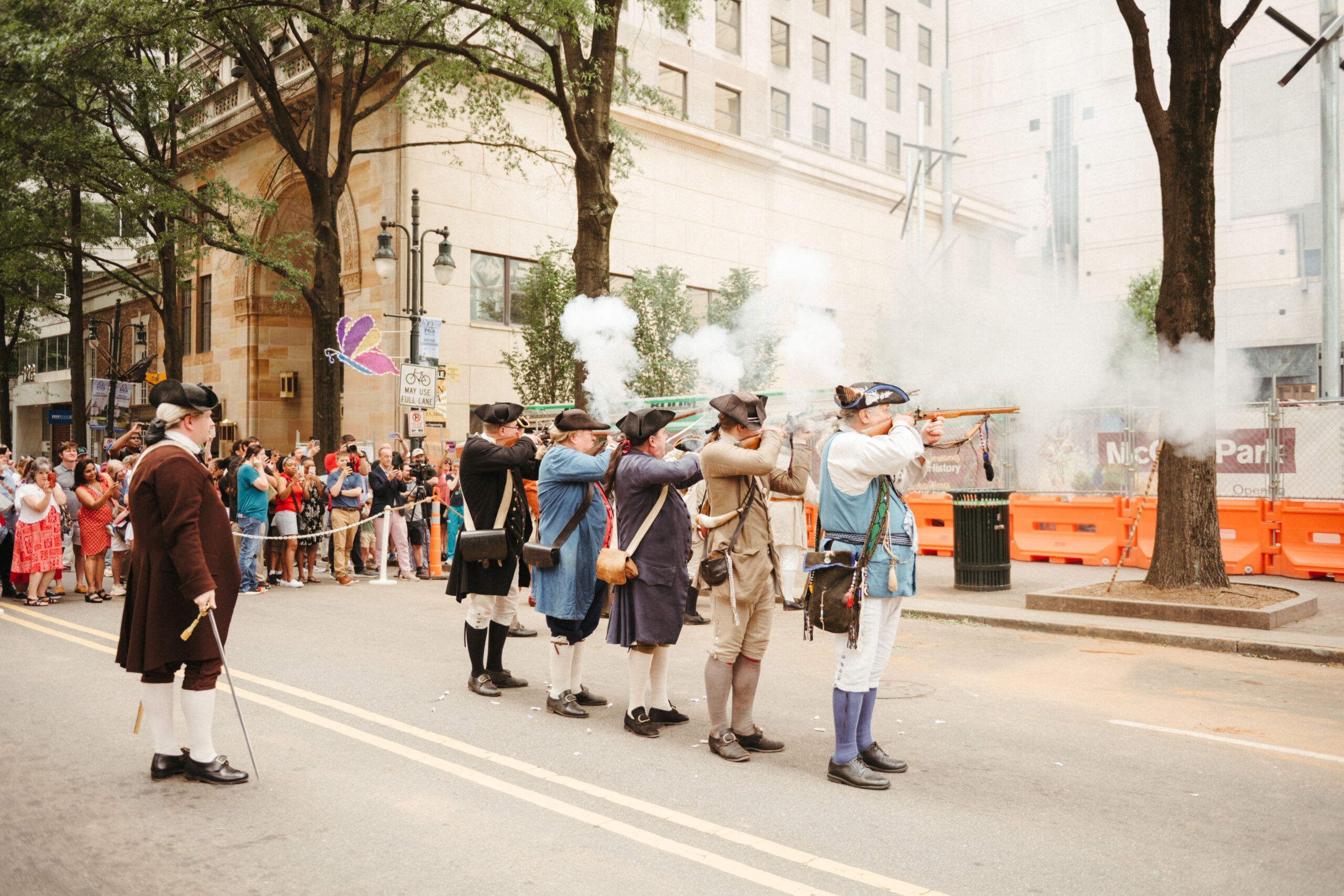
The May 20th Society also collaborates with Charlotte Center City Partners, a public-private economic development group, to host an annual anniversary celebration on May 20, during which participants gather in Independence Square for a reading of the declaration and firing of cannons.
But more than just a fun way to learn local history, Syfert, a lawyer by trade, said there was inherent value in using the debate over the document as a teaching tool.
With help from state Supreme Court Chief Justice Paul Newby, Charlotte officials and the May 20th Society teamed up to conduct a statewide moot court tournament for students in celebration of the Meck Dec’s 250th anniversary last year.
“We just love the commemoration of it in whatever form it takes, and the more people are talking about it, the better,” Syfert said.
“Frankly, if there wasn’t a controversy about this that was part of the heat of the whole thing, who would care?” he added. “I mean, the controversy is part of the fun.”
Topics on this page