Trump's Agencies Legalize H-2A Migrants for Dairy Industry
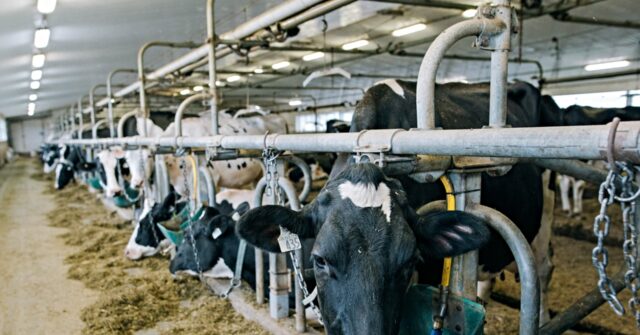
Agriculture Secretary Brooke Rollins is celebrating the agreement by the Department of Homeland Security to grant seasonal H-2A work permits to year-round migrant dairy workers.
“The guidance clarifies that dairying is an agricultural activity eligible for consideration under the H-2A program and recognizes that dairy operations may experience temporary or seasonal labor needs that qualify for H-2A employment,” Rollins’ department said in a June 17 press release.
“Obviously, someone in the administration wants to get dairy into the unlimited seasonal temporary agricultural program, so apparently [it] is just redefining the word ‘seasonal,'” responded Rosemary Jenks, the Harvard-educated lawyer who runs the Immigration Accountability Project. She added:
We’re going to be importing a serf class to our dairy industry, just like we do with our crops, and allow dairy owners to pay lower wages, and have worse working conditions, and push Americans [including recent legal immigrants] entirely out of the industry. It’s ridiculous.
The legislation that created the H-2A visa program says it is reserved for seasonal workers, and industry lobbies have been asking Congress for many years to remove the statutory limit, she said.
Unlike seasonal row crops or fruit orchards, “you have to feed cows, and move them, and milk them, every single day, 365 days a year,” she said.
“Cows do not go on vacation, and generally neither do dairy workers,” she said, adding: “If you start with a law that says these workers must be temporary or seasonal, and you end up with, ‘Oh yeah, [year-round] dairy workers qualify,’ you’ve turned yourself into a pretzel.”
The bureaucratic giveaway, she said, also minimizes marketplace pressure on the dairy industry to raise productivity by investing in robot cow-milking machines, including machines assembled in Palla, Iowa.
The machines are widely used in Europe and other developed countries, where farms are expected to maximize efficiency — and where politicians try to preserve their dense community of family farms, well-paid workers, and prosperous towns.
“Did it feel risky to put all of our resources into a system I hadn’t tried? …Yeah, it did!,” Glenn Brake, at the Oakleigh Farm in Pennsylvania, told the New York Times:
In 2019, our barn burned down in an electrical fire. Luckily we didn’t lose any cows, but we lost most of our equipment. We’d heard about a company making automatic milkers, feeders and cleaners. The most appealing part was how much time we’d save milking. Before the fire, it took two people to milk the cows: four hours in the morning and four hours in the evening. We’d get up around 2:30 a.m. and start milking by 3.
[…]
Now, I get up around 5:30 a.m. and I come down to check on things. We have an A.I. feeder, too — I call him Gordon. He has a personality, so I gave him googly eyes. So Gordon will run out here to the barn and say, “Oh, we need feed, yep.” So then he’ll go to the silo, load up and go out and feed the cows.
What do I do with all my free time now? The cows do still need manning — yesterday I was trimming their feet and chopping crops for their feed. Most of my kids have moved away or got full-time jobs, so it’s really just me doing the cow work. I do miss having them around. But on the other hand, when we were a family-operated farm, we couldn’t really do things that interrupted milking time. Now my son can go to his kid’s baseball games.
In 2024, the Wall Street Journal reported:
[Farmer] Onan Whitcomb … spent $800,000 on four Dutch-made milking robots. Milk production per cow has grown by 30% and the incidence of mastitis, an inflammatory disease, has declined by 80%, he says, meaning less spent on antibiotics. Whitcomb says he was able to cut 2.5 jobs, and the investment paid for itself in seven years.
The overall H-2A migrant program — which will import roughly 400,000 workers in 2026 — has slowed the technological development of the U.S. agricultural sector, Jenks added.
The new policy will allow the nation’s biggest dairy farms to minimize automation, to discard their existing workforce of illegal migrants, and to import an army of disposable and very cheap H-2A seasonal migrants.
The dairy industry employs roughly 130,000 workers. Half are American, half are migants, says the industry news site Progressive Farmer.
The employers’ opportunity to use capped-wage H-2A workers instead of free-market citizens will also impose hidden costs on the local towns.
The H-2A workers spend most of their earnings back in their home countries, so denying rural towns the business income, tax revenue, and the children that American workers produce. “We’re importing a class of peasants to do the work that the elites think is beneath us,” she said.
The result is that farming towns shrivel and die without the business income, tax revenue, and the children that American workers produce. “We’re actually sending them back to the 1200s [serfdom] … and this is just the opposite of what we should be doing in 2026,” Jenks said.
The new policy was driven by Rollins, not by Markwayne Mullin at the Department of Homeland Security, who was sworn into office in late March, Jenks said:
There’s no question that the Department of Agriculture has been doing everything it can to prevent worksite enforcement against farmers and dairy operations and hospitality operations, and it would appear that they have the White House’s backing on that … This was probably in the works before [Mullin] came in. I doubt that he would have opposed it [because] I don’t think he knows enough about the issue to be taking a stand against something that someone else in the administration really wants.
In June 2025, Trump sharply reduced immigration enforcement on farms, hotels, and restaurant companies. Those low-wage industries are run by GOP-leading businessmen who comprise the influential “gentry class” in nearly all GOP electoral districts.
The policy is vulnerable to a lawsuit if Americans can get standing to sue by showing they are harmed by their exclusion, she said.
Dairy industry officials are still asking Congress to formally include the dairy industry in the seasonal H-2A program.
“We urge Congress to build on these improvements by advancing additional solutions that further secure the agricultural workforce for dairy producers and processors,” said a June 17 statement from the International Dairy Foods Association.
“This is an important step; however, it does not fully solve the problem,” said Zippy Duvall, president of the American Farm Bureau Federation. “Legislation is needed to achieve durable and lasting reform that will provide certainty and fairness to both farmers and their employees as they contribute to a strong and healthy food supply,” he added.