Fed's Miran Says Inflation Overstated, Dismisses Tariff Concerns in Case for Faster Rate Cuts
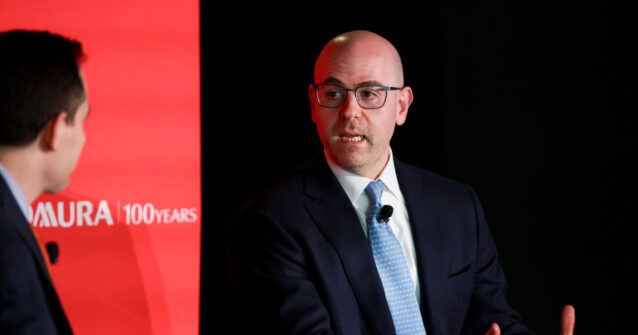
Federal Reserve Governor Stephen Miran argued Monday that inflation is significantly closer to the central bank’s two percent target than official measures suggest, making the case for faster interest rate cuts while systematically dismantling claims that tariffs are driving price increases.
In a speech at Columbia University, Miran said distortions in how the Fed measures inflation—particularly from lagging shelter costs and statistical quirks in service prices—create an illusion that price pressures remain elevated when underlying inflation is actually running near target.
“Keeping policy unnecessarily tight because of an imbalance from 2022, or because of artifacts of the statistical measurement process, will lead to job losses,” Miran said, warning that labor market deterioration “can occur quickly and nonlinearly and be difficult to reverse.”
Using what he called “market-based core ex shelter” inflation—which excludes both housing and imputed prices that don’t reflect actual consumer transactions—Miran calculated that underlying inflation is running below 2.3 percent, within range of the Fed’s goal.
Miran argued that elevated shelter inflation reflects supply-demand imbalances from two to four years ago rather than current economic conditions, since the Fed’s preferred price index lags behind actual market rents. Recent data on new tenant rents show extremely low increases, pointing toward sharp declines in measured shelter inflation ahead.
“We must be thoughtful in considering genuine underlying inflationary pressures,” Miran said. “Excess measured inflation is unreflective of current supply-demand dynamics.”
The Fed Governor also delivered a sweeping challenge to claims that tariffs are fueling inflation, arguing that economic theory, empirical evidence, and central banking doctrine all point away from trade policy concerns.
Miran presented detailed analysis suggesting tariffs will add at most 0.2 percent to consumer prices—which he described as “noise”—while systematically dismantling the economic studies that have predicted larger inflationary effects.
“If tariffs are the driver of recent inflation, then one would expect import-intensive core goods to see substantially more inflation,” Miran said. “In fact, total core goods prices have risen at approximately the same rate as import-intensive goods since the end of last year.”
Miran also compared U.S. goods inflation to other industrialized countries, noting that American price increases are comparable to Canada and the United Kingdom, slightly above the European Union, and below Mexico. “The U.S. doesn’t stand out in any direction,” he said.
The analysis represents a frontal challenge to widespread predictions that the Trump administration’s expanded tariff policies would significantly boost inflation. Miran, who was recently appointed to the Fed by President Trump, argued that conventional estimates of tariff pass-through to consumer prices suffer from fundamental flaws.
Drawing on academic research on trade elasticities, Miran argued that the burden of tariffs falls primarily on exporters rather than American consumers. Using product-level estimates of demand and supply elasticities, he calculated that for about 70 percent of import goods by value, the exporter bears at least 70 percent of the tariff incidence.
“As the largest trade deficit country, there are few substitutes, if any, for American demand, but many substitutes for potential supply,” Miran said, explaining why foreign producers would absorb most tariff costs rather than pass them through to U.S. buyers.
Miran cited research by Jackson Mejia showing that earlier studies of tariff pass-through during the U.S.-China trade conflict suffered from selection bias. These studies failed to account for how Chinese exporters avoided tariffs through transshipment—routing goods through third countries—and exploitation of duty-free import rules for low-value shipments.
“These studies suffer from bias from trade rerouting and de minimis exemptions,” Miran said, referring to research finding that up to 40 percent of product categories exposed to tariffs were affected by transshipment, with trade volumes approaching 25 percent for intermediate and capital goods.
Beyond questioning whether tariffs drive inflation, Miran invoked central banking doctrine arguing the Fed should ignore such effects even if they materialize. He compared tariffs to value-added taxes, which central banks traditionally “look through” rather than respond to with monetary policy.
“The standard practice for central bankers is to ‘look through’ a transient shock, as a one-time increase in the price level differs from a persistent shift to inflation,” Miran said. “Monetary policy achieves stable prices through balancing aggregate supply and demand; changes in prices stemming from relative tax adjustments—incidence aside—are not indicative of supply-demand imbalances.”
Miran acknowledged that in the short run, before threats of moving supply chains become credible, some pass-through might occur. But he argued this would prove temporary, with subsequent deflation as long-run economic elasticities assert themselves. “Not only would the increase in inflation be transitory, but likely so would the increase in the price level, meaning subsequent offsetting deflation,” he said.
The timing of recent goods inflation also conflicts with the tariff narrative, Miran argued. While core goods inflation in the Fed’s preferred price index appears to coincide with 2025 tariff implementation, the consumer price index shows the upturn began in mid-2024, before the administration’s expanded trade policies took effect.
Miran said he remains uncertain about what is actually driving elevated goods inflation, offering three possibilities: statistical noise in a volatile series, continued post-pandemic oscillations around a lower trend, or a longer-term shift toward higher goods inflation driven by supply chain restructuring for national security reasons that predates recent tariff policy.
“I accept I don’t know what’s driving higher goods inflation currently,” Miran said. “Pretending we have more knowledge than possible will stymie our understanding of reality.”
Miran also criticized how the Fed measures certain service prices, particularly portfolio management fees, which he said contribute meaningfully to reported inflation despite having no relationship to actual supply-demand pressures in the economy. Industry data from Morningstar shows asset management fees fell 6 percent in 2024, while the Fed’s price index recorded a roughly 20 percent increase based on rising assets under management.
“If PCE had instead matched industry data with a 6 percent decline, core PCE would have been about 40 basis points lower than officially reported,” Miran said. “Yet here we are, keeping interest rates too high because of the phantom inflation of portfolio advisory fees.”
Fed officials cut interest rates for a third consecutive time last week but signaled additional reductions are not guaranteed, with several policymakers expressing concern about inflation remaining above target. Miran has emerged as one of the more dovish voices on the Federal Open Market Committee, advocating for a quicker pace of rate cuts to move policy closer to a neutral stance that neither stimulates nor restricts economic growth.