American Citizen Tests Positive for Ebola in DR Congo
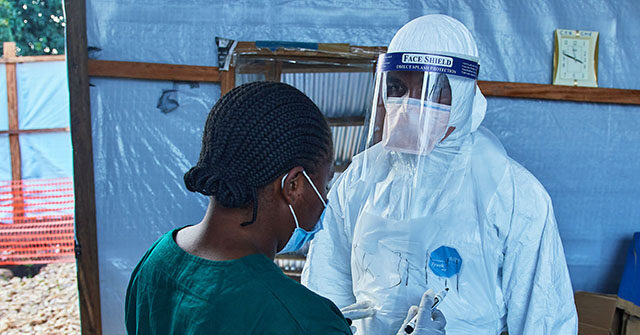
The U.S. Centers for Disease Control and Prevention (CDC) announced on Friday that an American citizen has contracted Ebola while performing humanitarian work in the Democratic Republic of the Congo (DRC).
CDC did not identify the Ebola patient but said it was coordinating with his employer, as well as U.S. and DRC health officials, to ensure the patient receives proper care, and there is no further transmission of Ebola.
The U.S. State Department said on Saturday it was aware of the incident, and was involved with supporting the patient.
On Sunday, a spokesman for the disaster relief organization Samaritan’s Purse told the leftist outlet New York Times (NYT) that the patient was an employee of the group. The patient has been receiving treatment since last Monday at one of the two Samaritan’s Purse treatment centers in Ituri province, the epicenter of the Ebola Bundibugyo outbreak.
According to the spokesman, the patient has been working on logistics from Ituri’s capital city of Bunia for the past month and was not directly involved with treating Ebola victims. Another source “briefed on the case” told the NYT that Samaritan’s Purse is working on evacuating the Ebola patient to a treatment center in Frankfurt, Germany.
Samaritan’s Purse is headed by evangelist Franklin Graham and is among the largest private organizations working on the Ebola outbreak. The group’s treatment center in Bunia has 50 beds and is currently being expanded to 70, while the other center is a 31-bed unit located in the town of Nyankunde. Samaritan’s Purse has over 70 personnel currently on the ground in the eastern DRC.
“Samaritan’s Purse has been on the frontlines of fighting Ebola for more than a decade, and we aren’t going to stop now. We are going to do everything we can to help save lives. We want people to know that God loves them, and they are not alone,” Franklin Graham said of the group’s DRC mission.
The patient discussed by CDC on Friday is the second U.S. citizen to contract Ebola during the current outbreak. The first was a doctor named Peter Stafford, who caught the dangerous disease while performing medical missionary work in May and was evacuated to Germany for treatment at the Charite University Hospital in Berlin.
Stafford’s wife Rebekah, who is also a doctor, and four children were kept in isolation as “high-risk contacts” until the entire family was discharged in June and returned to the United States.
Before they were evacuated to Germany, the Staffords were based out of Nyankunde, the same town where Samaritan’s Purse has a treatment center. In a June interview with Christianity Today, they said that based on their experiences, they fear the official Ebola infection and death totals are an undercount.
Peter Stafford said his own harrowing Ebola encounter began with a patient who died at Nyankunde Hospital with symptoms of the infamous disease, but he tested negative – possibly because DRC health officials misunderstood which strain of Ebola they were dealing with at the time. Test kits prepared for the more common Zaire strain do not detect the genetically different, and much less common, Bundibugyo strain. Many heath officials are worried the Bundibugyo outbreak spread widely before it was correctly identified.
“I was scared, and I didn’t handle it necessarily as well as I would have hoped. I had hoped that there was still some chance that it was something else, that it was the flu or maybe malaria,” Stafford said of learning, a few days after the incorrectly-tested patient died in Nyakunde, that he himself had contracted Ebola.
DRC health officials said on Monday that the outbreak is up to 1,926 confirmed cases and 702 fatalities. The latest update said Ebola has spread to two more provinces in the northeastern Congo, Haut-Uele and Tshopo.
Local health officials began tracing contacts from known Ebola patients to those two provinces in June, but no confirmed infections were reported until Monday, when the DRC announced one infection in Haut-Uele and four in Tshopo. The Haut-Uele patient died, as did two of those in Tshopo.
“Although current investigations suggest that all cases detected in these two provinces are primarily imported from Niania in Ituri, it is necessary and appropriate … to consider these two provinces as an epidemic zone,” the DRC National Institute of Public Health said.
On Friday, World Health Organization (W.H.O.) Emergencies Director Chikwe Ihekweazu estimated that 80 percent of new Ebola patients in Ituri are “coming outside of known contact lists,” which means they had no traceable connection to persons who were infected earlier.
Ihekweazu said this could mean the true number of infected persons could be up to four times larger than official estimates and models.
On the positive side, roughly 90 percent of all reported cases are still coming from four health zones in the Ituri province. Another bit of good news is that Ebola Bundibugyo appears to be less lethal than other strains – but that leads to the unfortunate complication that some people are attempting to treat Ebola at home, instead of reporting to health clinics.
Another complicating factor is the extreme political instability of the eastern DRC, where dozens of militant groups have long battled the DRC government, and each other, to control turf. Reuters reported on Monday that one of the most notorious insurgent groups, AFC/M23, is attempting to use the Ebola outbreak to prove it can effectively “govern” the territory it occupies.
AFC/M23 controls significant territory on the edges of the outbreak region, including two cities called Goma and Bukavu, which have reported four Ebola infections between them.
The insurgency put together its own health operation, and announced it was monitoring some 400 exposed persons with a 98 percent success rate – a far more aggressive contact tracing operation than the central DRC government has been able to manage.
Rebel forces flooded social media with videos of their leaders visiting laboratories and clinics to monitor the anti-Ebola effort, and made much of receiving assistance from neighboring Rwanda, which has long been accused of sponsoring the insurgency to break the DRC apart.
At the end of June, the insurgents announced the outbreak was “over” in the region under their control, with zero new cases detected for 21 days, even as Ebola Bundibugyo continued spreading through other parts of the Congo.
Some outside analysts said there were signs of the insurgents being more aggressive with quarantine procedures and inter-province travel bans than the main DRC government, although they noted that the area controlled by the rebels never had many Ebola cases to begin with, and they doubted the rebel administration could handle a major spike in cases.
“AFC/M23 is keen to demonstrate its capacity to function as a state and manage a public health crisis better than the Congolese government – but with only four cases recorded, it has been a limited test so far,” researcher Reagan Miviri told Reuters.