The Evolution of Iran
Vice President J.D. Vance hailed “very good progress” and a “major milestone” after the first round of high-level U.S.-Iran talks concluded in Switzerland on June 22, 2026. Mediators reported agreement on a 60-day roadmap toward a potential final deal, including Iran’s reported commitment to readmit International Atomic Energy Agency inspectors and address issues surrounding the Strait of Hormuz and reduction of conflict in Lebanon. Technical discussions continue this week.
Advertisement
These developments arrive against the backdrop of a transformed Iranian leadership. In March 2026, the Assembly of Experts selected Mojtaba Khamenei, second son of the late supreme leader Ayatollah Ali Khamenei, as Iran’s new supreme leader following his father’s death in late February during the opening phase of the Iran war. The 56-year-old cleric, born in Mashhad in 1969, has long operated as a low-profile but highly influential figure. He served for nearly two decades as a key representative in his father’s office, cultivated extensive patronage networks within the Islamic Revolutionary Guard Corps (IRGC), and maintained close associations with hard-line clerical and security elements, including study under the late extremist cleric Ayatollah Taqi Mesbah Yazdi.
Mojtaba has never held elected public office, delivered major public speeches, or cultivated a broad popular following. His public footprint remains deliberately minimal. Few photographs or videos exist. His behind-the-scenes role, nonetheless, positioned him as a central power broker. He survived the strike that killed his father and several family members, a circumstance Iranian state narratives have framed with symbolic significance, akin to his father’s own survival of an earlier assassination attempt. His selection reportedly reflected significant IRGC influence and signaled continuity with his father’s hawkish orientation. U.S. sanctions from 2019 already targeted him for alleged involvement in repressive domestic policies and regional destabilization activities.
Advertisement
This leadership transition occurs at a moment of acute regime stress, war losses, economic strain, and the need to consolidate authority after a violent rupture. Mojtaba enters the role with deep institutional ties to the security apparatus that could enable tighter control over hard-line factions. At the same time, the post-war environment creates structural pressures that no supreme leader can ignore indefinitely: reconstruction needs, sanctions relief calculations, and the imperative of regime survival.
Any new supreme leader must signal fidelity to revolutionary ideology and IRGC prerogatives to secure his position. Public rhetoric and appointments will likely emphasize continuity with the “resistance front” and resistance to perceived Western designs. Yet the same leader faces powerful incentives to pursue tactical pragmatism when core survival interests are at stake, precisely the pattern observed in prior Iranian leadership adjustments. Mojtaba’s profile suggests a security-centric style: potentially harsher domestic repression of unrest, but room for calibrated negotiations framed as strategic necessity rather than ideological retreat.
Advertisement
The question is not whether he will immediately transform the system, because he operates within powerful constraints. The question is whether the combination of inherited networks, post-conflict realities, and external incentives positions him as an agent capable of incremental, interest-driven adjustment.
Observers should, but critics won’t, exercise caution against over-relying on the surface language of negotiations, repeated pronouncements of prior ideological commitments, or the familiar toolkit of traditional statecraft to divine the underlying direction of Iranian policy. These elements often function as necessary theater for domestic power consolidation rather than transparent indicators of strategic intent. In systems where elite factions and security institutions hold inherent veto power, public signaling to hardliners can serve as essential cover for pragmatic adjustments pursued quietly where material incentives align. Apparent continuity in rhetoric may mask incremental behavioral change driven by economic or survival calculations.
Advertisement
Similarly, “engagement doctrine” failures should be ignored. Before Trump infused statecraft with realism, and multifaceted tangible achievable shared benefits, simple engagement was considered sufficient incentive for nations to conform to Western ideals and norms. The arrogance of the academic and professional foreign service class, who truly believed that simple inclusion in conversations would induce change, was palpable to critics, friends, and foes. Worse, “help” in the guise of corrupt aid and conditioned capital transfers often strangled economies and felt more like a hindrance.
The Abraham Accords process illustrates these realities. The United Arab Emirates and Bahrain moved rapidly and publicly into full normalization with Israel, generating immediate economic and security dividends. Saudi Arabia, by contrast, adopted a distinctly more deliberate and lower-profile tack. Riyadh continued to voice strong public support for the Palestinian cause and a two-state solution, avoided the high-visibility ceremonies of the initial Accords signatories, and maintained plausible deniability around incremental steps such as granting Israeli overflight rights, facilitating business and security exchanges, and allowing limited people-to-people contacts. Under Crown Prince Mohammed bin Salman, these moves advanced alongside ambitious internal modernization through Vision 2030, social liberalization, economic diversification, and regional repositioning, without triggering immediate domestic upheaval or fracturing key alliances. Saudi Arabia thus progressed in the direction of reform and closer ties while managing optics differently from its neighbors, demonstrating that divergent public postures can coexist with substantive directional movement when leadership prioritizes long-term achievable incentives over ideological purity.
Advertisement
Similar dynamics are likely at work in Tehran. Mojtaba’s public signals to the IRGC and hard-line clerical networks may be indispensable for consolidating authority, even as post-war realities and external incentives create space for pragmatic recalibration behind the scenes.
The deeper challenge admittedly remains the Islamic Republic’s foundational ideological and theological orientation which forms a worldview rooted in revolutionary anti-imperialism, explicit hostility to the existing international order, and a self-conception that frames confrontation with the United States and Israel as existential and near sacred duty. This orientation has shaped institutions, resource allocation, and elite socialization for decades. Critics rightly contrast any reform narrative against this reality. Most presume that a system built on ideological rage is incapable of adapting or structural transforming without regime collapse. History demonstrates, however, that regimes with comparably intense ideological foundations have moderated when the material costs of ideology became unsustainable and the benefits of pragmatic engagement became compelling.
Advertisement
The Abraham Accords provide the clearest modern regional example. Normalization between Israel and several Arab states succeeded without regime change because concrete economic and security incentives, billions in trade growth, investment vehicles, technology partnerships, and job creation reordered preferences. Participants gained access to an expanding table of prosperity whose returns demonstrably outweighed the costs of continued isolation or confrontation.
Applied to Iran, the same logic holds under the right conditions. The current mediated framework offers limited relief in the form of sanctions adjustments and potential reconstruction support that the regime has paid dearly to obtain through conflict and proxy commitments. These remain marginal, however, relative to the scale of gains available through deeper integration into regional economic architectures. If leadership perceives that sustained confrontation imposes compounding domestic costs (economic stagnation, social discontent, reconstruction burdens) while pragmatic steps unlock larger returns, adjustment becomes rational even within an intense ideological framework.
Mojtaba’s tenure will test this proposition in real time. As a figure with strong IRGC and hard-line clerical ties, he possesses the institutional capital to manage internal pushback against any pragmatic moves. His low public profile and survival narrative may afford some maneuvering room. The decisive variable will be whether external incentives, credible pathways to economic relief and integration, align with regime survival calculations strongly enough to shift behavior without requiring wholesale ideological renunciation. Ideological regimes adapt when survival imperatives dominate; they rarely do so absent such pressures.
The Switzerland talks and the new leadership configuration therefore represent more than traditional statecraft procedural milestones. They constitute a live experiment in whether sustained maximum economic, military, and political pressure, followed by structured incentives, can produce measurable behavioral change even in a system whose foundational commitments appear wholly resistant to reform. The answer will depend less on traditional statecraft — i.e., declaratory language, milestone achievement, diplomacy, and domestic communication than whether Iran’s leadership calculates that the returns from pragmatic engagement exceed the costs.
The elephant in the room is standing on the throat of Iran but offering more than a future gasping for breath. It is up to Mojtaba whether Iran will realize or squander the opportunity.
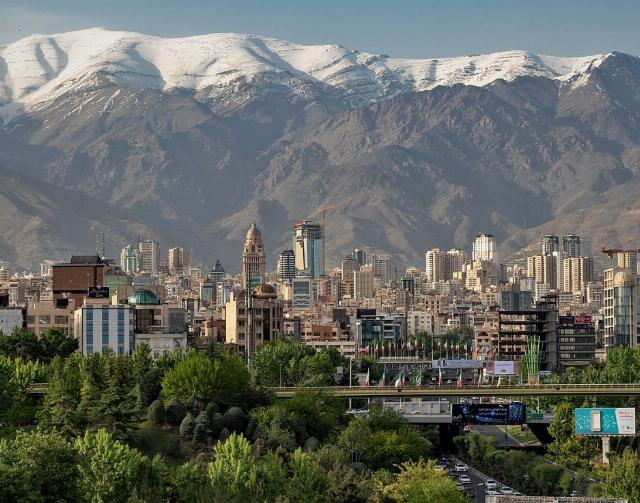
Image: Ninara via Wikimedia Commons, CC BY-SA 4.0.
