JD Vance: Nick Fuentes ‘can eat shit’
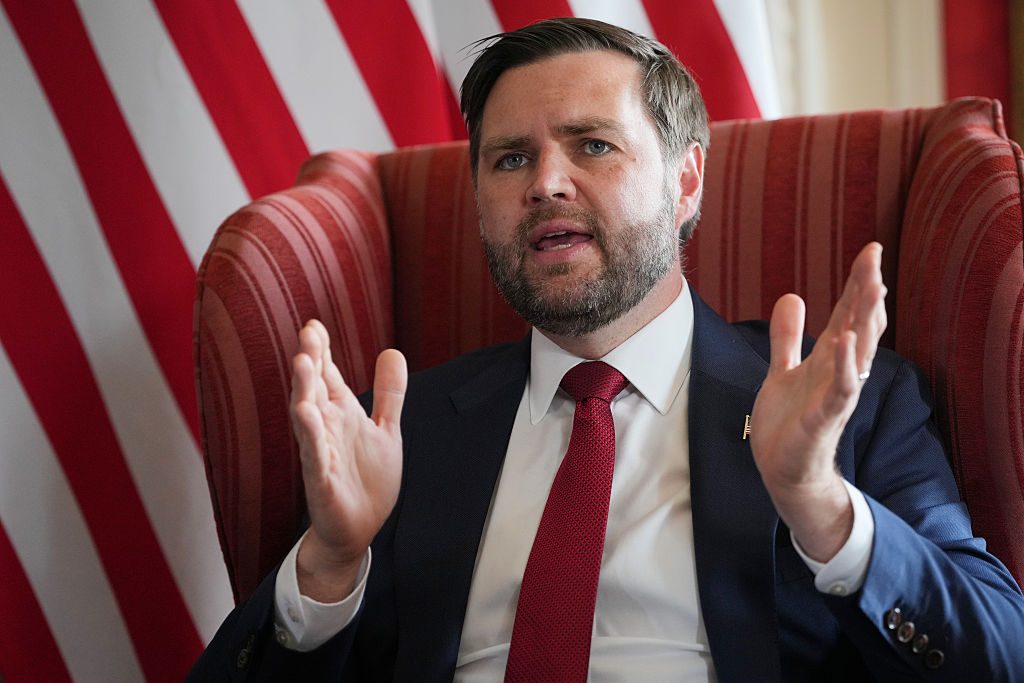
JD Vance has for months faced mounting pressure to censure Nicholas J. Fuentes and his army of boisterously racist and antisemitic supporters, known as Groypers. Speaking exclusively to UnHerd at the vice president’s residence on Friday, he doesn’t mince his words. “Let me be clear,” he says. “Anyone who attacks my wife, whether their name is Jen Psaki [the former Biden press secretary] or Nick Fuentes, can eat shit. That’s my official policy as vice president of the United States.”
“Antisemitism, and all forms of ethnic hatred,” he says, “have no place in the conservative movement. Whether you’re attacking somebody because they’re white or because they’re black or because they’re Jewish, I think it’s disgusting.” If that were the end of it, Vance would be a typical politician of an earlier age, and we likely wouldn’t be sitting down for an interview in his library at the Naval Observatory in Washington.
Vance isn’t typical. About to take off for the Christmas vacation, America’s first millennial veep is dressed in a crisp button-down and fleece vest with dark denim. His getup strikes a sharp contrast with his old-timey surroundings, lined with leather-bound books by and about vice presidents. His own memoir, Hillbilly Elegy, is among the newer additions; a medieval-style painted crucifix stands out from the shelves.
More to the point, Vance is acutely sensitive to subterranean political and cultural shifts which until recently only registered on the seismometer known as the internet, but which are starting to remake the world aboveground. Fuentes — who has called Second Lady Usha Vance a “jeet” and labeled the vice president a race-traitor for marrying her — is but one jagged spike on the seismic wave. And to Vance, not even an especially pronounced one.
Says Vance: “I think that Nick Fuentes, his influence within Donald Trump’s administration, and within a whole host of institutions on the Right, is vastly overstated, and frankly, it’s overstated by people who want to avoid having a foreign-policy conversation about America’s relationship with Israel.” That is, the Hitler-praising Groyper king functions as a useful foil for pro-Israel hard-liners in the Right’s raucous internal debate over America’s alliance with the Jewish state.
The debate descended into out and out civil war last week at a gathering of Turning Point USA, the organisation founded by the late Charlie Kirk, with Ben Shapiro denouncing the podcaster and Vance ally Tucker Carlson — and being denounced, in turn, by Steve Bannon and Megyn Kelly, representing the insurgent Israel-critical camp. The vice president tells me he hasn’t yet watched the dueling speeches but thinks it’s healthy for the debate to continue. In his own address to TPUSA Sunday, Vance glossed over the controversy, rejecting “purity tests.”
Tucker Carlson, for example, gets a robust defense from Vance. “Tucker’s a friend of mine,” he tells me. “And do I have disagreements with Tucker Carlson? Sure. I have disagreements with most of my friends, especially those who work in politics. You know this. Most people who know me know this. I’m [also] a very loyal person, and I am not going to get into the business of throwing friends under the bus.”
He goes on: “The idea that Tucker Carlson — who has one of the largest podcasts in the world, who has millions of listeners, who supported Donald Trump in the 2024 election, who supported me in the 2024 election — the idea that his views are somehow completely anathema to conservatism, that he has no place in the conservative movement, is frankly absurd. And I don’t think anybody actually believes it.”
What’s really afoot, he thinks, is “gatekeeping”, and people are “trying to settle their own ideological scores” — especially with respect to Washington’s policies in the Middle East.
“I happen to believe that Israel is an important ally, and that there are certain things that we’re certainly going to work together on,” Vance says. “But we’re also going to have very substantive disagreements with Israel, and that’s OK. And we should be able to say, ‘We agree with Israel on that issue, and we disagree with Israel on this other issue.’ Having that conversation is, I think, much less comfortable for a lot of people, because they want to focus on Nick Fuentes.”
Fuentes thus refracts — and, with his noxious rhetoric, distorts — a legitimate discontent. Says Vance: “99% of Republicans, and I think probably 97% of Democrats, do not hate Jewish people for being Jewish. What is actually happening is that there is a real backlash to a consensus view in American foreign policy. I think we ought to have that conversation and not try to shut it down. Most Americans are not antisemitic, they’re never going to be antisemitic, and I think we should focus on the real debate.”
What about Fuentes’s promotion of an overt white racial politics, complete with liberal use of the N-word? Is Vance worried by that stuff? Yes — but he believes there have been far worse offenders who got away with racial politics in recent years, because their version of it was aligned with elite prerogatives and progressive moral hierarchies.
“Let’s say you believe, as I do, that racism is bad, that we should judge people according to their deeds and not their ethnicity,” he later adds. “Is Nick Fuentes really the problem in this country? He’s a podcaster. He has a dedicated group of young fans, and some of them have been shitty to my friends and family” — not least, Mrs Vance. “Does that annoy me? Of course. But let’s keep some perspective. For the past five to 10 years, I’ve watched one-half of our political leadership go all in on the idea that discriminating against whites in college admissions and jobs is not just OK, but affirmatively good.”
He goes on: “If you believe racism is bad, Fuentes should occupy one second of your focus, and the people with actual political power who worked so hard to discriminate against white men should occupy many hours of it.”
Then, too, Right-wing racialism is, in large part, a reaction against bipartisan elites who for decades maintained a porous border, with the flow of newcomers surging to a flood under the Biden administration. “That necessarily leads to the destruction of social cohesion in the country that I love,” he says. “Ethnic rivalry and balkanisation is the inevitable consequence of these things. You don’t have to think it’s a good thing. I certainly don’t, but it’s a predictable consequence.”
But wouldn’t Vance’s own children — Ewan, Vivek, and Mirabel — be treated with contempt in the Groypers’ ideal America? The difference, for Vance, is once more about possession of actual power to effectuate policy. “If you look at my kids — half white, half-South Asian — they were among the most discriminated against in the entire elite-college and jobs hierarchy under Joe Biden. And the Left explicitly promises to bring that hierarchy back if they ever again get power.”
Calling out some of his likely opponents in the 2028 contest, he adds, “It pisses me off that Fuentes calls my kids ‘jeet,’ and I appreciate that Ro Khanna would never do that. You know what pisses me off a million times more? That Ro Khanna, AOC, and Chris Murphy would deny them jobs and opportunities because they have the wrong skin color.” (Khanna, the Indian-American California lawmaker, has said he’d be “fine” with his kids being disadvantaged by race-based affirmative action.)
“If you believe racism is bad, Fuentes should occupy one second of your focus.”
All of this raises a deeper question: who counts as a “true” American? For many on the hard Right, the fashionable answer is “Heritage Americans”. That category excludes anyone who arrived after the initial wave of Anglo settlement, sometimes defined as narrowly as the Mayflower and its descendants. This treats as lesser citizens not just recent arrivals from Asia, Africa, and Latin America, but also Ellis Islanders like Italians and Jews, possibly even the Scotch-Irish.
What does Vance make of Heritage Americanism? He worries it poses more questions than it answers. “Is a Heritage American somebody who’s from the late 17th century [or] the late 18th century?,” the vice president asks. He tries to strike a balance between credal nationalism — Americans are people who believe in American ideals like liberty and equal justice — and thicker notions of belonging, emphasising shared language, culture, and history. Both, he says, have something to them.
The Heritage Americanists, he argues, grant too little to the credal aspect. “We take ourselves to be on a very unique national project,” he says, “a project that is very unusual compared to what the European nations were doing at the time, to what other nations in the world were doing at the time. We believe in the fundamental dignity and equality of every human being.”
Pure credal nationalists, meanwhile, forget that people are more than their abstract commitments: “Do I think that somebody who came to the United States 15 minutes ago has the same understanding of American culture and American identity as somebody whose family has been here for 10 generations? No. Of course, I don’t believe that, because human beings are complex, and part of knowing a culture isn’t just believing certain things, but actually living in a culture, absorbing it.”
Contra the Heritage Americanists, Vance believes that culture and identity are transmissible over time. “The racial nationalists — or anybody else who wants to say that it’s purely genetic or purely having some connection to the late-17th-century Mayflower descendants — what they ignore is that people can accumulate it over time. [It] doesn’t happen overnight, but the idea that we have to be a static nation of people who came or who are descendants of those who came on the Mayflower, I think that’s not consistent with American practice, either.”
I ask him if he’d countenance differing legal treatment for the Mayflower descendant versus the person who received his passport 15 minutes ago. “No, no!” he replies. “Whether you got your citizenship an hour ago, or you got your citizenship or your family got citizenship 10 generations ago, we have to treat all Americans equally.”
But: “I also think that we have to accept that if you overwhelm the country with too many new entrants — even if they believe the right things, even if they’re fundamentally good people — you do change the country in some profound way. . . . The problem with American immigration over the four years of the Biden administration, [was] that we let in too many people, too quickly. And if the numbers were much smaller, and we had tried to select for people who were much better at assimilating into American culture, I don’t think that everybody would be looking around and saying, ‘What the hell is going on?’ ”
For a much longer span, of course, it was religion that defined Western identity, with Christendom encompassing a patchwork of nations otherwise at each other’s throats. Can faith still serve as a sort of moral glue today, in societies that are fast descending into what used to be called the “Blade Runner scenario”, after director Ridley Scott’s 1982 sci-fi dystopia that portrays 21st-century Los Angeles as a city divided among polyglot ethnic formations arrayed tensely against each other?
“When I talk about America having some common culture,” Vance says, “I think Christianity is very much at the heart of that. With the exception of Jefferson and a couple of others, most of our Founding Fathers were devout Christians. . . . There’s a lot about Christianity that is very useful, even if you’re not a Christian. I think Christianity gives us a common moral language. You saw that in the Civil Rights Era, you saw that during the Civil War. It was one of the ways that we were able to actually come together as a nation, post-Civil War: that shared Christian identity.”
And yet, religion often clashes with contemporary politics. Vance’s own spiritual leader as a Roman Catholic, Pope Leo XIV, takes a much more universalist approach to questions of immigration and assimilation, and has reportedly deputised the US bishops to counter the Trump administration’s hawkish border policies. How does Vance reconcile his religious leader with his political positions?
While he welcomes the Vatican’s voice in international affairs, he thinks of its counsels as one moral lens that must be applied alongside other perspectives. The Bishop of Rome “is not going to be looking at an immigration policy with the same prudential lens that I have on.” The “dignity” of would-be migrants is part of it. So are “the wages of workers” and “the social cohesion of the United States of America.”
“Balkanisation and ethnic hatred,” reflected in the rise of the likes of Fuentes & Co., are thus mostly symptoms, to Vance’s mind. Moralising denunciation, in his telling, will do little to address the underlying disease. Critics will no doubt see his reluctance to draw brighter red lines as a political strategy: taking care of his Right flank ahead of a 2028 presidential campaign.
He is certainly careful about whom to denounce and on which grounds. Still, I walk away from JD Vance’s home concluding that the position he espouses — the need to renegotiate questions of immigration and belonging to avoid a descent into even worse ethnic strife — is a sincerely held expression of his worldview. Whether it can be translated into a responsible politics will be the big test of the next few years.
UnHerd subscribers can read the full transcript of Sohrab Ahmari’s interview with JD Vance here.