Trump Called Democrats Communists 81 Times in Two Weeks. History Knows This Technique.
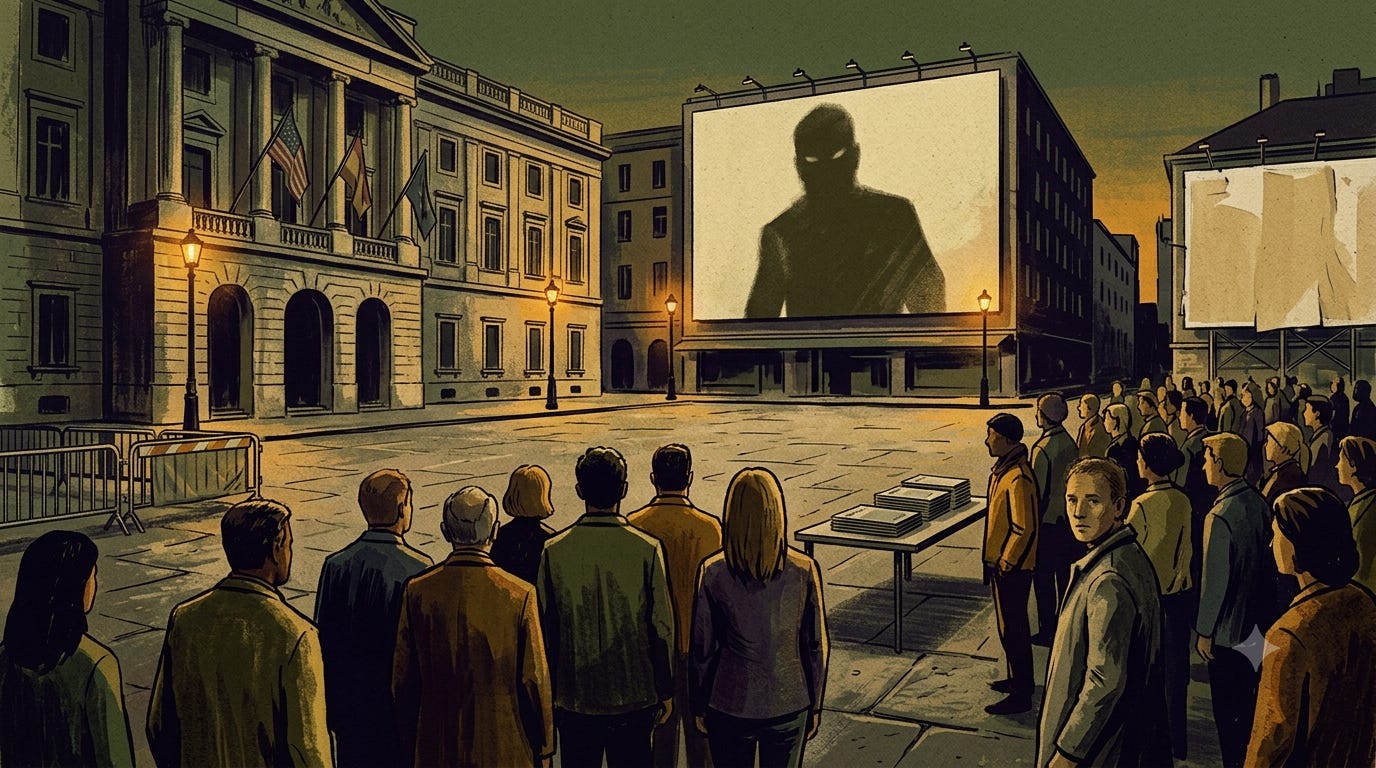
During the September 2024 presidential debate, Donald Trump said this:
“In Springfield, they’re eating the dogs. The people that came in, they’re eating the cats. They’re eating the pets of the people that live there.”
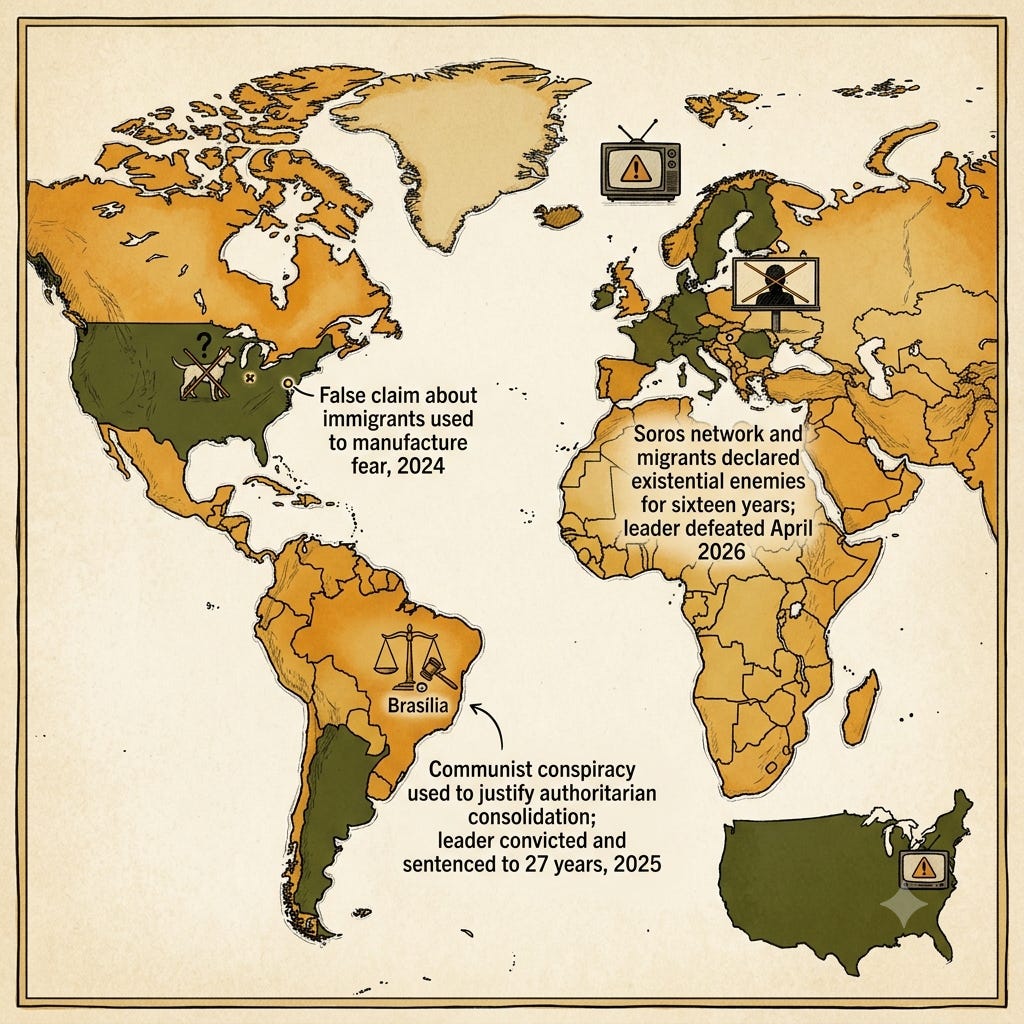
The moderator fact-checked him on air. Springfield’s city manager told ABC there were no credible reports of pets being harmed by immigrants. Local police denied it. The city set up a webpage debunking the claims. The woman whose Facebook post had started the rumor retracted it. PolitiFact named the claim its 2024 Lie of the Year.
Trump kept repeating it.
That is the technique in its simplest form. The claim does not need to be true. It needs to be vivid, it needs to be frightening, and it needs to attach a face to the fear. Haitian immigrants in Springfield became the enemy not because there was evidence they had done anything wrong but because the accusation was politically functional. The debunking spread the story further. The repetition made the claim feel substantial. The people of Springfield — a city that had welcomed Haitian workers into its factories and its economy — faced bomb threats and evacuations at schools and government buildings in the weeks that followed.
This is where the manufactured enemy always starts. Not with a grand ideological declaration. With something small and visceral and impossible to fully disprove. They’re eating the dogs. Soros is funding an invasion. Antifa burned the cities. Communists have infiltrated the Supreme Court. Each claim plants a seed of fear that grows regardless of whether the soil is true.
On the evening of July 16, 2026, President Trump addressed the nation in primetime on a grander version of the same theme. Most networks refused to carry the speech live. Fox News aired it. He claimed that China had stolen the voter data of 220 million Americans and used it to manipulate public opinion against him in 2020. He said foreign actors had compromised American elections. He called for FBI investigations and prosecutions. He announced a White House website posting declassified documents that he said proved the truth.
The documents did not support Trump’s central claim. The intelligence community’s own assessment, signed off by agencies he had appointed, concluded that China had not attempted to change vote totals or fake ballots. Internal emails released with the documents showed Trump-appointed officials pressing analysts to reframe that conclusion, and analysts pushing back in writing. John Solomon — a conservative commentator Trump had recently brought onto his White House staff — said afterward that “the intelligence community has zero evidence that someone has flipped — that a foreign power flipped — a vote in 2020, 22 or 24.”
Trump presented documents as proof of foreign interference. The documents did not provide that proof.
The speech was not designed to establish a fact. It was designed to establish a threat. And the timing is not accidental. The party that holds the White House typically loses seats in midterm elections — a historical pattern that terrifies Trump’s strategists. His record on the issues voters care most about — the cost of living, housing, healthcare — has not generated enthusiasm. The economy cannot carry the midterms. So he needs an enemy. He needs an emergency so large and so immediate that ordinary political accountability is suspended. A president under attack by existential foreign and domestic enemies cannot be held responsible for grocery prices.
The same week, Secretary of State Marco Rubio convened a summit of 66 nations to address what he called the resurgence of left-wing political violence. The event focused almost entirely on the left, with no comparable attention given to right-wing political violence or the events of January 6th. Rubio called leftists “enemies of civilization” and “an encroaching darkness.” He said they were motivated by “poisonous resentment cloaked in the language of equality and justice.” Stephen Miller said that when leftists claim their civil rights are being violated, they are lying, and their appeals “must fall on deaf ears.” The State Department announced visa restrictions against members of what it called far-left terrorist groups.
Reuters had already documented that Trump invoked communism 81 times in the two weeks between June 23rd and July 8th. At Mount Rushmore on July 4th, he called communism a greater threat to America than World War I, World War II, Pearl Harbor, and September 11 combined. Focus groups conducted by his team showed the message strongly energized his base.
None of this happened in isolation. Since January 2025, the administration had declared a national emergency at the southern border, invoking the Alien Enemies Act of 1798 — a statute previously used only during declared wars — to speed deportations without individual hearings. It had designated cartels as foreign terrorist organizations under counterterrorism statutes. It had targeted law firms by executive order, restricting federal contracts for firms whose lawyers had previously opposed Trump. It had threatened Harvard’s tax-exempt status. It had described NGOs assisting migrants as enabling invasion.
Political scientists who study democratic backsliding — Ruth Ben-Ghiat, Steven Levitsky, Timothy Snyder — have noted that authoritarian movements almost always expand their enemy lists over time. It starts with one group. Then it incorporates the institutions that try to protect them: the lawyers, the judges, the journalists, the academics, the civil servants. The important fact is not which group is named first. The important fact is that the list keeps growing, and that growing list keeps justifying growing powers.
This is not chaos. It is a technique. And history has seen it before.
This is the seventh installment of The Strongman’s Playbook. It is a ten-part series examining how authoritarian leaders consolidate power once they have won office. One technique per installment. The historical cases do the argumentative work.
If you subscribe now, you can follow the full series as it unfolds and read the previous series, The Fall, in the archive. Ten parts on how authoritarian regimes end. Together, the two series tell the complete story.
New subscribers get 20% off the first year:
Viktor Orbán built his government on two manufactured enemies, constructed with care, maintained with discipline, and designed to be permanent.
The first was George Soros. Orbán and Soros had history — Soros had funded Orbán’s own university education in Oxford in the 1980s through a foundation supporting young Central Europeans. By 2010, that relationship was long over. Soros backed the Open Society Foundations, which funded civil society organizations, independent media, and academic institutions across Central Europe. In a country where Orbán was systematically capturing media, marginalizing NGOs, and reshaping universities, the Open Society Foundations were an obstacle. Orbán solved this by turning Soros into a symbol.
The campaign escalated deliberately. By 2017, the Hungarian government was running billboard campaigns featuring Soros’s face with the slogan “Let’s not let Soros have the last laugh.” Government media described a “Soros plan” to flood Hungary with migrants, undermine Christian values, and destroy national sovereignty. The accusation was unfalsifiable. Any denial could be dismissed as what a Soros agent would say.
The practical consequences were substantial. Hungary passed the “Stop Soros” laws in 2018, criminalizing assistance to asylum seekers and imposing punishing requirements on NGOs receiving foreign funding. The Central European University, long associated with Soros’s support, was effectively expelled from Hungary in 2019. Hungarian academics connected to Open Society funding found their positions increasingly difficult.
 The illustration I used for “Hungary’s Victory Is Real. And So Are the Lessons Trump Will Draw Before the Midterms” in The Planet on April 13, 2026
The second enemy was migrants. The 2015 migration crisis gave Orbán real material. But he transformed a policy problem into an existential civilizational threat. Migrants were not people fleeing war. They were an invasion. They were instruments of the Soros plan to replace the European population. A fence went up within weeks. A referendum was called. The emergency did not end when the immediate crisis eased — because the point was never to solve the problem. The point was to maintain the state of emergency the problem justified.
It is worth noting something about why this framing worked in Hungary specifically. Hungarians lived under actual communist rule until 1989 — within living memory for much of the electorate when Orbán came to power. The fear of foreign ideological influence, of hidden networks, of institutions captured by outside forces, was not invented. Orbán activated something real in the collective memory of a country that had genuinely experienced those things. That historical substrate does not exist in the United States in the same way. The Reuters focus groups confirm it: the communist framing resonates less with voters under fifty who did not live through the Cold War.
Orbán governed for sixteen years on the strength of those manufactured enemies. In April 2026, he was defeated in Hungary’s parliamentary elections. His successor, Péter Magyar, won a two-thirds majority and moved quickly: resuming cooperation with the European Union, joining the European Public Prosecutor’s Office, launching corruption investigations into the previous government, abolishing institutions Orbán had created to entrench his power, passing constitutional amendments that removed Orbán-aligned officials from key positions.
And here is the detail that arrived today, as I write this piece. Reuters reported this morning that Orbán has announced a “resistance movement” against Magyar’s new government, accusing him of establishing a “tyranny” and claiming Hungary is no longer a democracy. Prosecutors had raided Fidesz offices as part of corruption investigations.
Think about what that means. For sixteen years, Orbán portrayed NGOs, Brussels, George Soros, migrants, and the opposition as existential threats to Hungary. Now that he has lost power, he is portraying the new democratic government — the one elected by Hungarian voters — as the existential threat. The manufactured enemy technique does not retire when its practitioner loses office. It continues in opposition. It is the only political language Orbán knows.
This also contains a note of genuine hope, though a cautious one. Orbán’s manufactured enemies proved politically effective while he controlled the state, but they proved surprisingly fragile once voters rejected him. The anti-EU posture largely disappeared. Hungary resumed cooperation with Brussels. Reforms began dismantling captured institutions. Enemy narratives can be extraordinarily durable while a leader controls the state. But they are not necessarily permanent once democratic institutions regain their independence.
Dismantling sixteen years of captured institutions, however, has proved far harder than winning the election itself. That asymmetry — quick to build, slow to undo — is the warning Hungary offers the United States.
Jair Bolsonaro built his political career on a communist threat that was both everywhere and nowhere.
The Brazilian left had real political power. But Bolsonaro’s communist threat was not the Workers’ Party’s actual policies. It was a comprehensive conspiracy: communists had infiltrated the universities, the media, the judiciary, the electoral commission, and every cultural institution. Every body that exercised independent authority over the executive became, in his framing, a node of the communist network. The Supreme Court was communist. The electoral system was communist. Journalists were communist propagandists. NGOs were communist fronts.
This framing had a precise function. It meant that any institutional check on Bolsonaro’s power could be dismissed not as a legitimate exercise of democratic oversight but as the enemy working against the nation. When the Supreme Court ruled against him, it was not applying the law. It was acting on behalf of the communist conspiracy. The logic was self-sealing. Evidence that the threat was real was, obviously, evidence. Evidence that it was not real — the absence of communist policies in a functioning market economy, the electoral commission’s clean record, the independence of the courts — was itself proof of how thoroughly the communists had infiltrated the institutions supposed to verify such things.
 Before Bolsonaro’s 27-year prison sentence: President Trump greets Brazil’s President Jair Bolsonaro, March 7, 2020, upon his arrival to Mar-a-Lago in Palm Beach, Fla. (The White House from Washington, DC)
Bolsonaro lost the 2022 election to Lula by less than two percentage points. His supporters, who had been told for years the electoral system was communist-controlled, and any result against Bolsonaro must be fraudulent, stormed Congress, the Supreme Court, and the Presidential Palace on January 8, 2023. In September 2025, Brazil’s Supreme Court convicted Bolsonaro on five counts — including attempted coup d’état and attempted abolition of democratic rule — and sentenced him to 27 years and 3 months in prison. Because of his health, Brazil’s Supreme Court has allowed him to serve the sentence under house arrest with strict conditions: an ankle monitor, no social media, no cellphone, visitors only with court approval, police monitoring of the residence. The court extended those conditions again this month.
The institutions held long enough to deliver the verdict.
I have a friend from Albania who grew up under Enver Hoxha’s communist state — one of the most closed and repressive regimes in postwar Europe. She told me what it was like: she and her family and practically everyone they knew understood perfectly well how many lies they were being told. They knew it partly because they could illegally watch Italian television. They could see how much better life was outside the borders of Hoxha’s communist paradise.
And yet, she said, once the system was fully in place, it was extraordinarily difficult to dismantle. Everyone knew it was false. The institutions were rotten through. And still it held, decade after decade, because the cost of resistance was too high and the mechanisms so interlocked that each individual calculation said: not now, not me, not yet.
That is what I think about when I watch America. I see genuine signs of hope — courts pushing back, grand juries refusing to indict, elections still contested, journalists still reporting. I am optimistic by nature. But I also see how patient the strategy is: each step that meets too much resistance is simply withdrawn and tried again from a different angle, while the easier targets are flipped one by one. Each institution captured makes the next one harder to defend, because the captured institutions are turned toward weakening what remains.
There is a detail in the Reuters reporting worth holding onto. The communist message resonates less with independents and younger voters who did not live through the Cold War. That observation matters. The manufactured enemy is most powerful when it connects to genuine historical memory and genuine historical fear. For voters who lived through the Cold War, communism carries a weight it does not carry for anyone under fifty.
But the technique does not require persuading everyone. It requires persuading enough, for long enough, to change what kinds of power can be exercised and what kinds of opposition can be sustained. The Springfield claim about Haitians eating dogs was fact-checked live on national television. Trump kept repeating it. Springfield faced bomb threats. The manufactured enemy does not require belief. It requires circulation.
The enemy is manufactured to justify attacking institutions. The institutions are attacked to prevent them from exposing the enemy as manufactured. The circle closes.
Part 8 is next. We move to buying the base.
Please like, share, and support.
Stay inspired,
Alexander
This is the seventh installment of The Strongman’s Playbook — a ten-part series examining how authoritarian leaders consolidate power once they have won office. One technique per installment. The historical cases do the argumentative work.
If you missed the previous series, The Fall, it is all in the archive: ten parts on how authoritarian regimes end. Together, the two series tell the complete story — how power is seized, and how it is eventually lost.
If you know an American who is watching the news and wondering how this is supposed to end, send them Part 1. The courts are where the story begins.
New subscribers get 20% off the first year.
 More from Alexander Verbeek:
If you missed part 6 of The Strongman’s Playbook:
How Trump's America Is Using History the Way Every Strongman Uses It: As a WeaponAlexander Verbeek·Jul 12
On the evening of July 4, 2026, fireworks lit the sky over Washington. On the same afternoon, while the crowds were gathering, the White House quietly posted a 162-page document to its website. The report was titled “Saving America’s Story.” It was aimed at the Smithsonian’s National Museum of American History, and it was the most explicit statement yet…
Read full story☕️ Daybreak Notes & Beans: Every morning before dawn, I search for the best news you didn’t see. Science breakthroughs, conservation wins, human kindness, and beauty — delivered in time for your first coffee. Published most days of the week, positive, and unapologetically hopeful.
 The Shark That Lived Through the Renaissance, the Industrial Revolution, and YouA shark that was already old when Shakespeare was born…3 days ago · 93 likes · 26 comments · Alexander Verbeek
✍️ More: where I publish 🧭 Morning Compass and 🎙️ Morning Comments
🧭 The Morning Compass is the best way to quickly catch up on the more serious news that’s going on during your first coffee. I also share what to expect in today’s news, what happened on this day in history, what I recently published, what I captured, and what I stumbled upon.
🎙️ My Morning Comments are short videos where I dive a little deeper into the story that stood out most that morning.
 🧭 Spain Won. Trump Lost. The War Got Worse. The Week Only Just BeganWhat’s the news…4 days ago · 97 likes · 28 comments · Alexander Verbeek
Screen Skills: A tech-newsletter for non-tech people. Short, practical digital literacy guides for people who want to use their devices with more confidence. No jargon, no condescension. Usually, I publish it every other working day.
 If your phone is stolen abroad, here is exactly what to doPicture this. You are finally in that city you have been wanting to visit for years. You are standing on a busy square, phone in hand, checking the map to find the restaurant you booked for tonight. Someone brushes past you, and within a second, the phone is gone. You spin around, but there is no one to chase…2 days ago · 39 likes · 5 comments · Alexander Verbeek
🎒 The Curious Wanderer
I write The Curious Wanderer for people who like to move through the world slowly and look at it carefully. If that sounds like you and you enjoy culture, history, and travel storytelling, you may want to join my travel newsletter. Please subscribe below; there is a paid option for those who want to support the writing directly.
 A Morning in the Zeepeduinen: Drought, a Viking Fortress, and a Couple Who Walk 30 Kilometers Twice a WeekDear friends…3 days ago · 54 likes · 12 comments · Alexander Verbeek
Notes and sources
Springfield “eating the dogs” claim and debunking: ABC News — https://abcnews.com/Politics/trump-pushes-false-claim-haitian-migrants-stealing-eating/story?id=113570407
Springfield named PolitiFact’s 2024 Lie of the Year: PolitiFact — https://www.politifact.com/article/2024/dec/17/theyre-eating-the-pets-trump-vance-earn-politifact/
Springfield bomb threats following claims: BBC — https://www.bbc.com/news/articles/c1l4g6g5d97o
Trump primetime address on election integrity, July 16, 2026: AP News — https://apnews.com/article/6b9a3a0d2c010d98b7f526991901e114
Trump invokes communism 81 times in two weeks: Reuters, July 8, 2026 — https://www.reuters.com/world/us/trump-team-tests-anti-communist-message-midterms-rhetoric-intensifies-2026-07-08/
Rubio summit, “enemies of civilization”: The Guardian, July 16, 2026 — https://www.theguardian.com/us-news/2026/jul/16/political-violence-event-trump-marco-rubio
Border national emergency declaration, January 20, 2025: White House — https://www.whitehouse.gov/presidential-actions/2025/01/declaring-a-national-emergency-at-the-southern-border-of-the-united-states/
Alien Enemies Act invocation, March 2025: White House — https://www.whitehouse.gov/presidential-actions/2025/03/invocation-of-the-alien-enemies-act-regarding-the-invasion-of-the-united-states-by-tren-de-aragua/
Executive orders against law firms: Reuters, March 2025 — https://www.reuters.com/world/us/trump-signs-executive-order-against-law-firm-jenner-block-2025-03-25/
Orbán defeated, April 2026 Hungarian election: Reuters — https://www.reuters.com/world/europe/orban-ousted-after-16-years-hungarians-flock-pro-eu-rival-2026-04-12/
Magyar government dismantling Orbán system: Financial Times — https://www.ft.com/content/8a70ebb7-693d-497a-9b69-559ccbb7eee6
Orbán launches resistance movement against Magyar government, July 22, 2026: Reuters — https://www.reuters.com/world/hungarys-viktor-orban-urges-supporters-stand-up-against-pm-magyars-tyranny-2026-07-22/
Orbán’s Stop Soros laws and CEU: European Commission Rule of Law Report, Hungary — https://commission.europa.eu
Bolsonaro convicted, 27-year sentence: CNN — https://www.cnn.com/2025/09/11/americas/brazil-jair-bolsonaro-coup-trial-verdict-latam-intl
Bolsonaro serving sentence under house arrest: Brazil Supreme Court — https://noticias.stf.jus.br/postsnoticias/stf-mantem-ex-presidente-bolsonaro-em-prisao-domiciliar/