Is There Still a New England?
Humans thrive upon historical continuity and knowing their communities are built with deep roots. But histories based on theories of power dynamics destroy an unseen social glue, leaving behind those who understood their place through a shared history.
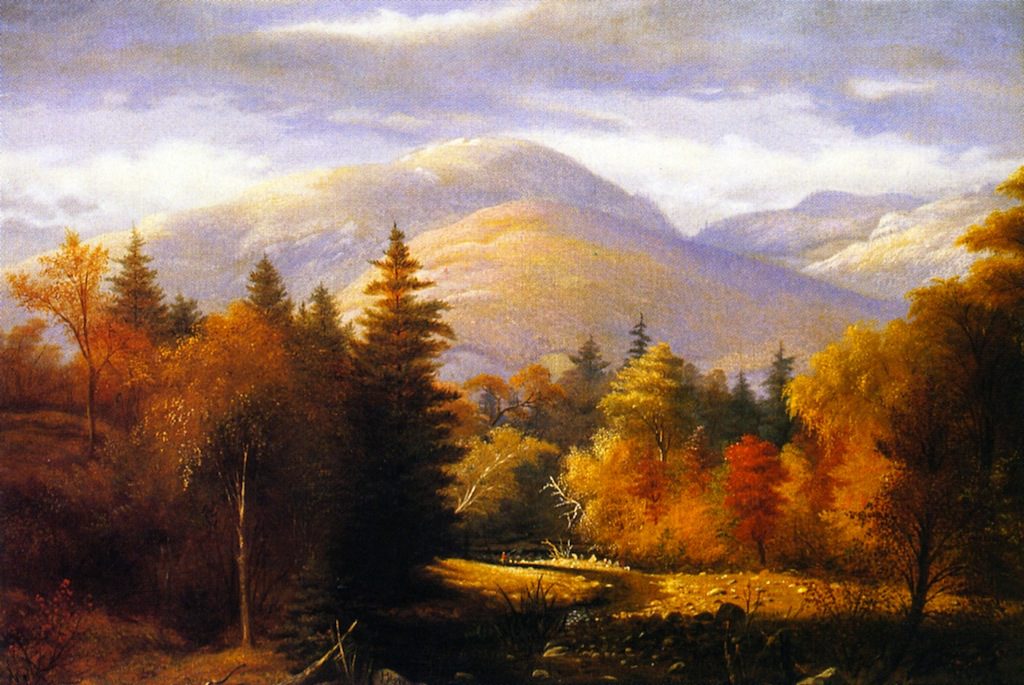
 For those disinclined toward interstate highways, the best way to enter New England is eastward out of Troy, New York on Route 7. The land rolls, as it has since the Mohawk Valley behind you, but once across into Vermont rise the Green Mountains. Like the mighty Argonath watching the approaches, with hippie Bennington town and the massive Bennington War Monument at its feet (a reminder of what Vermont is and once was), their time-rounded broad shoulders guard against invasion from western barbarians. Once through their notches on Route 9, the road twists, lifts, and dives through little Wilmington village (the New York and New Jersey plates show the first defenses have been breached), then over mighty Hogback Mountain, thence down finally into the Connecticut River Valley. Its gentle southward flow whispers, “You are in.” To the south, fortifications remain strong into the Berkshires of Massachusetts but then weaken. There’s a reason Connecticut is essentially two states divided by a northwesterly line from New Haven to Litchfield County: the southwest bubbles over with Yankee fans, the northeast live and die (mostly die) by the Red Sox. Mountains defend better than water. I never know what to do with Hartford, the Belfast of the Northeast, sitting in a demilitarized zone between the two.
I jest, but only partly. These geographic barriers helped insulate New England for centuries and maintain its particular regional identity. Yet each time I return from the Indiana Territory, I wonder if my birthplace has become more theme park than cultural reality. The colonial homes and stone walls once represented a coherent world view and reflected the people who settled there, and also grafted onto later generations. Geography and history imprinted itself onto residents. But is it now more of a living history museum play acting for tourist dollars? Is there still a New England?
From its initial seventeenth century settlement, Puritan austerity steered the religiously-infused political culture of this “New England”: earnest and painfully introspective (“Am I saved?”), but also industrious, reserved and insular, thrifty on a rocky land, and fiercely democratic. It made Boston into a busy wealthy port (filling descendants of Winthrop and Mather with angst over mixing wealth and piety) and a region sensitive over its traditional British liberties. Then came three waves of independence, the first political at Lexington and Bunker Hill, the second economic with Lowell’s looms, and the third cultural with the Boston-Concord axis of Emerson, Melville, and Hawthorne. The godlike Daniel Webster fused the strains together in a brilliant rhetorical effort at Plymouth in 1820, transforming New England’s Pilgrim founding into the American founding. Happy Thanksgiving, everyone. Merchants and industrialists supplanted the ministers, the Athenaeum overshadowed the Unitarian church, and Boston became the “Athens of America.”
Then began the slide. New York increasingly towered over a Boston falling behind economically and demographically. Urbanization and industrialism stripped young people away from the old small towns, particularly villages without railroad connections, leading to precipitous population drops. Boston Brahmins shrank in horror at rising Irish immigration, making enemies of Catholics rather than natural English-speaking and culturally adjacent allies and leading to decades of political warfare. New England letters likewise slipped. Robert Frost kept the old flame lit, but the dip from Longfellow to Amy Lowell and John Marquand was steep. New England managed a rescue effort in the 1890s with the advent of nostalgic “Old Home Days,” when towns invited faraway sons and daughters to rediscover their old haunts and relive the good old days (and spend money). Soon after, the Boston elite founded the Society for the Preservation of New England Antiquities (now called Historic New England) to save colonial homes from destruction. Both efforts succeeded. Many “Old Home Days” survive today and the SPNEA saved much of the region’s colonial architecture from the wrecking balls of economic development.
Postwar America badly hurt regional identity. Too many Brahmins embraced the deprivations of urban renewal and down came Boston’s West End and Scollay Square. They were replaced by skyscrapers and high rises in the International Style, the architecture of everywhere. Looking up at the glass and steel, you could be in Boston, Buenos Aires, or Tokyo. A growing regional elite of transient technocrats and “global citizens” connected to international business, technology, and universities replaced the old – citizens of nowhere living in the city of everywhere. Half of Vermont residents are now born elsewhere, 40% of Massachusetts residents come from other states or countries, and in Boston less than half are born in-state. Meanwhile, the region’s two most famous living history museums, Sturbridge Village and “Plimoth Plantation,” were founded in 1946 and 1947, respectively. You go there to see how people used to live.
A more powerful blow came at the hands of academics. Inspired by Benedict Anderson’s 1983 Imagined Communities, scholars took his thesis of nationalism as socially constructed and applied it to regional identity. In New England, Andersonism meant Brahmin elites invented a mythic harmonious community of covered bridges, colonial farms, and orderly country villages to mask Lowell’s dark satanic mills and protect their social and political authority. Even foodstuffs like baked beans, brown bread, clam chowder, and Thanksgiving dishes were stolen or invented to sustain elite hegemony. Andersonism undermined this by explaining identity as malleable (that which can be socially constructed can be deconstructed and reconstructed again) and open to reformulation. It claimed to close the gap between reality and historical imagination, and reimagined New England as a new de-centered, diverse, more equitable, pluralistic, and inclusive (of “marginalized communities”) historic community. The old mythic Yankee consensus was blown up and replaced by many contested spaces across the region – strikes, exploitation, oppression, genocide, etc. – and regional identity was democratized into many New Englands.
The historians are not totally wrong. All communities are imagined in some way. There are national and regional myths and corresponding historical narratives unconsciously adopted over centuries that create both self and social understanding and a high degree of social trust. You share something assumed and in common with your neighbors. When you undermine that and substitute something else in its place, it never turns out as expected. Historical narratives are complex understandings of the past, present, and future woven together with other institutions and practices our eyes and reason cannot fully see. The survival of the New England historical narrative over four centuries is evidence, not of elite conspiracy or nefariousness, but that it served some useful purpose in helping people understand themselves and their place in the world. It gave (and gives) people an identity – “we are this and not that,” “we are from here and not there” – and this is essential for healthy human psychology. We need to be part of something somewhere, an “other Eden, demi-paradise … land of such dear souls, this dear dear land.” Parochialism is natural to us.
If the New England historical narrative hadn’t served a useful purpose for diverse people across time, it would have been rejected and replaced long ago – not by academics, but by New Englanders themselves. As my old professor Jerry Z. Muller explained,
The conservative defends existing institutions because their very existence creates a presumption that they have served some useful function, because eliminating them may lead to harmful, unintended consequences, or because the veneration which attaches to institutions that have existed over time makes them potentially usable for new purposes.… For the conservative, the historical survival of an institution or practice… creates a prima facie case that it has served some human need. That need may be the institution’s explicit purpose, but just as often it will be a need other than that to which the institution is explicitly devoted.
Humans thrive upon historical continuity and knowing their communities are built with deep roots. But Anderson-inspired histories based on theories of power dynamics destroy an unseen social glue, leaving behind those who understood their place through a shared history. Racial and ethnic identity politics take its place and social trust erodes, moving from an imagined community to an unimaginable and unpleasant one. Your neighbors are now strangers. “When I come across some old custom or old habit which simply will not fit into modern ways of reasoning,” the eighteenth century German writer Justus Moser declared, “I keep turning around in my head the idea that ‘after all, our forefathers were no fools either,’ until I find some sensible reason for it.”
New England is a community that well understands, like John Henry Newman, loyalty to persons and their little patch of ground. So much remains. The Athenaeum, the Public Library, the Symphony and age-old Boston institutions are strong. Harvey Mansfield may be gone, but I hold out hope for New England colleges and universities (goodbye, Hampshire) and that the ghosts of Irving Babbitt, Paul Elmer More, and Barrett Wendell still haunt the halls. Everywhere I go, particularly deep in the hills of New Hampshire and Vermont, I see lovely small restaurants, coffee houses, tiny shops offering everything from antiques to art, and countless cat-filled bookshops resembling a cross between Diagon Alley and Portobello Road stuffed into a little red barn. Everyone lives their lives to the rhythm of the seasons, from winter’s crispness through black fly spring hell, to the glory of deep blue summer to the florid explosion of autumn. They drive the same country roads and live in the same homes as generations before. Few lay awake at night brooding over the inequitable telling of history, at least not in my experience. It’s old and often troubled, like Hardy’s thrush, but it’s still New England:
At once a voice arose among
The bleak twigs overhead
In a full-hearted evensong
Of joy illimited;
An aged thrush, frail, gaunt, and small,
In blast-beruffled plume,
Had chosen thus to fling his soul
Upon the growing gloom.
__________
The Imaginative Conservative applies the principle of appreciation to the discussion of culture and politics—we approach dialogue with magnanimity rather than with mere civility. Will you help us remain a refreshing oasis in the increasingly contentious arena of modern discourse? Please consider donating now.
The featured image is “Green Mountains, Vermont” (1866), by James Hope, and is in the public domain, courtesy of Wikimedia Commons.
