Trump Sees The Primaries As Proving His Strength. He May Come to Regret It.
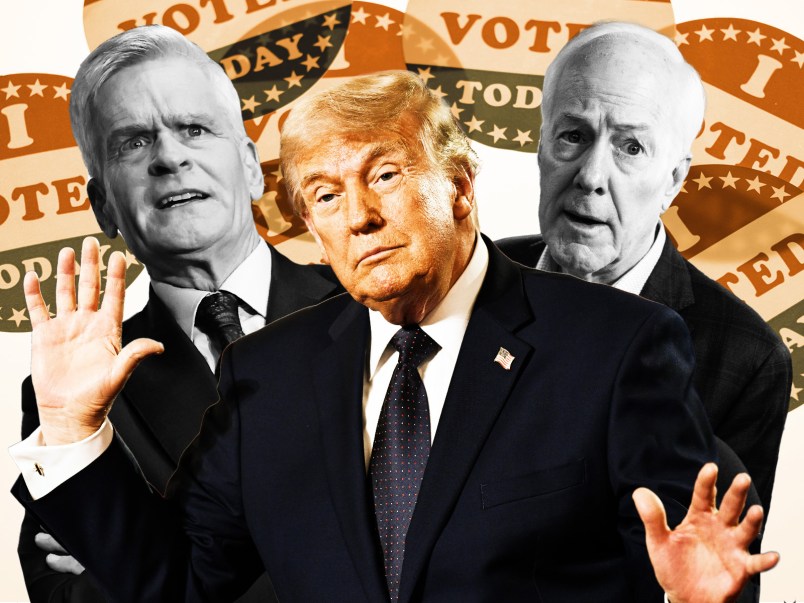
So far, a clear media narrative has emerged from the 2026 midterm election primaries: Trump’s unprecedented reshaping of the Republican Party in his image over the last decade is nearly complete, and his influence remains as strong as ever.
He’s repeatedly succeeded in unseating his political enemies in Congress and in state legislatures. He vanquished state legislators who defied his redistricting push in Indiana, defeated now-outgoing Sen. Bill Cassidy in Louisiana, and booted Rep. Thomas Massie in Kentucky. In Texas, he backed scandal-laden election denier Ken Paxton, who ousted longtime senator John Cornyn (R-TX) in a runoff. His candidates mostly prevailed in Georgia, where the governor’s race is heading to a runoff between Trump’s pick and a billionaire who wanted to be Trump’s pick. Cornyn, in a post-defeat speech, lamented what he characterized as low voter turnout for his runoff. “Another reminder,” said Cornyn, “that those who show up decide for those who do not.”
Georgia Republicans also gave voice to their fears about Democratic enthusiasm after the open primary there saw a drop in people who voted in the Republican contest and a jump in those who voted in the Democratic one.
But it all raises another question, with Trump’s popularity reaching historic lows: Are general election voters going to choose these new, victorious, Trump-preferred candidates?
Experts who spoke with TPM weren’t surprised about the ultra-MAGA outcomes of most states’ GOP primaries so far, even in spite of the unpopular Iran war, painful gas prices, and surveys that show Trump losing support on the economy, the one area where Republicans tend to enjoy unshakable voter confidence. Recent polls show Trump’s approval rating on the economy is worse than his overall approval rating. The opposite was true in 2018, said Kyle Kondik, managing editor at Sabato’s Crystal Ball, and that prevailed throughout Trump’s first term.
“I don’t think there’s really any conflict between these two realities,” said Kondik when asked about the president’s recent success in the primaries, “because even though Trump’s overall approval rating is poorer, the numbers amongst Republicans are still pretty decent.”
But given polling that shows overall voter dissatisfaction with the president specifically and Republicans more broadly — especially on economic issues, and among independent voters — the wisdom of selecting candidates who have built their entire identity around Trump is questionable at best, election analysts and experts in public opinion told TPM. That may be what Republican primary voters want. Is it what America wants?
The primary season four years ago offers a cautionary tale.
GOP ‘Pulling Defeat from the Jaws of Victory’MAGA’s coalescing around Trump picks, no matter how extreme or embattled, could contribute mightily to the party’s downfall, several people who spoke with TPM said. They pointed to several 2022 races that saw Trump favorites win primaries, even defeating sitting GOP officials who voted to impeach the president, only to lose the general election in what in hindsight looks like a rather predictable turn of events.
“In 2022 there were multiple instances of Republicans pulling defeat from the jaws of victory by nominating candidates that were too far right for their electorate,” Matthew Baum, a professor of public policy at Harvard University, told TPM. “And I think there’s certainly a possibility of that happening here.”
Former GOP New Hampshire Senate candidate and MAGA conspiracy theorist Don Bolduc parrotted lies that the 2020 election was stolen and continued to support the unfounded belief that widespread election fraud compromises U.S. elections. He earned Trump’s nomination but lost the GOP primary in 2020, then came back in 2022 with Trump’s praise to win his party’s Senate primary against a more moderate Republican candidate. Bolduc lost the general election in a race Cook Political Report rated as “leans Democrat.”
Fellow conspiracy theorist Blake Masters was endorsed by Trump in the 2022 Arizona Senate race. His primary-winning candidacy was funded by billionaire Trump ally Peter Thiel, for whom Masters had worked. Neither Trump’s stamp nor Thiel’s $15 million could secure Masters’ victory. He was defeated in the general election by incumbent Sen. Mark Kelly (D-AZ).
In another Arizona statewide race that year, Trump’s endorsement of gubernatorial candidate Kari Lake over Karrin Taylor Robson could’ve been the factor that cost Republicans the Arizona governorship, said Kondik; given the narrow margin by which Lake lost to her Democratic opponent. Lake at the time said it was “disqualifying” that Robson wouldn’t support the Stop the Steal conspiracy theory.
And in Michigan, Trump successfully ousted Rep. Peter Meijer (R-MI) in the 2022 primary after the latter voted to impeach the former following January 6. Meijer lost to election denier John Gibbs, who also expressed the belief that Hillary Clinton participated in a satanic ritual. Gibbs then lost the general election to Rep. Hillary Scholten (D-MI).
That year also saw the Trump-backed candidacies from Herschel Walker in Georgia and Mehmet Oz in Pennsylvania; both lost their purple states.
Comparing this year’s general election to 2022 based on the primary season is “premature,” said David Wasserman, senior editor and elections analyst at The Cook Political Report. 2022’s candidates were uniquely extreme, though Trump-backed 2026 candidates in Georgia and Texas are giving them a run for their money.
But then, as now, Trump getting his pick could be a flashing warning sign to Republicans at large.
“It’s just very clear,” Robert Shapiro, professor of political science and international and public affairs at Columbia University, told TPM. “His candidates he’s supported have been performing well. And of course the danger here for the Republican Party is that doing well in the primary may not be indicative of what’s going to happen in the general election.”
“We’ve seen too many cases of that happening.”
On the Issue of TurnoutIt’s worth noting that no one who spoke with TPM for this story suggested lower primary turnout numbers among Republican voters and higher engagement among Democrats represented much more than the typical dynamic: voters use the primary to lash out against the party in power. Midterm turnout among a president’s party is historically lower than among the opposing party, and Trump’s magnetic pull inside his own party has done nothing to impact this age-old pattern.
Midterms bring out only the most engaged party activists and ideologues, said Baum. And runoffs, like the one Cornyn lost, attract only a fragment of that already narrow population. The 2026 GOP electorate’s most energized voters are those far-right MAGA conservatives who won’t break from Trump for anything — not even the sky-high gas prices, the rising consumer inflation, or the White House’s denial of peoples’ real-world economic situations, which ignited voters against Biden.
“Trump enjoys more rock-solid support than his predecessors inside his base,” said Baum. “His base is probably a little larger and probably somewhat stronger in their conviction. But if you look at the overall aggregate numbers, it isn’t by that much.”
While low voter turnout is a fact of U.S. primary elections, Wasserman said Trump’s stronghold on his party is also the result of the weeding out of non-MAGA Republicans.
“The voters who would be inclined to defect, they left long ago during 2015 and 2016 or in subsequent years,” Wasserman told TPM.