Over Half Of MAGA Republicans Say Political Violence Can Be Justified, Survey Finds

Photo by Strange Happenings on Unsplash
1 in 3 Americans Say Violence Is Justified for at Least One Political Goal, With MAGA Voters Most Supportive In A NutshellA new national survey of more than 8,000 American adults found that 35.6% said political violence is usually or always justified for at least one specific political goal. That figure was 32.3% just a year earlier. For Americans who identify as MAGA Republicans, the number climbs past 50%. Still, the study found little change in Americans’ willingness to personally commit political violence, and most respondents rejected it outright.
Published in the journal Injury Epidemiology, these are the latest results from a long-running national survey tracking how ordinary Americans feel about democracy and the use of force in politics. Now in its fourth wave, the survey suggests that support for political violence, under at least some circumstances, is no longer confined to a tiny fringe. While the overall increase from 2024 to 2025 was modest, the gap between political groups is wide.
Researchers noted that the 2024 presidential election, which returned Donald Trump and a Republican administration to power, provided an important backdrop for the 2025 survey. In previous years, with a Democratic administration in office, Republicans and MAGA-affiliated voters had shown the highest levels of support for political violence. Heading into 2025, the central question was whether winning the election would cool those attitudes, or whether other forces would keep them elevated.
8,000 Americans Were Asked to Rate Whether Violence Could Ever Be Politically JustifiedParticipants were drawn from a large, nationally representative online research panel called the Ipsos KnowledgePanel, recruited in 2022 and at least 18 years old at that time. This fourth wave of the survey was conducted between May 23 and June 13, 2025, in both English and Spanish. Out of 9,179 people invited, 8,248 completed it, an 89.9% completion rate that researchers described as exceptionally high.
Respondents weighed in on whether political violence was justified “in general” and then specifically to achieve any of 20 stated political goals spanning the full spectrum, including stopping voter fraud, preventing racial discrimination, protecting women’s reproductive rights, stopping illegal immigration, and stopping police violence. They were also asked about personal willingness to use violence, ranging from damaging property to threatening, injuring, or killing someone, and whether they expected to be armed with a gun if they ever acted on those beliefs.
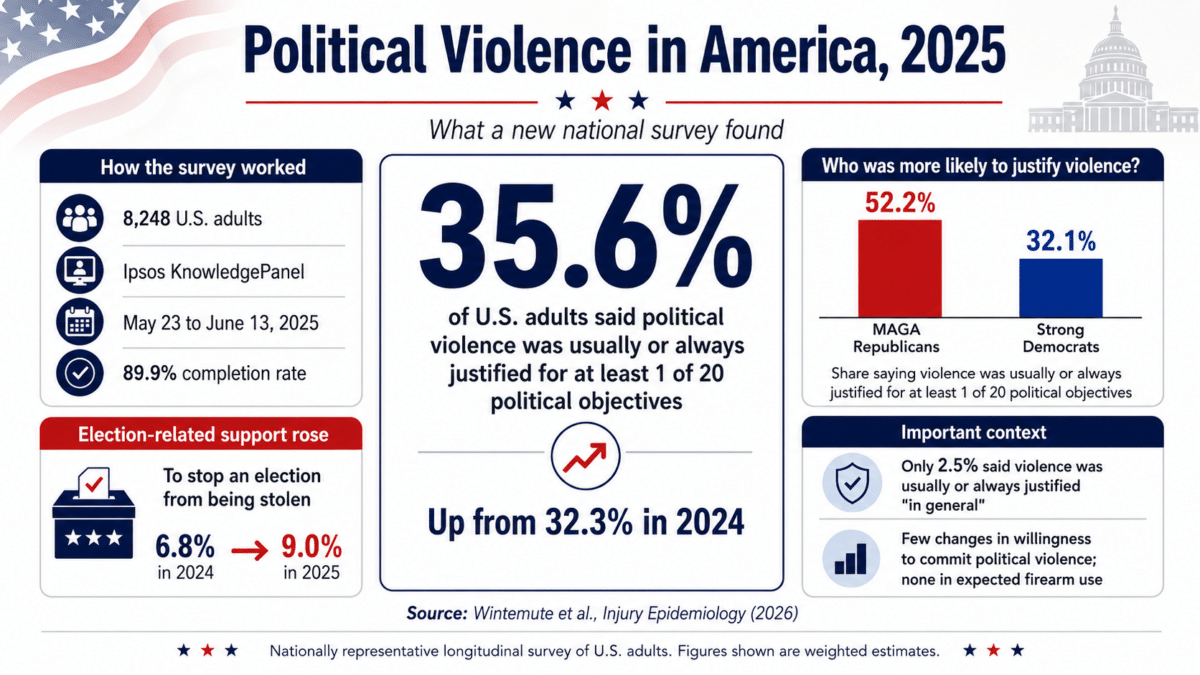 Over 1 in 3 Americans now say political violence is sometimes justified, with MAGA Republicans far ahead of all other groups. (Image by StudyFinds)
MAGA Republicans Remained Far More Likely Than Democrats to Back Political Violence
Over 1 in 3 Americans now say political violence is sometimes justified, with MAGA Republicans far ahead of all other groups. (Image by StudyFinds)
MAGA Republicans Remained Far More Likely Than Democrats to Back Political Violence
Even after Trump’s return to power, MAGA Republicans were substantially more likely than strong Democrats to say violence was usually or always justified to advance at least one of the 20 political goals: 52.2% held that view, compared to 32.1% of strong Democrats. MAGA Republicans also showed higher support than strong Democrats on several individual political goals tested, including preserving an American way of life based on Western European traditions, stopping a protest or demonstration, and supporting the right to life.
Overall support did tick upward, with violence seen as justified across 16 of the 20 individual objectives, but the increases were uniformly small. Democrats showed some increases the researchers suggested might reflect a reaction to being out of power and to actions taken by the Trump administration in 2025. Notably, strong Democrats were not more likely than MAGA Republicans to justify violence to advance any of the 20 objectives, even after those Democratic increases.
On willingness to personally commit violence, there were few meaningful changes across all groups. When it came to expecting to use a firearm during political violence, one of the survey’s most sobering measures, there was essentially no change at all. Researchers did note small increases in willingness to commit violence as part of a group or as a lone individual, with Democrats showing the larger movement on those measures.
Election-Related Violence Attitudes Are Ticking Up Ahead of the 2026 MidtermsOne area where attitudes hardened was around elections. The share of respondents saying violence is usually or always justified “to stop an election from being stolen” rose from 6.8% in 2024 to 9% in 2025. Support for violence to stop voter fraud and voter intimidation also increased.
Framing the entire study as an effort to support violence prevention, researchers stated directly that “the need for such efforts is urgently needed in this US election year,” a reference to the 2026 midterms. Separate findings from the same survey wave showed that nearly 10% of respondents strongly agreed that the current federal administration “should use the military to help enforce its policies in the United States,” and that between 2% and 3% said they were very or completely willing to personally commit violence in connection with government enforcement actions.
America has not lurched into dramatically higher levels of political violence support in the past year, and it has not pulled back either. In a midterm election year, with election-related violence attitudes already moving in the wrong direction, that trajectory is the central concern.
Disclaimer: The content of this article is based on the findings of a peer-reviewed research study. It is intended for general informational purposes only and does not constitute legal, political, or professional advice. Survey-based research reflects self-reported attitudes and carries inherent limitations, including potential sampling bias and social desirability effects.
Paper Notes LimitationsThe survey’s authors acknowledge several limitations. The study follows the same group of participants over time rather than recruiting new people each year, which means the results may not perfectly reflect the broader American adult population, particularly since Wave 1 respondents were found to be older, more frequently white and non-Hispanic, more often married, and to have higher education and income levels than non-respondents. Additionally, the survey relies on self-reported attitudes, and people may underreport socially sensitive views like support for political violence. The survey was in the field from May 23 to June 13, 2025, meaning it did not capture the effects of prominent acts of political violence that occurred after that date. The authors also note that response scales were designed without a neutral midpoint, a deliberate choice to reduce fence-sitting, but one that may affect comparability with other surveys.
Funding and DisclosuresThis work was supported by grants from the Joyce Foundation, the California Wellness Foundation, and the Heising-Simons Foundation, and by the California Firearm Violence Research Center and UC Davis Violence Prevention Research Program. External funders played no role in the design of the study, the collection, analysis, or interpretation of data, or writing of the manuscript. The authors declare no competing interests.
Publication DetailsAuthors: Garen J. Wintemute, Sonia L. Robinson, Andrew Crawford, Julia P. Schleimer, Daniel J. Tancredi, Aaron B. Shev, Elizabeth A. Tomsich, Mona A. Wright, Bradley Velasquez, Shaina Sta. Cruz, and Veronica A. Pear, all affiliated with the University of California, Davis. Corresponding author: Garen J. Wintemute ([email protected]). | Journal: Injury Epidemiology, Volume 13, Article 43 (2026) | Paper Title: “Views on democracy and political violence in the United States in 2025: findings from a nationally representative survey” | DOI: 10.1186/s40621-026-00684-3 | A preliminary version of this study was published by SocArXiv on December 8, 2025. The study was reviewed by the University of California, Davis Institutional Review Board (protocol 187,125), classified as exempt from full review under category 2 (survey research).