Two Hours? Too Long! Ideal Movie Length Is Shrinking for Americans
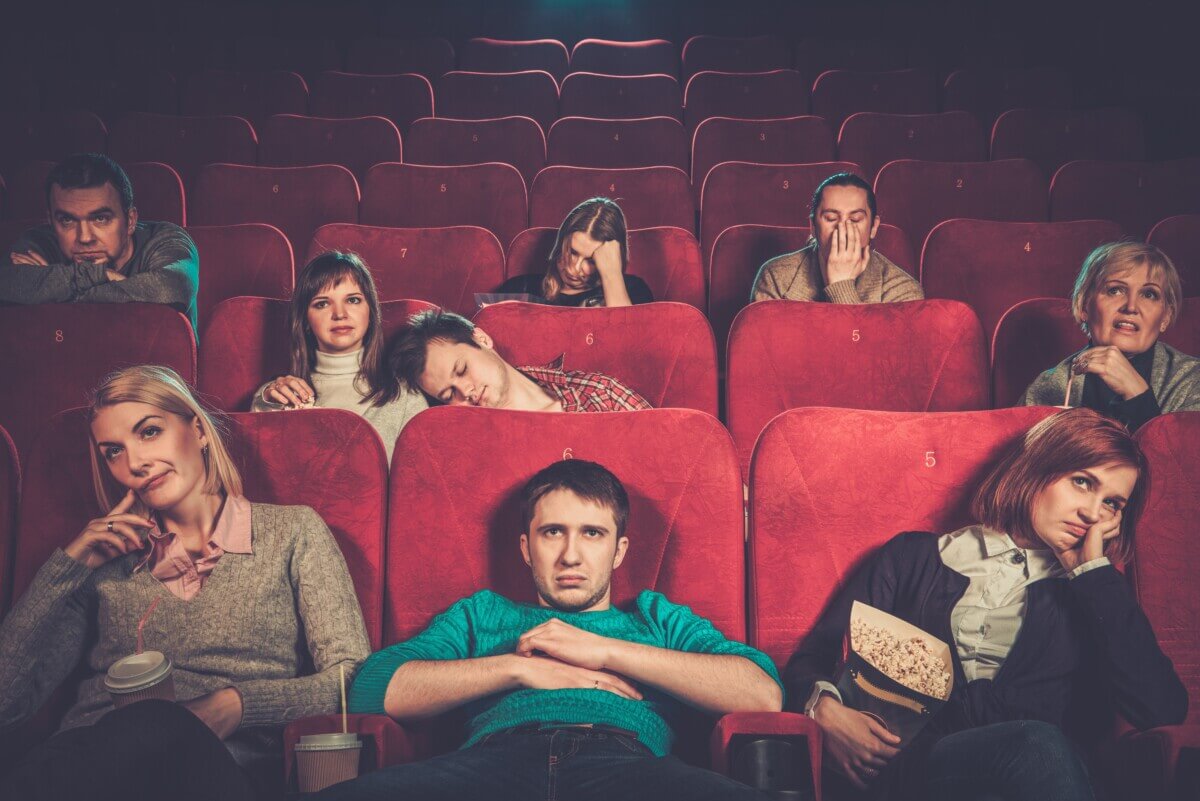
Group of people watching boring movie in cinema (© Nejron Photo - stock.adobe.com)
Perfect Movie Lasts Just 88 Minutes As Attention Spans Decrease, Survey Says In a NutshellAmericans have settled on a perfect length for a movie, and it comes in just under an hour and a half. Asked to name their ideal runtime, 2,000 U.S. adults landed on an average of 88 minutes, according to new survey data.
That preference sets up an awkward summer at the multiplex. Many of the season’s biggest titles run far longer than 88 minutes, and Christopher Nolan’s “The Odyssey,” at 172 minutes, comes close to doubling it. A moviegoer who buys a ticket expecting a brisk night out could end up sitting through nearly three hours instead.
Appetite for long films looks to be fading, too. Talker Research, which conducted the research, asked the same question in 2024 and got a slightly higher answer back then, 92 minutes, meaning the ideal has dropped by four minutes in two years.
How Long Is the Perfect Movie?Only a small slice of moviegoers wants to sit still for a long feature. Just 10% of respondents picked two hours or longer as their ideal, and a mere 3% said a film should run past two and a half hours. For most people, the sweet spot sits comfortably under 90 minutes.
Something is nudging the ideal lower, though the poll did not set out to measure what. A shorter attention span and the habit of watching at home, where a film can be paused or split across sittings, are plausible explanations, but the survey records only the preference, not its cause. Its value is in the number itself: a clear, current read on how long the average viewer wants to sit in a theater seat.
None of this means people have stopped enjoying movies. Rather, the appetite seems to be for stories that get in, land their point, and get out. An 88-minute average leaves little room for a slow first act or a drawn-out finale, the kind of padding that has crept into plenty of modern releases.
 The younger the generation, the less likely they are to watch longer movies. (Credit: Getty Images in collaboration with Unsplash+)
Generational Split in Preferences
The younger the generation, the less likely they are to watch longer movies. (Credit: Getty Images in collaboration with Unsplash+)
Generational Split in Preferences
Age turned out to be the clearest divide in the data. Boomers proved the most patient viewers, naming 93 minutes as their ideal, the only group to clear the 90-minute line. Every younger generation wanted less.
Gen X settled at 89 minutes and millennials at 86. Gen Z came in shortest of all, averaging just 82 minutes. Lined up side by side, the pattern is tidy: the younger the audience, the shorter the film they say they want.
That gap of 11 minutes between boomers and Gen Z might not sound like a canyon, but it captures a real difference in habits. Older viewers grew up when a trip to the theater was the main event of an evening. Younger ones came of age with a library of short clips a thumb-swipe away, and their ideal runtime reflects it.
This Summer’s Lineup Runs Past the Ideal Movie LengthReality at the box office looks nothing like that 88-minute wish. Only two big releases land near the mark, “Minions and Monsters” at 90 minutes and “Jackass: Best and Last” at 92. Nearly everything else asks for more.
“Toy Story 5” runs 102 minutes, about 15 minutes over the ideal and a full 21 minutes longer than the 81-minute original from 1995. Family sequels have a habit of ballooning, and this one is no exception.
Climb further up the lineup and the overages grow. “Supergirl” comes in at 108 minutes, 20 over the ideal. A live-action “Moana” runs 115, and “The Devil Wears Prada 2” reaches 119, roughly half an hour past what viewers said they wanted. From there the biggest tentpoles pull away entirely. Steven Spielberg’s “Disclosure Day” stretches to 145 minutes, and “Spider-Man: Brand New Day” hits a flat two and a half hours at 150. Nolan’s “The Odyssey” tops the list at 172 minutes, an 84-minute overage that nearly doubles what audiences asked for.
Which Films Actually Hit the MarkA short list of classics fits the 88-minute template almost exactly. “The Lion King” (1994), “Zombieland” (2009), “The Producers” (1967), and “Airplane!” (1980) all land right around that runtime, proof that a tight, quick movie is nothing new.
Whether Hollywood takes the hint is another matter. Studios keep filling the summer calendar with long event films, from superhero tentpoles to a three-hour literary epic, even as audiences report wanting something shorter. A big-screen spectacle can still draw a crowd, yet many of this season’s runtimes sit far beyond the length viewers name as ideal.
Still, the survey lands a clear message from the seats. For now, the gap between an 88-minute wish and a 172-minute epic captures a plain tension: audiences keep asking for less, and the summer slate keeps serving more. If future surveys keep showing shorter preferred runtimes, studios betting on ever-longer films may find more of the crowd checking the clock.
Survey Notes LimitationsA few caveats are worth keeping in mind. Respondents reported an “ideal” runtime, a subjective and hypothetical number, so the survey measures stated preference rather than actual viewing behavior or ticket-buying. Participants were general-population Americans with internet access, recruited and polled online, which can skew a sample away from people who spend less time on the web. The film runtimes listed for comparison are illustrative; the survey did not test how any specific title performs. And the two-year drop from 92 to 88 minutes reflects two snapshots, not a continuous trend line.
Funding and DisclosuresThis survey was commissioned and conducted by Talker Research, the research arm behind the write-up. Talker Research notes that its stories and infographics are produced as ready-to-use content, and its work is managed by Talker Inc. No outside academic funder or peer-review body is involved.
Publication DetailsThe survey was released by Talker Research on July 7, 2026. The underlying survey polled 2,000 general-population U.S. adults with internet access and was administered online by Talker Research between June 11 and 17, 2026. Complete methodology is available through Talker Research’s Process and Methodology page as part of the American Association for Public Opinion Research (AAPOR) Transparency Initiative. As a commissioned survey rather than a peer-reviewed study, the report carries no DOI.