Going to Museums and Movies May Slow Aging, Study Finds

(Credit: pexels.com)
In a NutshellA night at the theater or an afternoon at a museum might do more than lift the spirits. A new study found that older adults who regularly visited cinemas, museums, and theaters had measurably lower physiological age than those who rarely or never went. The difference was modest but real, and it held up even after researchers accounted for income, physical health, and lifestyle habits. Earlier research the authors cite has suggested the effect of cultural engagement on aging may be comparable to that of regular physical activity.
Age is usually treated as a single number, but scientists have long known that two people born in the same year can age at very different rates. Physiological age, sometimes called biological age, measures how worn down the body’s systems are, based on markers such as blood pressure, lung function, grip strength, and blood chemistry. A physiological age higher than a person’s actual age signals faster bodily decline and a greater risk of serious illness and death. The study, published in the Journal of Epidemiology and Community Health, suggests that something as ordinary as a trip to the movies could help keep that number lower.
Inside the Study: Measuring Cultural Habits Against Biological AgeResearchers drew on data from the English Longitudinal Study of Ageing, a long-running national study tracking the health of older adults in England. They used a statistical method built to strip away the influence of personal traits that don’t change over time, such as genetics or personality, which might otherwise explain the link between cultural habits and health. By focusing on changes within the same individuals over time, they made a stronger case that cultural engagement itself tracks with slower aging, rather than healthier people simply going out more.
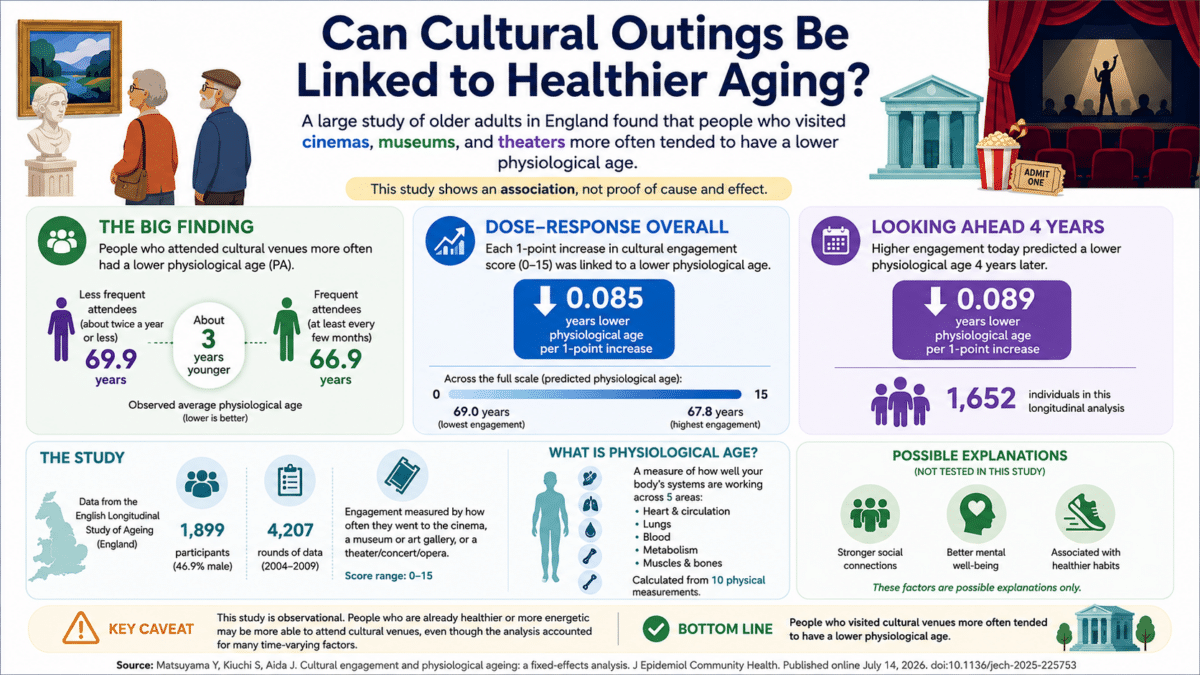
In total, 1,899 individuals took part, about 47% of whom were male, generating 4,207 survey and health data rounds collected between 2004 and 2009. Cultural engagement was measured by asking participants how often they visited the cinema, a museum or art gallery, or a theater, concert, or opera. Answers ran from “never” to “twice a month or more” and were converted into a combined score from 0 to 15. On average, participants scored 4.3. Those who attended at least every few months averaged 7.3, while those who went twice a year or less averaged 2.3.
Physiological age came from ten physical measurements across five body systems, covering the heart and circulation, the lungs, the blood, metabolism, and muscles and bones, plugged into an established scientific formula. Across all participants, the average physiological age was 68.7 years, and the average actual age was 69.6 years. Frequent cultural attendees had a mean physiological age of 66.9 years, compared with 69.9 among less frequent participants, a gap of about three years.
 Infographic by StudyFinds
Breaking Down the Numbers on Museum Visits, Movie Nights, and Aging
Infographic by StudyFinds
Breaking Down the Numbers on Museum Visits, Movie Nights, and Aging
Each additional point on the cultural engagement score corresponded to a 0.085-year drop in physiological age. Across the full 15-point scale, predicted physiological age ranged from 69.0 years at the lowest engagement to 67.8 years at the highest.
Researchers also conducted a separate analysis to determine whether cultural engagement at one point predicted physiological age four years later. That analysis, covering 1,652 individuals, found a similar pattern: a one-point higher score was associated with a 0.089-year lower physiological age over time.
Several possible explanations stand out to the authors. Cultural participation tends to strengthen social bonds, and loneliness is known to speed physical decline. It may also nudge people toward healthier habits, since prior research has found culturally active people more likely to eat well and exercise. Cultural engagement has also been tied to better mental health, and chronic psychological stress is linked to faster bodily aging.
Researchers were careful to flag a key caveat: people already aging more slowly may simply have more energy to get out, rather than the outings driving the benefit. The four-year analysis, which measured engagement well before the physiological age assessment, was designed partly to address that worry, though it cannot rule it out entirely.
Why Expanding Access to Cultural Venues Could Benefit Healthy AgingOlder adults who attended more often tended to be wealthier, better educated, and in better health to begin with, differences the researchers adjusted for statistically. Even so, cultural venues are not equally within reach for everyone. The authors argue that expanding affordable access to museums, theaters, and similar venues could broaden participation among groups that currently attend less often.
A 10-week museum program referenced in the study, featuring guided talks, hands-on object handling, and art activities, improved emotional outcomes such as cheerfulness and encouragement among socially isolated older adults. Programs like that could help extend the benefits to people who might not seek out cultural venues on their own.
Results are specific to adults in England, and the researchers acknowledged that they may not generalize equally across countries or cultural settings. The engagement measure relied on self-reporting and covered only cinemas, museums, and performance venues, leaving out other forms of cultural life.
Still, the study adds to a growing body of evidence that how people spend their time in later years, alongside diet and exercise, may shape how their bodies hold up. A museum visit or an evening show is no substitute for medical care, but it may be doing something real for the body as well as the mind.
Disclaimer: This article summarizes findings from a peer-reviewed study for a general audience and is for informational purposes only. It is not medical advice. The research shows an association between cultural engagement and slower physiological aging, not proof that one causes the other. Anyone with questions about their health or aging should consult a qualified healthcare professional.
Paper Notes LimitationsAuthors flag several important limitations. First, because cultural engagement and physiological age were measured at the same time points, the direction of the relationship is not fully certain, since people aging more slowly may simply be more able to participate. The four-year analysis eases this concern but does not settle it. Second, the size of the association was fairly small, which the researchers suggest may partly reflect their statistical approach, which captures only within-person change over the study period and may miss the cumulative effect of lifelong cultural habits. Third, cultural engagement was self-reported and covered only three activity types (cinema, museums, and theater or concert attendance), which may not capture the full range of cultural participation. Fourth, methods for estimating physiological age can yield different results depending on which measurements and calculations are used, though the researchers relied on an approach validated for predicting mortality. Fifth, the findings may not generalize beyond adults living in England.
Funding and DisclosuresThis work was supported by the Japan Society for the Promotion of Science, grant number 24K02658. The English Longitudinal Study of Ageing is funded by the National Institute on Aging and by UK Government departments coordinated by the National Institute for Health and Care Research. The Harmonized ELSA dataset was developed with funding from the National Institute on Aging. The authors declared no competing interests. They disclosed that they used ChatGPT to correct grammatical errors and improve readability in an early draft, and stated that they carefully checked and edited the final manuscript for scientific accuracy.
Publication DetailsAuthors: Yusuke Matsuyama, Sakura Kiuchi, Jun Aida — Department of Dental Public Health, Institute of Science Tokyo, Bunkyo-ku, Tokyo, Japan
Journal: Journal of Epidemiology and Community Health (BMJ Group), published online ahead of print, July 14, 2026
Paper Title: “Cultural engagement and physiological ageing: a fixed-effects analysis”