Backyard Bug Spray May Be Breeding Tougher Mosquitoes, Study Shows

(Credit: © Grustock - stock.adobe.com
In a NutshellMosquitoes in suburban North Carolina are fighting back against the sprays meant to kill them, and they are gaining ground fast.
A study published in Parasites & Vectors followed a single genetic change in the Asian tiger mosquito across Wake County, North Carolina, for nearly a decade. What the researchers found was hard to ignore: a mutation that helps mosquitoes survive a common class of insecticides called pyrethroids, the active ingredient in many drugstore bug sprays and professional yard treatments, went from one central neighborhood to nearly the entire study area in just a few years. That pattern lines up with the scattered, uncoordinated way people spray for bugs in the suburbs, though the study stops short of proving the connection outright.
Aedes albopictus, better known as the Asian tiger mosquito, is more than a backyard nuisance. It spreads diseases like dengue, Zika, and chikungunya, and pyrethroids are one of the main tools used to keep it in check. Once mosquitoes stop responding to those chemicals, public health officials lose one of their most dependable defenses, and this work points to resistance that is already well on its way.
How Insecticide-Resistant Mosquitoes Spread Across the CountyResearchers from North Carolina State University and Augusta University collected and tested mosquitoes across suburban Wake County from 2016 to 2024, genetically screening 2,669 individual insects trapped at homes, businesses, and one university site with traps set out week after week through the summers. Their target was a tiny change in the gene that controls how nerve signals travel through the insect’s body. Pyrethroids kill by scrambling those signals, and the mutation reshapes the nerve channel just enough to dull the insecticide’s effect. Mosquitoes carrying it can survive doses that would drop their neighbors. Every result was double-checked with a repeat test, and a subset was confirmed by direct DNA sequencing, which matched the faster method almost perfectly.
In 2016, no mosquito in the sampling area carried the mutation. It surfaced for the first time in 2018, in an older, more affluent neighborhood near the center of the county. By 2022, every long-term monitoring site had mosquitoes carrying at least one copy. By 2023, the mutation had fanned out across the full sampling region, with the heaviest concentrations still clustered around the spot where it first appeared.
By 2023, more than a third of the relevant gene copies in the local population carried the resistant version, the highest level recorded during the study. Resistance also spread quickly, a pace consistent with a strong survival advantage for the mosquitoes that carried it, the kind of edge that shows up when a chemical steadily wipes out the mosquitoes that lack the mutation while sparing the ones that have it. One wrinkle makes the trend easy to underestimate. A mosquito generally needs two copies of the mutation, one from each parent, to get its full protection, so low-level resistance can quietly build in a population long before it becomes obvious in the field.
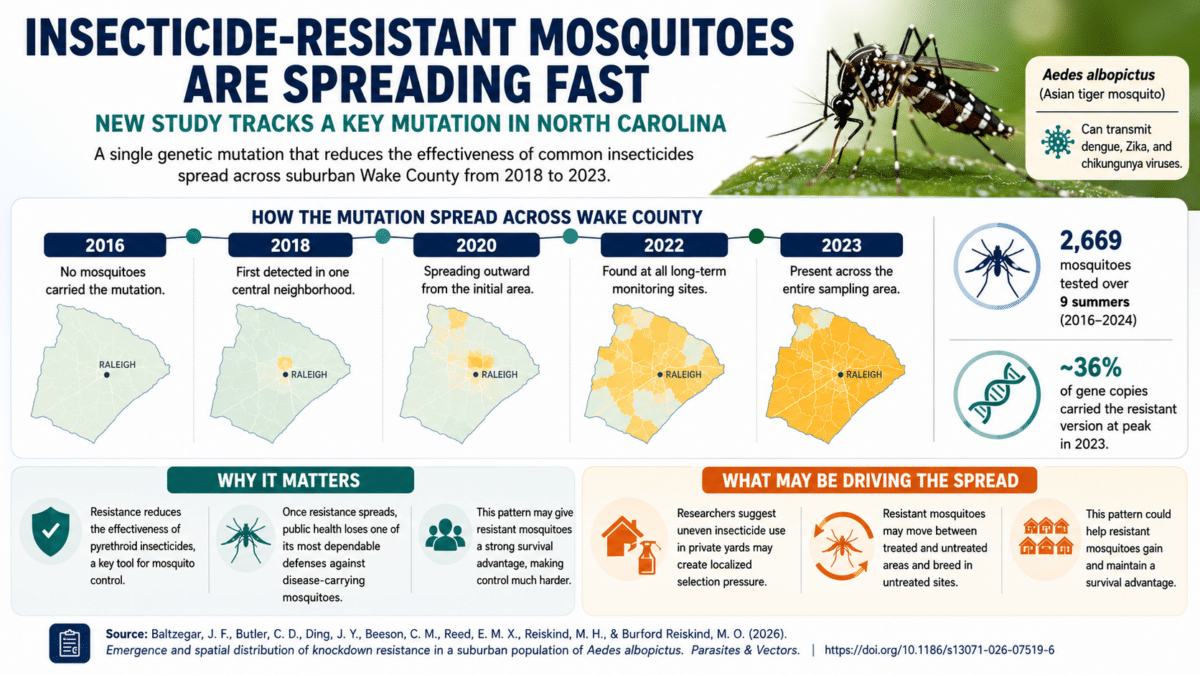 Infographic by StudyFinds
Why Backyard Spraying May Fuel Insecticide Resistance
Infographic by StudyFinds
Why Backyard Spraying May Fuel Insecticide Resistance
Suburban spraying habits may be part of what feeds the problem. In cities and on farms, insecticide use tends to be organized and recorded. In the suburbs, it is a free-for-all. Homeowners grab cans of bug spray at the hardware store, neighbors hire different pest control companies, and some blocks get treated over and over while others get nothing. Uneven exposure like this may create favorable conditions for resistance to take hold and spread, since a mosquito that survives a heavily sprayed yard can fly next door and breed in an untreated one.
Researchers point specifically to what private companies and homeowners do on their own property, calling for mosquito management strategies that address “private-sector contributions to insecticide selection pressure.” Put plainly, what happens in a single backyard may help shape the evolutionary future of the whole neighborhood’s mosquitoes, rather than only what public spraying programs do.
Resistance to pyrethroids has been studied for years in Aedes aegypti, a cousin species that carries dengue and yellow fever. This same mutation in Aedes albopictus, in an American suburb, has gotten far less attention. This work delivers a plain warning: the resistance long tracked in other mosquitoes is now firmly taking root here.
The Bug Spray That Stops WorkingMosquito control has always been a grind, but this study offers concrete evidence that the insects are adapting, and doing it quickly. If the chemicals communities rely on to hold back disease-carrying mosquitoes quietly lose their bite, the consequences could reach beyond nuisance bites if resistance keeps spreading. The authors call for steady monitoring and coordinated management that account for what goes on in private yards, not only public spaces. For now, that backyard piece of the puzzle stays almost entirely unmanaged.
Paper Notes LimitationsWork was carried out entirely within Wake County, North Carolina, so the results may not carry over neatly to other regions with different climates, mosquito densities, or spraying habits. Researchers tracked a single mutation in one gene, which leaves out other genetic routes that can also blunt an insecticide. They did not directly measure how much insecticide residents or private companies actually used, so the suspected drivers of the spread remain an educated inference rather than a proven cause. One more caution: resistance appeared to dip slightly in 2024, but that year involved far fewer sampling sites than 2023, which makes any direct year-to-year comparison unreliable.
Funding and DisclosuresThe work was supported by seed grants from the Genetics and Genomics Academy and the Global One Health Academy at North Carolina State University. The authors reported no competing interests. Technical laboratory assistance came from Ashara Wurst.
Publication DetailsAuthors: Jennifer F. Baltzegar, Cole D. Butler, Jessica Y. Ding, Chay M. Beeson, E. M. X. Reed, Michael H. Reiskind, and Martha O. Burford Reiskind (corresponding author: [email protected])
Affiliations: Augusta University (Augusta, GA); North Carolina State University (Raleigh, NC)
Journal: Parasites & Vectors (2026)
Paper Title: “Emergence and spatial distribution of knockdown resistance in a suburban population of Aedes albopictus“
DOI: 10.1186/s13071-026-07519-6
Published online: June 27, 2026
Note: This is an early-access accepted manuscript (“article in press”). The publisher notes it is an unedited version that may undergo further editing before final publication.