The Continued Case for Trump – The American Spectator | USA News and Politics
Back in the seemingly ancient days of 2019, the always astute Victor Davis Hanson, a senior fellow at Stanford University’s Hoover Institution as well as a professor emeritus of classics at California State University, Fresno, penned The Case for Trump. In the book, Hanson discussed “how a celebrity businessman with no political or military experience triumphed over sixteen well-qualified Republican rivals, a Democrat with a quarter-billion-dollar war chest, and a hostile media and Washington establishment to become president of the United States — and an extremely successful president.”
Of note, Hanson argued that America needed an outsider “to do what normal politicians would not and could not do — a fact that explains the furor directed at Trump by the political and media status quo.”
That was in 2019, now a full seven years from 2026. A 2026 in which the Trump presidency, in its second and final term, is roaring along at full speed. The president, celebrating his eightieth birthday this year, is still very much the energetic outsider who drives both Washington insiders and the media crazy.
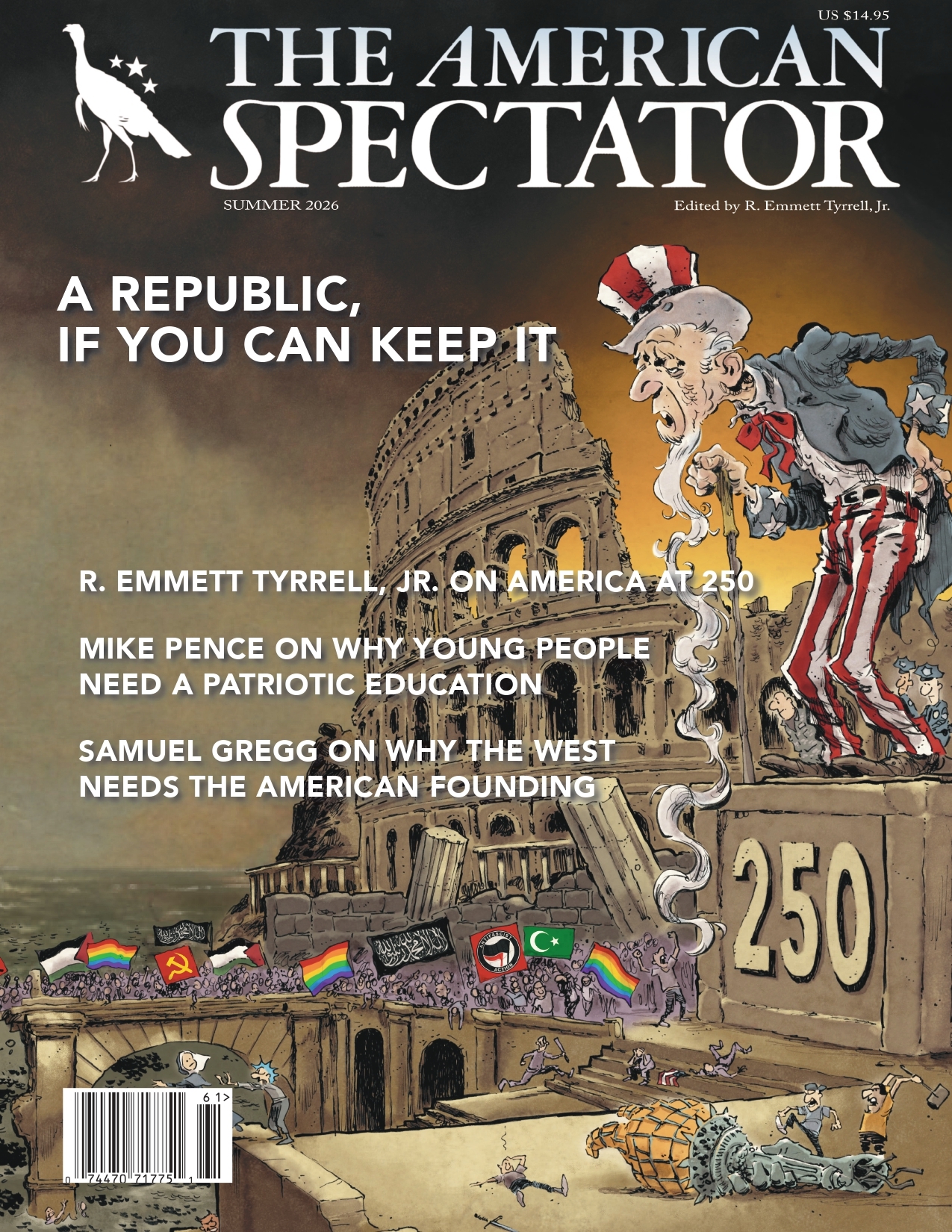
Subscribe to The American Spectator to receive our summer 2026 print magazine.
Which is another way of saying that there is a continued case for Trump.
The hard fact is that the Washington establishment is both old and resistant to change. It would take Trump — or, for that matter, any Washington outsider — time aplenty to change the capital’s long-accustomed ways of doing business.
Without question, the four years of the Biden presidency did much to help Trump make his case for a second term. Americans saw Biden’s policies at work. They saw an America that, in Hanson’s words, “was no longer great.”
All of this gave Trump plenty of room to make the case for his “Make America Great Again” policies — to make America very much a country with a can-do spirit, a nation filled with resolve and energy. A country with abundant resources, not run into the ground by careerists.
There was also something else at work. Trump is the only American president other than Grover Cleveland to have served one term, lost, and then come back to win a nonconsecutive second term. Particularly in Trump’s first term, his status as an outsider businessman with no prior political experience was something of a liability as he faced the Washington establishment and the media. In his second term, however, Trump appears to be putting the lessons of his first term to good use. Whether dealing with foreign policy — including America’s NATO allies, the war with Iran, and the complexity of the Middle East, Russia, and China — or domestic issues such as the state of the economy, the second-term Trump is much more at home than his first time around.
That does not mean he has not attracted vociferous and occasionally violent opponents.
The president has been the target of assassination attempts, the first at a rally in Butler, Pennsylvania, with gunshots narrowly missing killing him. Another took place at his own Florida golf course.
As his second term was underway, a would-be assassin launched a lone attack on the traditional White House Correspondents’ Dinner at the Washington Hilton Hotel. That too was a narrow escape, as the would-be assassin, armed with a shotgun, pistol, and knives, was intent on killing not only the president but as many members of his Cabinet as he could. The president was swiftly whisked off the stage. His would-be assassin — a 31-year-old committed leftist, a software developer with a master’s degree — was Cole Allen, who, predictably, had written a manifesto he shared with his family.
In that manifesto, Allen portrayed Trump as something approaching what one observer called “a sociopathic mob boss, and a traitor beholden to Vladimir Putin.”
This is, suffice it to say, decidedly not how Trump views himself or how he is viewed by his fellow Americans.
It is safe to say that we have a continued case for Trump precisely because a majority of the American people support his ongoing agenda in both domestic and foreign policy.
That’s not to mention that Trump has been gifted in the opponents he has drawn on Capitol Hill. A so-called new face of the Democrats was a New York representative named Alexandria Ocasio-Cortez, a decidedly committed socialist who blasted Trump and his GOP congressional allies as “cold-hearted monsters” for opposing the hard-driving socialism central to her politics.
In fact, as time moved on, one asset Trump arguably possessed was the presence of former President Barack Obama on the campaign trail for Democrats. It did not escape Trump’s notice that Obama-backed Senate and gubernatorial candidates in potentially pro-Democrat states such as Florida and Georgia, despite receiving Obama’s staunch support, lost their election races.
Trump’s good fortune extended beyond his opponents in Congress. In the media, ABC late-night host Jimmy Kimmel was repeatedly in the news for targeting not only the president but First Lady Melania Trump as well. Kimmel joked that Mrs. Trump had “a glow like an expectant widow.” Suffice it to say, the remark backfired big-time, drawing not just the wrath of both the president and first lady but public opinion as well.
And also, the much-gossiped-about speculation that Trump would be impeached has finally been reduced to, as the slang expression goes, one big nothingburger.
That’s not to mention that in April 2026 Trump’s longtime nemesis, former FBI Director James Comey, was the subject of an arrest warrant issued by a Washington grand jury. CBS News reported this gem of a story this way:
Washington — A federal grand jury indicted former FBI Director James Comey on Tuesday for allegedly making threats against the president, marking the second time he will be prosecuted by President Trump’s Justice Department.
The indictment charges Comey with two counts: knowingly and willfully making a threat to take the life of — and to inflict bodily harm on — the president, and second, knowingly and willfully transmitting in interstate commerce a threat to kill the president.
There is also something else that has played a role in the American people’s ongoing support of Trump. Unlike his predecessors, for whom twenty-first-century technology simply did not exist or was in its infancy, Trump has leveraged his political savvy to engage in repeated Twitter duels with celebrities and political opponents. These clashes have led critics to call him treasonous and even liken him to Nazis, as former CIA Director Michael Hayden once did.
As has been noted, Trump’s polling popularity has stayed in the mid-forties. In one case, Rasmussen Reports recorded Trump with a 51 percent positive rating.
On the foreign policy front, at the start of 2026, Trump played host to Britain’s King Charles III, the two reportedly fifteenth cousins! Trump really went out of his way to play the courteous host, understanding the importance of the American–British alliance, particularly as 2026 marks the 250th anniversary of the signing of the Declaration of Independence.
It is very safe to say that 2026 will be filled with celebrations of the 250th anniversary of the Declaration, with Trump serving as America’s master of ceremonies in chief.
All of which is to say, the remarkable story of President Donald Trump, with a little over two years remaining, still has a long way to go.
As has already been seen, there is very little about the Trump presidency that can be seen as “normal,” whatever “normal” in an American presidency may be.
But while it is still too early to assess the Trump presidency before its completion, it is easy to say that the continued case for Trump will proceed.
Stay tuned.
Subscribe to The American Spectator to receive our summer 2026 print magazine.