Establishment Gloats Over Ukraine's Pivot to Civilian Targets, as Putin's Rhetoric Heats Up
Again the MSM has caught up in the slipstream of our analysis.
The current geopolitical cue revolves around Ukraine’s putative pivot from strikes on Russia’s refineries to an all-out war against “Russia’s Amazon”:
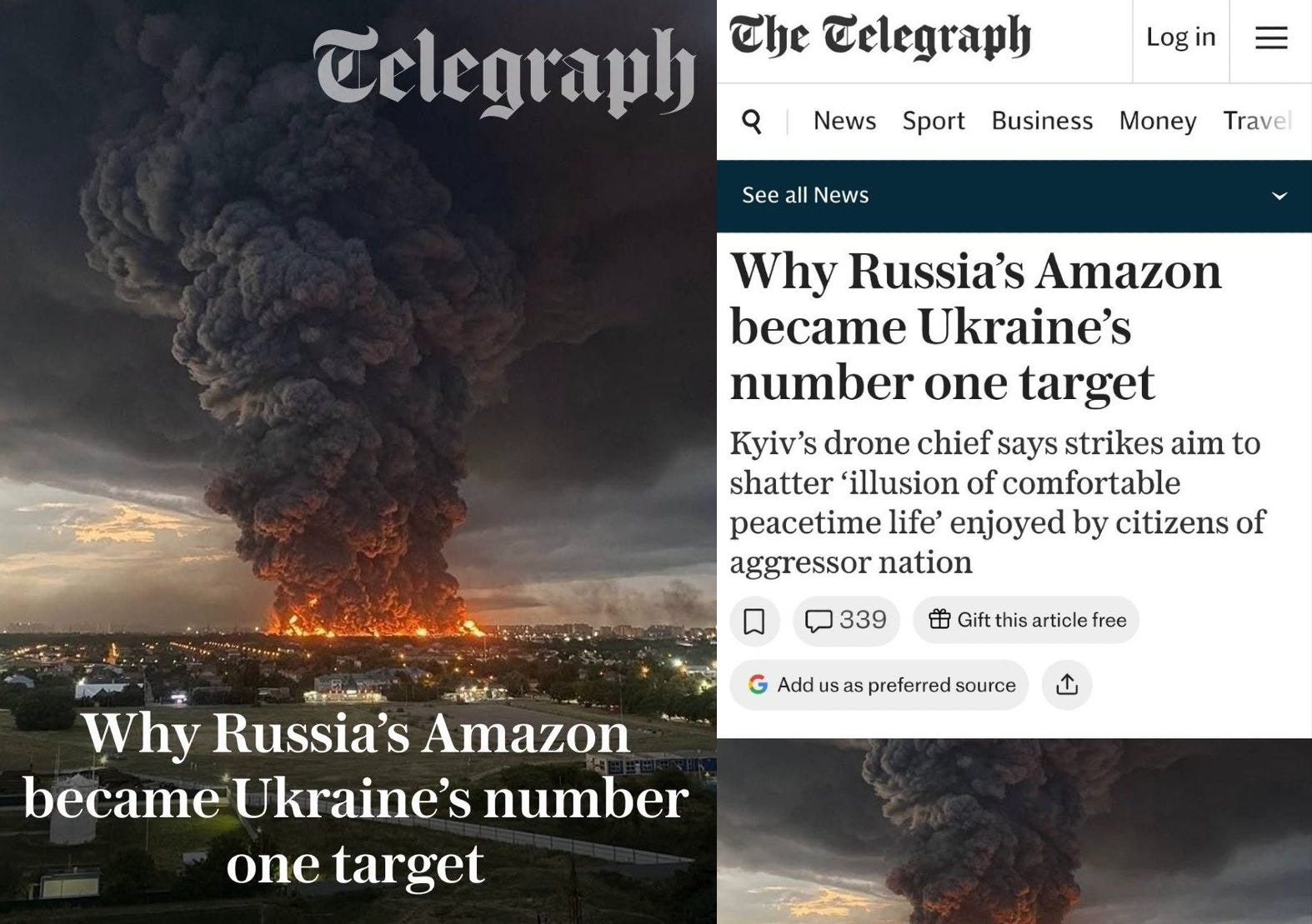 https://www.telegraph.co.uk/world-news/2026/07/24/why-russias-amazon-became-ukraines-number-one-target/
After months of escalating attacks on oil depots and refineries, it has abruptly shifted targets, turning its sights to something more unexpected: warehouses and depots belonging to Wildberries, a Russian retail giant often described as the country’s equivalent of Amazon.
But the biggest bombshell is what they now openly admit to.
The above Telegraph piece veritably gloats over the fact that these strikes are having a major effect on Russia’s civilian population and its perception of the conflict.
But the strikes have another effect.
Robert Brovdi, Ukraine’s drone chief, said the strikes were aimed at destroying the “illusion of a comfortable, well-fed peacetime life enjoyed by the obedient biomass of an aggressor country”.
The damage is impossible to hide.
They show that Russia is vulnerable.
After only briefly and passingly mentioning that some “radios and military gear” are available on the Wildberries site, the authors quickly abandon that line of justification in favor of obsessively cataloguing the civilian toll the strikes are exacting:
Encompassing almost 80 million active customers and some one million sellers, Wildberries accounts for 52 per cent of Russia’s e-commerce market – a market which is booming, having grown 28 per cent last year.
The destruction of its warehouses has sent a shock wave through the small businesses selling goods through the site. Hundreds of people have posted videos online complaining that they had lost large inventories of goods and would not receive compensation from the company.
So, it’s not the “military radios” they really care about, it’s the “shock waves” sent through small businesses the article authors are salivating over in the hopes that it will result in mass unrest against Putin.

They end the piece by verbalizing these hopes outright, and proving that Zelensky’s pivot to hitting Russian retailers has nothing whatever to do with paralyzing the army’s ability to buy some kind of radios or armor—as if the Russian Army purchases its gear from Wildberries—but rather everything to do with pressuring Russian citizens, as is the standard M.O. of all failed imperial “kinetic” foreign policy:
Some, however, remain hopeful that a fresh reminder that the war has come to Russia’s doorstep could begin to chip away at public indifference.
“Before, the war was a peripheral phenomenon that didn’t directly affect the lives of ordinary Russians,” said Abbas Gallyamov, a political analyst and former speechwriter for Putin. “Now it comes in the form of fuel shortages and disruptions to online shopping.
“This negative momentum for the Russian authorities undermines the picture painted by propaganda,” he added. “[The strikes] strengthen anti-war sentiment.
“People rally behind a government that is winning, not one that is losing.”
The final line says it all: “People rally behind a government that is winning, not one that is losing.”
Of course, the putrid scamps behind such articles would never do their ethical due diligence of presenting both sides of the story, which includes second order consequences Ukraine may be experiencing as a result of this pressure campaign against Russian citizens that’s got the establishment presstitutes all so randy with excitement.
From one Ukrainian account:
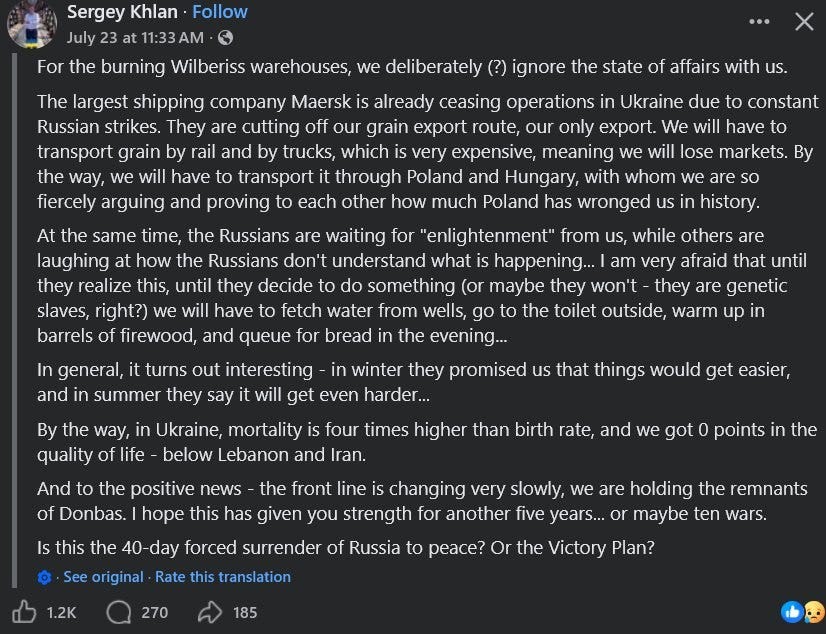
One of the more interesting current discussions about Russia’s response to these Ukrainian provocations revolves around the theory that Putin has slowly been forced to change his approach to the war due to the increasing pressure from his own General Staff and security apparatus.
In truth, we can’t know for certain the ‘chicken-or-the-egg’ causal chain of the shift, but we do know this shift in tone and rhetoric is real. Just yesterday Putin told a conference that Ukraine will certainly lose its western territories:
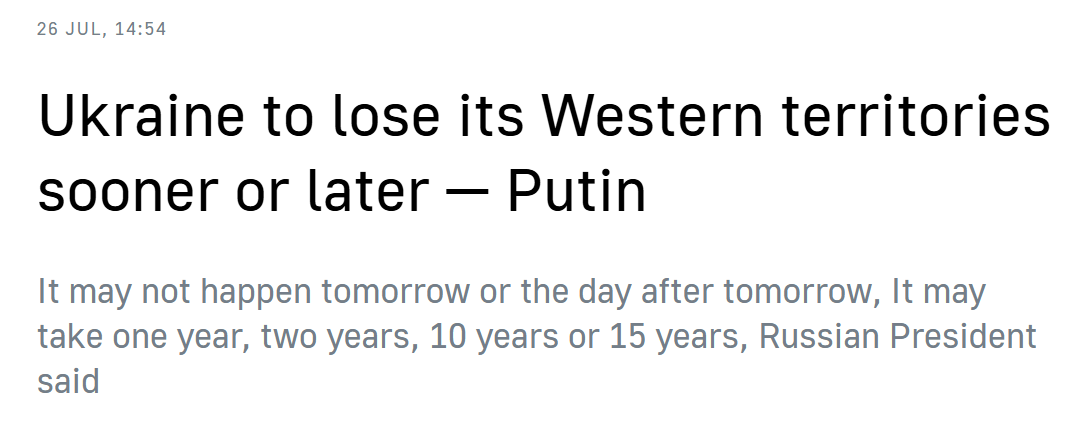 https://tass.com/politics/2165687
He then went on to liken the attackers of Russian cargo ships to pirates, and told his naval command to begin treating them as one would treat pirates:
It still had the hallmarks of Putinism: the strict legalistic adherence; “framework of international maritime law”, etc. But the tone shift is obvious: “Decisive action” must be taken against these pirates, says Putin.
Even more notably, at his latest speech Putin told the audience a “secret”, that one of the Russian SMO medal winners whispered to Putin that Russia should “go harder” in the war, to which Putin responds: “I really want to.”
This is intriguingly revealing. On one hand, Putin openly gives the reasons for why the Russian Army cannot go “all out” as most people would like: because it would incur much greater losses, and Putin believes Russia’s current persistent slow-march across Ukraine is the ideal pace which maximizes victorious conditions while minimizing losses.
But the fact that he even brings it up and stages it in a kind of dialectic with the Russian people is intriguing in and of itself, because it represents Putin’s response to what is clearly becoming a growing call from society. Putin uses the soldier’s request as a chance to finally address this elephant in the room while acquitting himself of guilt by framing it as something Putin himself wishes he could do, but is not capable of doing for the given justifications.
Now Zelensky has continued agitating about Russia facing a crisis related to the above, with growing rumors—fanned by Ukraine—that a large-scale mobilization is imminent after Russian Duma elections in the fall. Zelensky himself has claimed upwards of 50,000 North Korean troops are getting readied to be “mobilized” into the Russian Armed Forces, while Putin will call up an additional 500k Russian troops.
Russian Chairman of the State Duma Defense Committee Andrey Kartapolov blanketly rejected the rumors, reiterating once more that “There is no need to carry out a mobilization” because Russia gets ample recruitment from voluntary signups. He adds that the more civilian infrastructure Ukraine hits, the more these signups are boosted by indignant citizens:
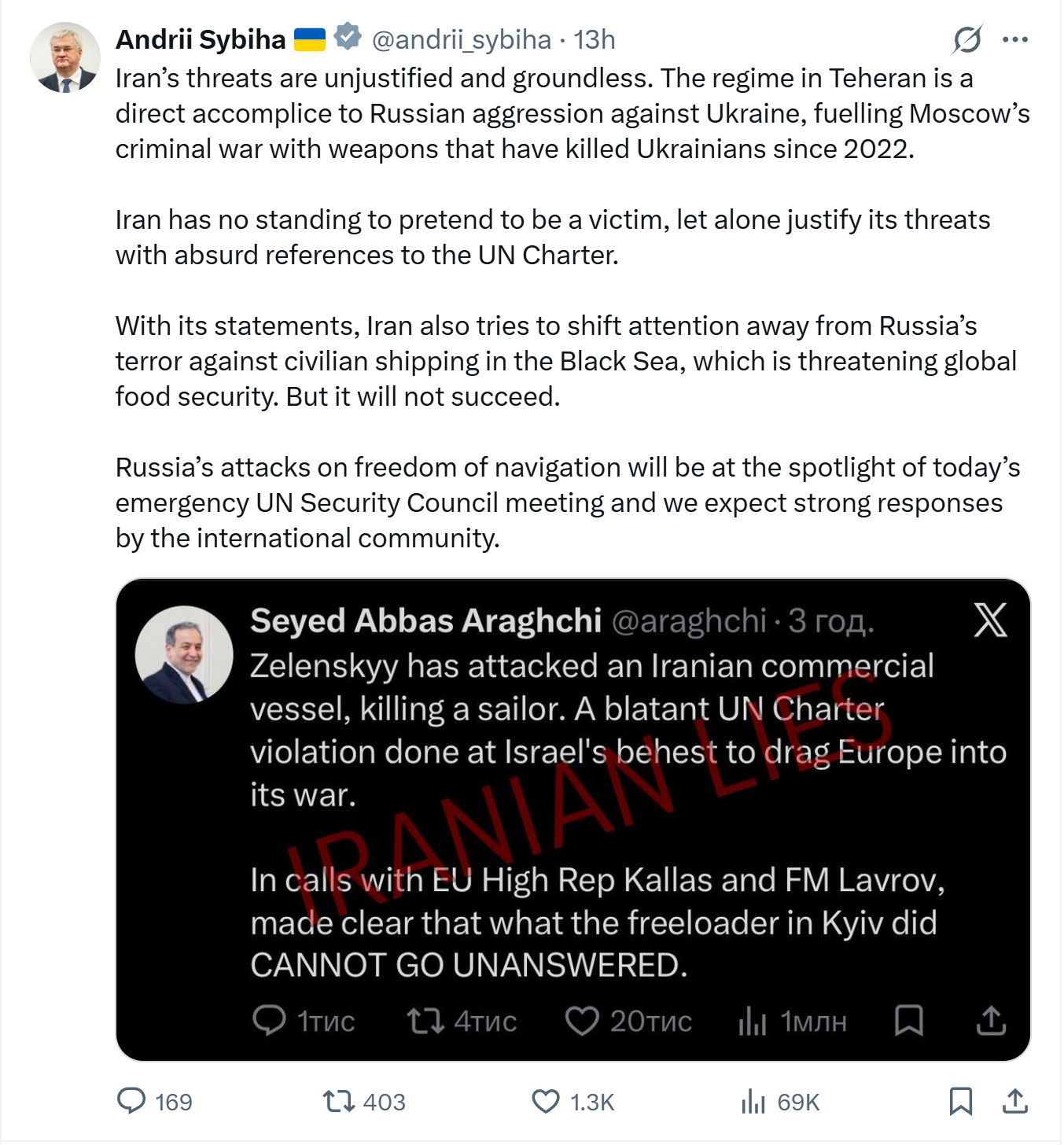
Zelensky is now apparently trying his hardest to merge the Ukraine and Iran wars in order to benefit from some military cross-pollination. By hitting an Iranian ship, which resulted in the death of an Iranian sailor, Zelensky appears to hope he can accomplish two things:
Curry favor with Trump. Essentially a “pick-me” move by Zelensky meant to show Trump his diehard loyalty to the Empire. “See, I hit your enemies for you, so will you help me now?”
As stated, cross-pollinate the two wars so that they appear to ideologically and strategically overlap as much as possible so that weapons aid to Ukraine can be more easily packaged as a kind of “broader” investment into combating America’s enemies, and thus made more palatable to the American lumpen.
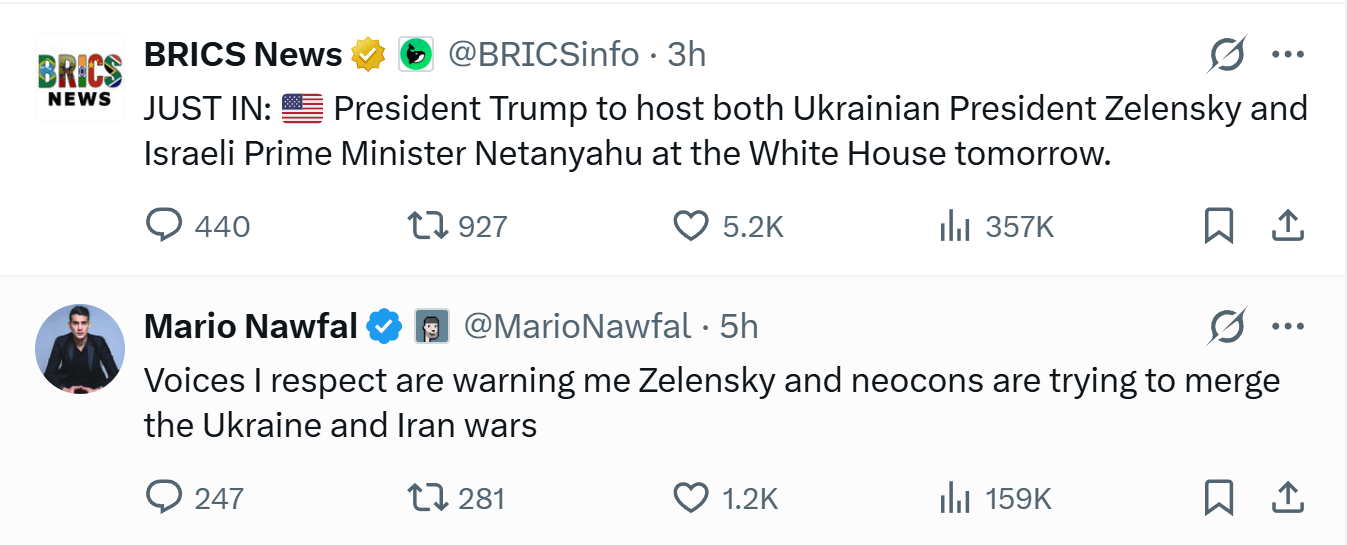
Trump’s simultaneous hosting of both characters from each respective war seems to imply such a direction is being considered or developed by imperial scriptwriters.
Iran was not impressed by Ukraine’s brazen act, however, and now a diplomatic tiff between the two nations has ensued:
All the while, Russia has ramped up its new campaign of Ukrainian infrastructural destruction in line with the hardening of Putin’s rhetoric.
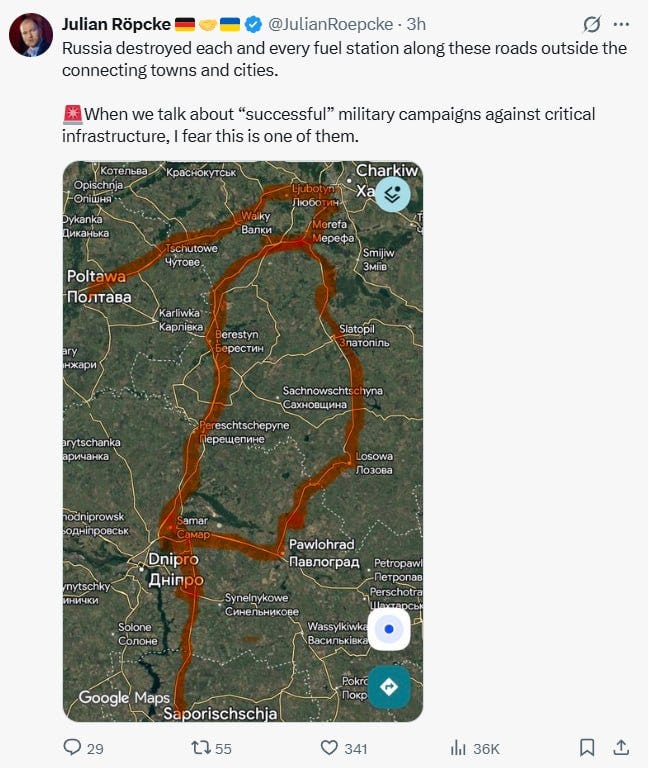
A Ukrainian regional council deputy from Kharkov revealed that every single gas station from Kharkov to Poltava has already been taken out by Russian drones:
All gas stations from Kharkov to Poltava have been destroyed, stated Kharkov Regional Council Deputy Skoryk.
He advised those planning a trip in this direction to stock up on fuel or cancel their trip.
Map-makers illustrated the extent of this damage:
 AMK Mapping 🇳🇿@AMK_Mapping_Ukrainian sources, including the Kharkiv Oblast councillor Oleksandr Skoryk, report that every single petrol station along the Kharkiv-Poltava Highway and Dnipro-Zaporizhzhia Highway have been destroyed by Russian drone strikes.
  8:31 PM · Jul 27, 2026 · 25.4K Views10 Replies · 51 Reposts · 550 Likes
Such a catastrophic predicament wouldn’t be complete without a conniption from resident doomsayer “Jihad” Julian Roepcke, who provided his own even sadder maps:
But roughly 30 days into Zelensky’s so-called 40-day campaign, Western publications are asking what effect, if any, has it had.
The Guardian quoted a bevy of experts—from Mick Ryan to Phillips O’Brien—and all seemed to agree that the campaign’s chief goal is to stir political and social unrest in Russia precisely timed with the State Duma elections, which begin not long after:
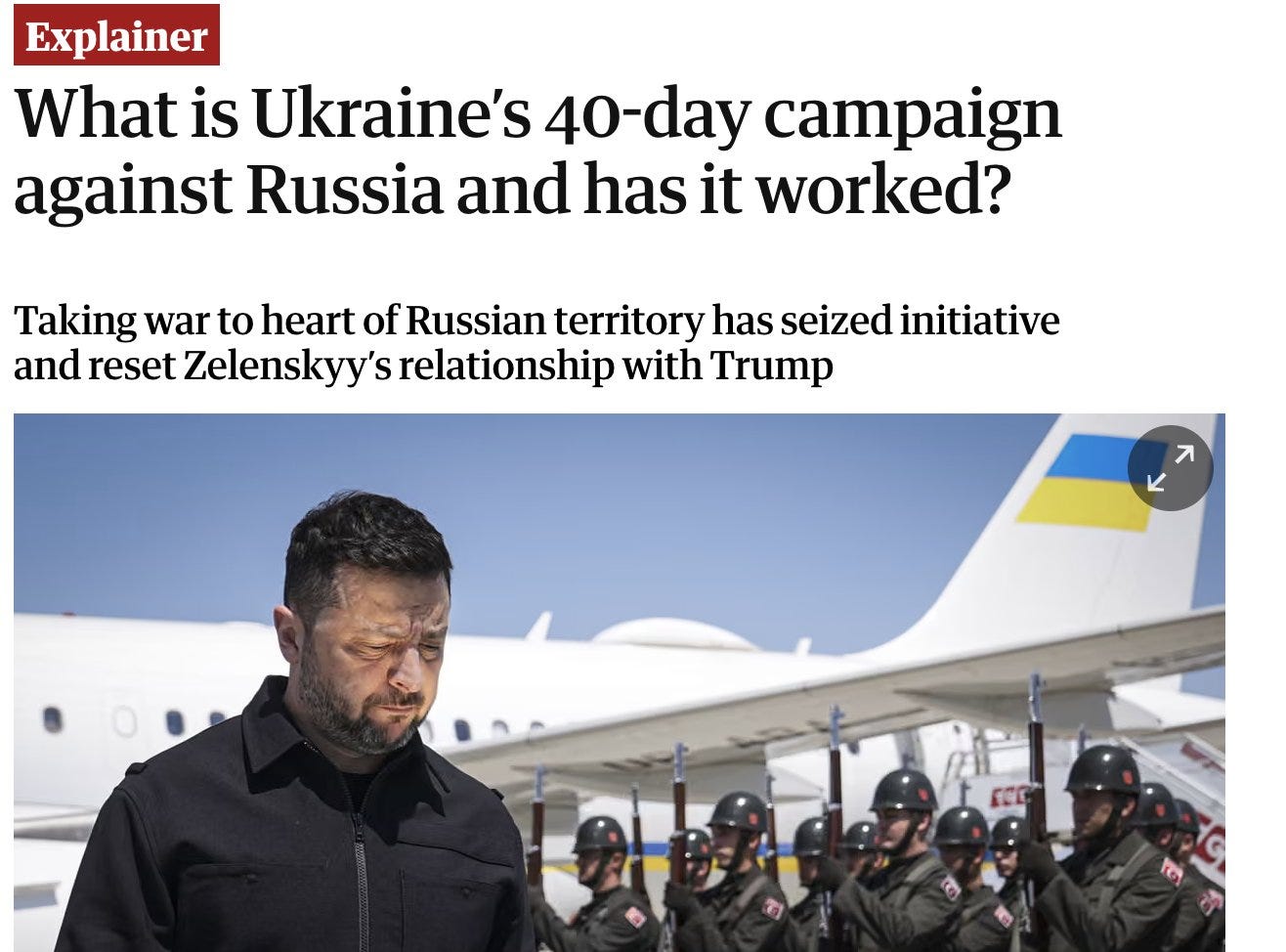 https://www.theguardian.com/world/2026/jul/16/ukraine-40-day-campaign-against-russia-has-it-worked
Beyond the metaphysical, Lutsevych sees the length of the campaign as having a political significance as well. “Elections for the Duma [Russian parliament] are in September. Part of the idea is to make Putin understand that it hurts his hold on power by doing everything to bring the war to Moscow and St Petersburg in particular.”
O’Brien admits it’s an outright psychological campaign simply meant to make some kind of point or attempt at a “gotcha”:
Phillips O’Brien, a professor of strategic studies at the University of St Andrews, adds: “It is a psychological campaign. I don’t think there is an expectation that the 40-day campaign will force Russia to surrender. It is a way of saying: ‘We can take the war to you’.
The article claims that the campaign may have succeeded in bringing Zelensky back into favor with Trump because, as others have noted, Trump likes “winners”. Now at a critical turning point when talks of Patriot production are brewing, Zelensky needs all the pull with Trump that he can get, particularly as Ukrainian experts again warn that Ukraine is approaching what will become another long, hard winter.
While crisis actor Zelensky dreams of stirring his performative unrest, Putin on the other hand appeared upbeat, again telling SMO participants that all objectives of the Special Military Operation will be completed in their entirety:
Now as of this writing, Ukrainian channels—and even Zelensky himself—warn that Russia is preparing one of the largest aerial strike packages of the war, with Kiev as the likely target.
Soon we will see if Putin’s sharpened rhetoric continues to live up to its word.
Your support is invaluable. If you enjoyed the read, I would greatly appreciate if you subscribed to a monthly/yearly pledge to support my work, so that I may continue providing you with detailed, incisive reports like this one.
Alternatively, you can tip here: buymeacoffee.com/Simplicius