The hack and the flack: How Steve Hilton’s wife, Rachel Whetstone, conquered California
Published Jul. 6, 2026at6:00am
Steve Hilton, the conservative British political operator running for governor of California, launched his longshot campaign in April 2025 before the idyllic backdrop of a Huntington Beach boardwalk. There, flanked by a yellow sign sporting his Trump-inspired campaign slogan, “Golden Again,” Hilton broadcast live video calls from Ohio gubernatorial candidate Vivek Ramaswamy and the late Charlie Kirk, and was joined onstage by members of the conservative Huntington Beach City Council, whom he referred to as the “MAGA-nificent seven.”
Not accompanying Hilton that day was his wife, Rachel Whetstone. In fact, Whetstone, a ginger-haired, manor-born British public relations executive who looks like a day at the boardwalk would be her idea of hell, has not attended a single Hilton campaign event since he declared his bid for governor. She has not appeared on her husband’s Instagram or Twitter, participated in interviews, or so much as commented on his run. Reached twice on her cellphone over weeks, she politely declined an interview for this piece.
Such an absence would be odd in any political campaign, where trotting out one’s spouse and children (the Hilton-Whetstones have two) is as classic a virtue signal as eating barbecue or throwing out the first pitch. But it is even more notable because Whetstone, in some circles, is more famous and influential than Hilton himself.
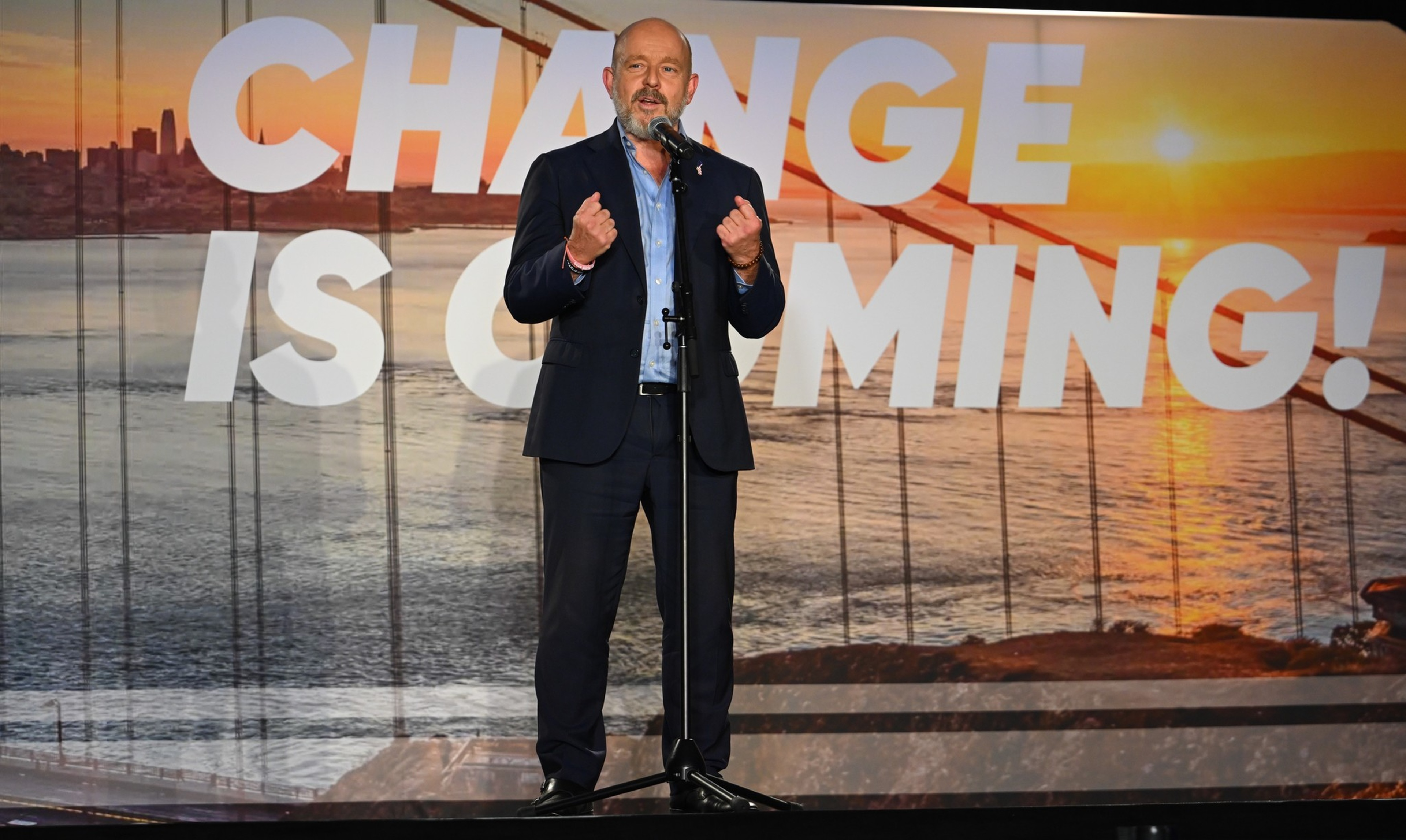 Steve Hilton speaks at his election-night watch party in Huntington Beach. | Source: Jeff Gritchen/Getty Images
Whetstone is what can only be described as a PR superstar — a woman Uber CEO Travis Kalanick used to call (opens in new tab) “the most powerful woman in Silicon Valley.” At 58, she has led communications for some of the world’s biggest tech companies: Google, Meta (then Facebook), Uber, Netflix, and now Sierra, the buzzy AI startup founded by OpenAI chairman Bret Taylor. One associate joked that if she hadn’t yet conquered FAANG — the Valley acronym for Facebook, Apple, Amazon, Netflix, and Google — then, “at least FUNG.”
In interviews with more than a dozen friends, associates, and former coworkers — most of whom spoke anonymously — Whetstone was described as “brilliant,” “fearless,” and “almost iconic,” but also “transactional,” “tyrannical,” and “one of the meanest people around.” (Several described her, essentially, as all of the above.) Some saw her brash, no-holds-barred communications style as saving their companies; others saw it as ruinous. One person had to reach for a fictional comparison. “You know when Tilda Swinton comes out in ‘The Chronicles of Narnia’ as the ice queen?” this person said. “She’s like that.”
Associates are equally divided on the political dimensions of her relationship with Hilton. While Whetstone has been an open conservative for decades, some said the anti-trans, pro-Trump tone of her husband’s campaign did not square with the woman they knew. Some insisted she and Hilton kept their work lives separate; others said she had personally connected his campaign with journalists she knows. Still others pointed out the hypocrisy of her husband’s populist, occasionally anti-tech rhetoric — not to mention his proclivity for using a flip-phone in lieu of an iPhone — noting that Whetstone’s career in Silicon Valley has funded his lavish lifestyle. “Really, Steve? How do you like that house in Atherton?” one joked.
What the majority agreed on, however, was that they could not imagine Whetstone in the governor’s mansion.
“She’s substantive, for sure, whip smart, and extremely scary on every level,” one fellow comms professional said. “But Rachel Whetstone as the first lady of California is the funniest shit.”

Whetstone is actually the reason Hilton lives in California in the first place. The pair met in the early 1990s at London’s Conservative Central Office, working in research and speechwriting. They came from strikingly different backgrounds: Hilton, the son of working-class immigrants from Hungary; Whetstone, the child of a posh, political family from rural Sussex. Whetstone’s grandfather, Sir Antony George Anson Fisher, was the founder of high-profile libertarian think tanks, her mother an accomplished equestrian and libertarian campaigner. The British society magazine Tatler described her upbringing as “a childhood of dogs, horses, rustling newspapers, and Radio Four.” A friend says she once facetiously joked that Hilton was the only man she’d ever dated who hadn’t gone to Eton.
Despite their differences, the two became fast friends, joining the up-and-coming clique of young conservatives who would soon run the country when David Cameron — an associate of theirs from the Conservative Central Office — became prime minister in 2010. Hilton made a name for himself as Cameron’s somewhat wacky chief adviser; a “bare-footed, new-age guru,” according to one observer, who helped soften the Tory leader’s image into one of compassionate, climate-friendly conservatism. Whetstone too seemed poised to be a major player in the new political order, until it was revealed in the early 2000s that she’d been in a years-long affair with Viscount William Waldorf Astor — the stepfather of Cameron’s wife. Whetstone left British politics for good shortly thereafter.
Whetstone and Hilton started dating not long after news broke of the affair — Hilton is reported to have comforted her through the scandal — and the two were married in 2008 in a surprise Cotswolds ceremony that family and friends had expected to be their son’s christening. By then, Whetstone had landed on her feet as Google’s head of communications for Europe, Asia, and the Middle East. Soon after, she was invited to serve as vice president of communications for the entire company. In a surprising move, the couple agreed to come to California for a year-long stint, with Hilton reporting remotely to London.
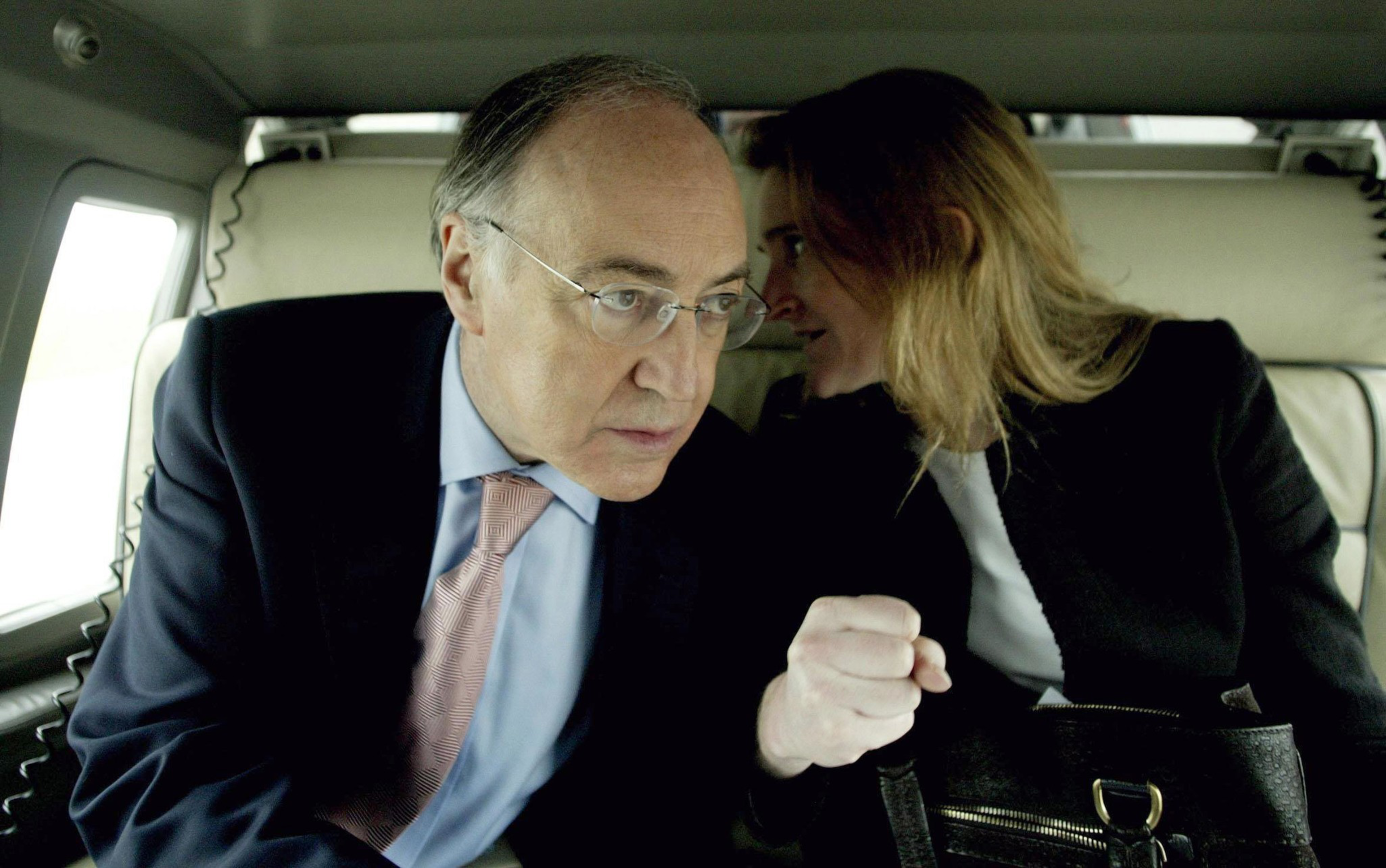 In Britain, Rachel Whetstone served as political secretary for Conservative party leader Michael Howard. | Source: PA Images via Getty Images
When Hilton and Whetstone arrived in Silicon Valley in 2008, their roles seemingly reversed. As head of communications at Google, Whetstone was undeniably the breadwinner. (In his 2024 tax returns, Hilton reported earning $250,000 from Fox News that year, while Whetstone earned $6.7 million at Netflix.) To people in the Valley, Whetstone was the only half of the couple that mattered. “Steve was totally off the radar. Nobody had ever heard of this guy,” a former coworker of Whetstone’s recalled. “Rachel was seen as the person who was much more influential than Steve.”
The couple moved back to the UK briefly in 2009, but when Hilton resigned as Cameron’s adviser three years later, they went straight back to Silicon Valley. While Whetstone led comms and policy for Google, Hilton bounced between jobs — taking an “unpaid sabbatical” at Stanford, writing a poorly reviewed book (opens in new tab) about big government, and starting the political crowdfunding platform CrowdPAC, which has since shut down and rebranded. Coworkers of Whetstone’s say they saw and thought little of her husband, except when he showed up in her office in a cycling kit. “Everyone knew that he had that political career that was quite substantive, but he was kind of just the quirky husband,” said tech journalist Kara Swisher, who first met Whetstone during those years.
So Whetstone’s coworkers were confused when Hilton popped up with a Fox News show in 2017, touting his support for Trump. Friends knew the pair were conservative, but in a British way — that is to say, fiscally conservative but socially liberal. The talking points Hilton used on Fox — calling for an investigation into the 2020 election results; railing against critical race theory and “radical gender ideology” — didn’t square with what they knew of Whetstone. “When I was working with her, I certainly felt that she has a moral compass, is LGBTQ friendly, comes from more of a ‘live and let live’ attitude,” one former coworker said. Another said that on TV, Hilton “was suddenly much more unrecognizably, weirdly conservative, in ways that none of us had known.”
Their dismay only grew when Hilton launched his campaign for governor in April 2025, promising to “end the years of Democrat failure” in California. He has since pledged to end homelessness by criminalizing street camping, described the state’s sanctuary immigration laws as “ridiculous” and “unconstitutional,” and last month joined a “Save girls sports” rally to protest trans athletes. In April, Trump gave Hilton his “COMPLETE & TOTAL ENDORSEMENT,” helping propel him past a GOP rival, Chad Bianco, in the June primary. As Hilton stormed into the November general election, where he’ll face off against heavy favorite Xavier Becerra, Whetstone’s former coworkers looked on in befuddlement. “A lot of us are just like, ‘Holy cow, what does Rachel think about all of this?” one said. “Because his public image and his courting of Trump and wearing of the Charlie Kirk bracelet does not align with what I know of her.”
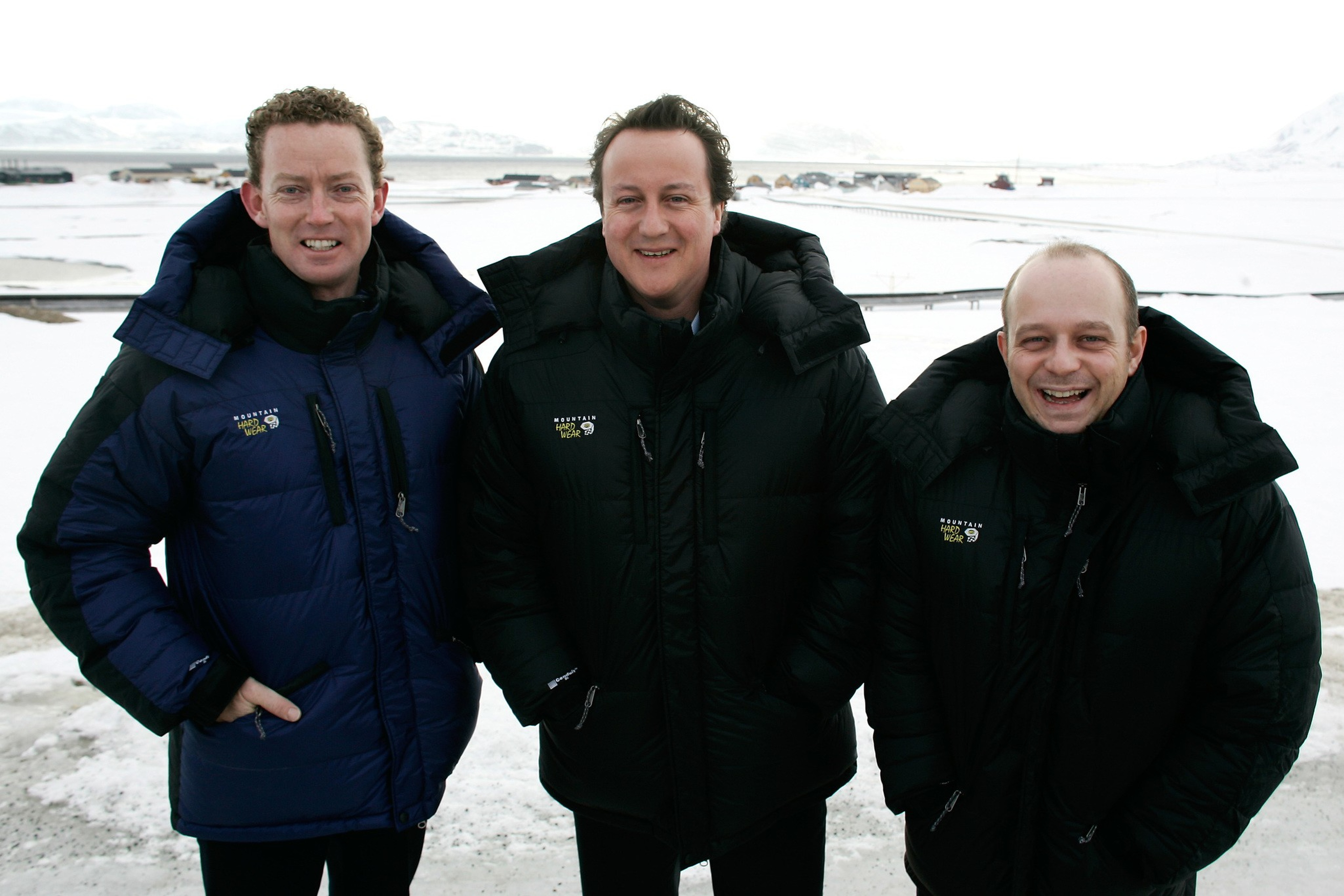 Hilton, right, was a top aide to Prime Minister David Cameron, center, helping soften his conservative image. | Source: PA Images via Getty Images
Associates were equally stumped by the idea of Whetstone as first lady of California. Aside from her dislike of formalwear and being in photos (“Have we ever seen them dressed up together for a formal event?” one former coworker asked), there is her strong distaste for anything resembling partisan politicking. One ex-colleague said Whetstone did not even like talking to reporters on the phone — “that was for her staff” — and scoffed at the idea of her shaking hands and kissing babies. As for performing the traditional first lady roles, such as hosting women’s events? Unimaginable. “She would be eyerolling behind the scenes about these sorts of things,” the person said.
That’s not to say Whetstone has been unsupportive of the campaign, albeit from her preferred position in the background. At least one journalist told The Standard that Whetstone personally encouraged him to cover Hilton’s campaign launch, and Swisher said Whetstone reached out to her during the primary about having Hilton on her podcast. (Swisher plans to interview him in the coming weeks.) For those confused about Whetstone’s politics, one longtime friend suggested: “Rachel has always been a conservative. I think what’s changed, candidly, is that you’re allowed to be as conservative in Silicon Valley now.”
Hilton, meanwhile, took offense to this line of questioning at all, saying in a statement: “We totally reject the tired, patronizing notion of a candidate’s spouse having to be dragged around the campaign trail as a prop.”
“I have my job, and my wife has hers, which she has always done so incredibly well — all of it alongside being my best friend, strongest supporter, the person I admire most and a wonderful mother to our two children, someone I love more deeply than words can express,” he said.
For someone capable of generating so much buzz, Whetstone cuts an unassuming profile. In London, according to the 2018 Tatler profile (opens in new tab), Whetstone was famous for driving a Fiat Panda so run-down that a homeless man once camped in it for the night, assuming it had been abandoned. At Google, she often showed up wearing Converse and jeans, her hair unstyled and face bare, former colleagues said. Two Uber colleagues recalled her walking around the mid-Market office barefoot, in echoes of her husband’s signature style.
A Google coworker recalled that when Whetstone was in charge of the communications department holiday party, they had pizza and beer at a dive bar on the Peninsula. One colleague who had been to her home — a $12.5 million Atherton mansion she shares with Hilton, their children, and, according to Tatler, bantam chickens, tortoises, and pigs — said there was schoolwork on the table and toys on the floor. “It felt like a real family lived there,” she said.
Have thoughts on this story?Start the conversationBut Whetstone’s lack of glamor should not be mistaken for an absence of ambition, coworkers said. “She didn’t like dressing up, she didn’t like putting on makeup, she didn’t like being out front,” one explained. “But she did very much like being powerful.”
Indeed, from her first day in Menlo Park, Whetstone was a force. Former Google coworkers described a no-nonsense workhorse who seemed not to sleep or to eat, addicted to the thrill of tackling the company’s seemingly ceaseless communications crises. And unlike many of her peers, Whestone was unafraid to make her opinions known — even if it meant contradicting co-founders Sergey Brin and Larry Page or CEO Eric Schmidt. “You can get away with saying a lot when you have a nice British accent,” one former coworker said. “She would just say what she thought and be very clear and concise about it, and people would listen to it.” Plus, this person added, “she was usually right.”
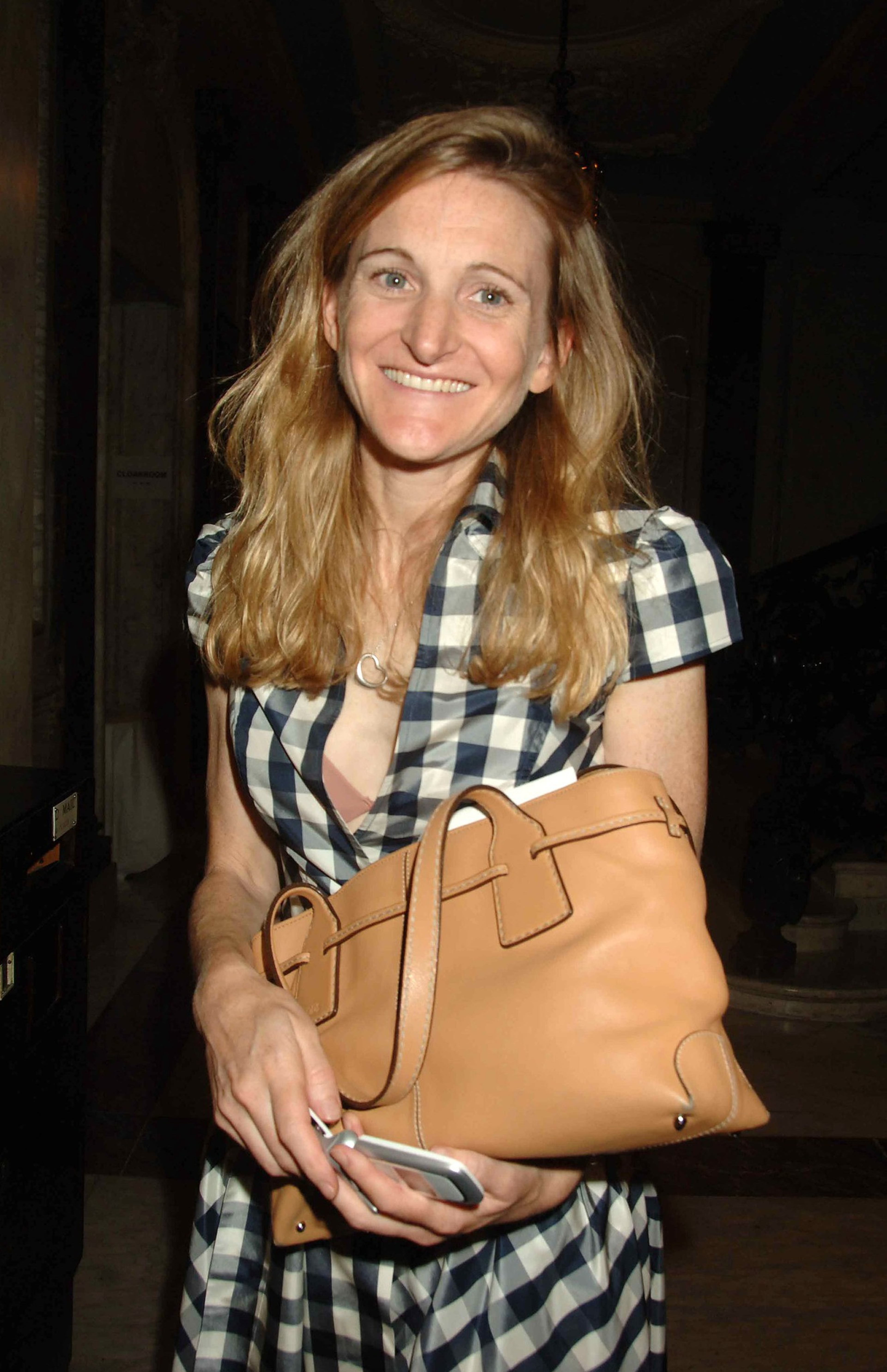 Whetstone was highly regarded at Google for her commitment to truth-telling. | Source: Alan Davidson/Shutterstock
Whetstone applied that same straightforwardness to her comms strategy, crafting a bold, unapologetic voice for Google’s public relations that delighted the tech press. Once, in response to a reporter’s request for comment, Whetstone’s team responded simply with a GIF of a girl shrugging. Days later, after The Wall Street Journal published a story critical of Google’s lobbying operation, Whetstone authored a blog post directed at the Journal’s owner, Rupert Murdoch. Titled “Really, Rupert?” (opens in new tab) the post tore apart the accusations in the article in cheeky, British style, deploying multiple GIFs for effect. It made headlines on both (opens in new tab) sides (opens in new tab) of the Atlantic.
But coworkers said Whetstone was also deeply principled, insisting that Google executives own up to mistakes and apologize when they had done something wrong. Two former coworkers recall her pushing executives to proactively reveal that Google’s streetview cars had unintentionally been gathering private data from home Wi-Fi networks in Germany — which it did, in a major scandal on the Continent (opens in new tab). “Rachel was, ‘We tell the truth — fiercely so,’” one former coworker said. “‘We put information into the world even if we don’t like it, because transparency builds trust.’”
That’s what makes her husband’s closeness to Trump — who recently (falsely) claimed that a phone call he made to a U.S. attorney (opens in new tab) was the only reason Hilton made it out of the primary — so baffling to some.
“Rachel is a nice person, even though she’s scary as hell,” a former coworker said. “The horribly homophobic, anti-transness of the cultural conservative world right now — the Steve Hilton Fox-ness? It just doesn’t seem like Rachel to me.”
The more you learn about Whetstone, the more you realize she is a study in contradictions. People described her as, alternately, the worst boss they’d ever had, or the one they learned from the most. One coworker compared her to artificial intelligence, saying: “You know how AI has a massive ego but no empathy?” But others said she knew the names of everyone on her 300-person staff at Google and made a point to deliver personal gifts whenever someone had a baby. One staffer recalled Whetstone pulling her aside to comfort her after a miscarriage. “Sometimes she seems superhuman,” this person said, “but she has these moments of real humanity as well.”
Several coworkers said they found Whetstone’s bluntness clarifying, her open ambition refreshing. Some women who worked alongside her even found it liberating. “Whatever women feel like they need to be in the world, she doesn’t,” one said. “If you feel like you need to be a people pleaser or liked or maternal or warm — Rachel’s like, ‘No.’” There are days, this person added, when she still tries to channel Whetstone in her work. “I’m like, what would Rachel do?” she said. “She’d probably be a bitch.”
This dichotomy extended to Whetstone’s work product. While her direct, brutally honest style played well at Google, it was less effective at Uber, where Whetstone moved in 2015 and quickly clashed with CEO Kalanick, who was much less open to her — or anyone else’s — advice, associates say. In 2017, she took a job at Facebook as head of communications for WhatsApp and Instagram, reportedly looking for something a little more relaxing. “I told her to go home and clean her closet for six months [after Uber],” one friend said. “She did not listen to me, and that was not a good idea.” Instead, she was pulled into managing press for what became Facebook’s most infamous scandal: the Cambridge Analytica affair.
During those early, rocky months at Facebook, Whetstone attempted to deploy the same bold, impish communications style she had used to great effect at Google. This time, however, her client was not seen as a scrappy underdog taking on media titans, but as a tech behemoth that had possibly handed the election to an authoritarian. It did not go well. In one infamous incident, Whetstone reportedly (opens in new tab) oversaw an interview in which CEO Mark Zuckerberg told Swisher that he would not ban Holocaust deniers from the platform, resulting in weeks of backlash. One former Facebook coworker called the interview “disastrous.”
As the Cambridge Analytica scandal progressed, tensions inside Facebook continued to rise. Multiple people described Whetstone as the “opposite” of all-powerful COO Sheryl Sandberg. (“Sheryl is like, ‘Let’s win them over with honey,’” one former coworker said. “Rachel’s like, ‘What is the hardest-core fight we can pick? And let’s pick that fight now.”) When Whetstone’s mentor, Elliot Schrage, left the company in June 2018, she did not take on his role as some had expected. Instead, she left the company five months later, after just over a year — even less time than her ill-fated turn at Uber.
A former Uber colleague recalled watching her resignation with grim satisfaction. “Textbooks will be written about how not to do things like this,” he said. “Facebook gave us Donald Trump, and Rachel Whetstone managed the response.”
Today, Whetstone runs communications for Sierra, a successful if deeply unsexy enterprise AI company started by former Googlers Taylor and Clay Bavor. She joined in March 2025, after an uncharacteristically drama-free six years at Netflix, where multiple colleagues sung her praises. Many observers saw the move to Sierra as a rare step down, and some wondered why she hadn’t taken a job at a leading AI company like OpenAI. A few ventured that she was perhaps making room for her husband’s political career; others doubted she was capable of it. “She is kind of addicted to the battle,” one friend said. “It’s hard to imagine her giving up a high-octane comms job for a more quiet life in the garden.”
The irony is that, despite her reduced status in Silicon Valley, Whetstone may end up being more politically influential in the U.S. than her husband. Despite his impressive showing in the primary — and support from tech moguls like Brin, Chris Larsen, and Palmer Luckey — Hilton is a Republican running in deep-blue California, and a British one at that. (As of early July, prediction market Kalshi gave Hilton just a 7.8% chance (opens in new tab) of defeating Becerra in November.) Whetstone, however, had a hand in shaping policy at some of the biggest companies in the country — and, according to many observers, in ushering in a new era of political savvy in Silicon Valley.
For one, Whetstone had a hand in training a generation of future tech comms leaders. At one point in the mid-2010s, people who worked under her at Google were running comms for a herd of unicorns: Gabriel Stricker at Twitter, Jill Hazelbaker at Snapchat, Ollie Rickman at Stripe, Aaron Zamost at Square, Barry Schnitt at Pinterest, Brian O’Shaughnessy at Skype, Anne Espiritu at Yahoo, Ricardo Reyes at Tesla. (Asked what made her such a good mentor, one disciple said, “I wouldn’t say she’s a good mentor. She’s a good leader.”)
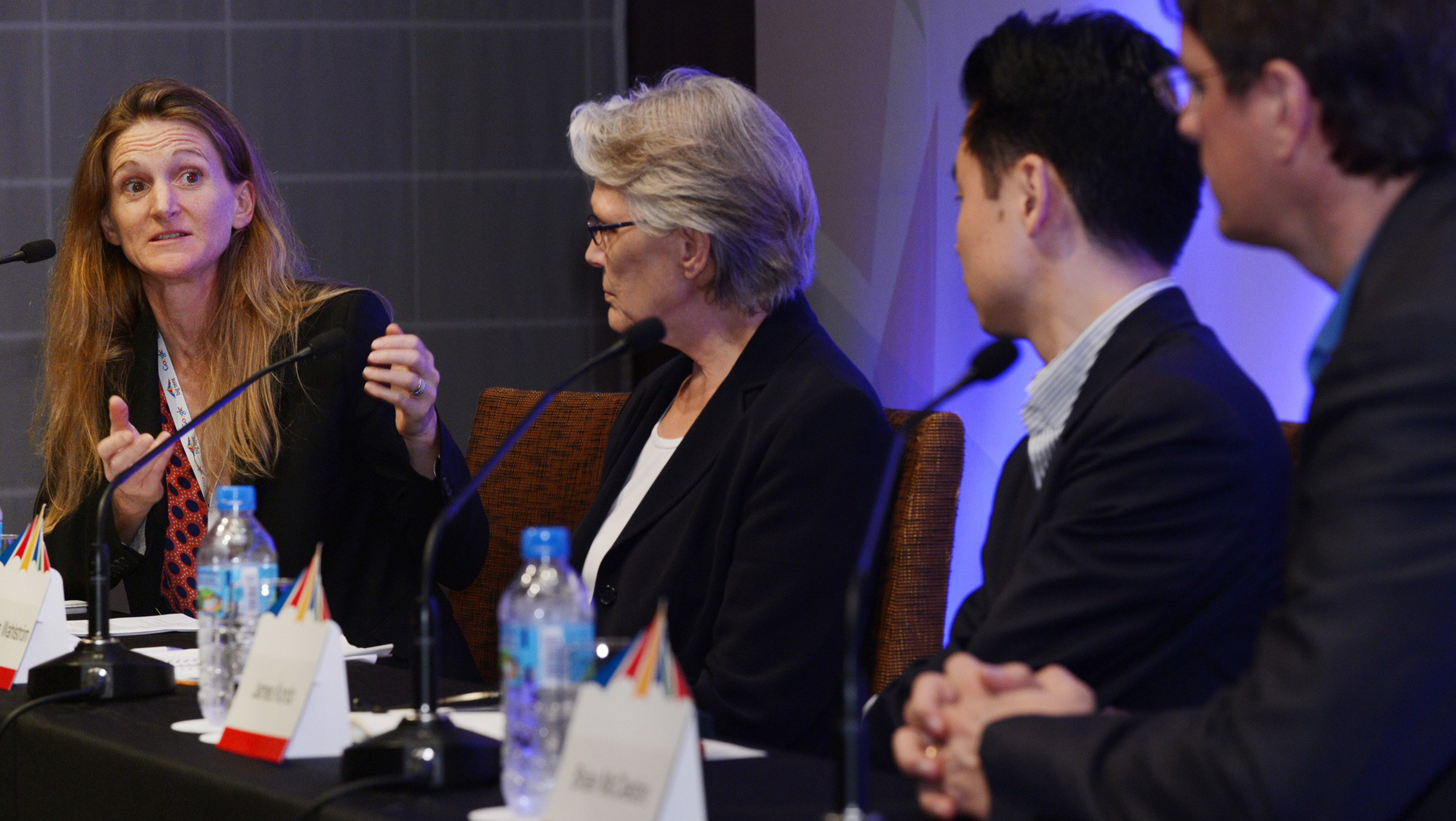 Whetstone helped train a new generation of Silicon Valley comms leaders. | Source: AFP via Getty Images
But more than that, Whetstone helped forge a new role: the communications chief who also runs policy; the PR guru who runs public relations blitzes like a political campaign; the corporate operator who knows when to turn to the masses, and when to play to the elite few in control.
At Google, a coworker said, Whetstone saw the anti-trust fight coming and “rightfully recognized that this was not a battle you win in the courtroom — this is a battle you win with the public and with policymakers.” While most of the company’s political staff at the time were wonks with connections with federal regulators, Whetstone started hiring staffers with experience on the Hill. When members of John McCain’s presidential campaign were left jobless in 2008, this coworker said, “Rachel was like, ‘Hire em up! These are smart, reasonable people who know how to talk across the aisle, they know how policies get made, and they have relationships in Washington.’”
And at a time when tech felt like “kind of a giant party with the Obamas,” one coworker recalled, Whetstone wasn’t afraid to work with Republicans. She pushed the companies she worked for to remain politically neutral and to remember that conservatives could, in fact, return to power. Whether this was prescient or just wishful thinking is a matter of debate, but coworkers said Whetstone’s outsider status – and her experience in the more coalition-oriented world of British politics – allowed her to see outside the liberal tech bubble and into a future where Republicans once again reigned.
The Silicon Valley of today looks much like what Whetstone may have envisioned: Tech companies employ armies of lobbyists; startups throw parties around the White House Correspondents Dinner; tech billionaires are arguably the largest set of donors to state and national political campaigns. (They are even, as The Standard reported, secretly backchanneling and starting their own political groups to fight local policies they dislike.) And Valley titans have pivoted enthusiastically to the new conservative administration, flanking the front rows of Trump’s inauguration and lining up to donate to his East Wing ballroom renovations.
To some, this is a sign of Whetstone’s genius. “She was early in predicting that in the long run, being viewed as bipartisan was going to be important,” one coworker said. “And I think she was proved right there.” But to others, it represents something darker: a more strategic, cynical tech industry, ushered into political power by people who, like Whetstone, have been trained in its dark arts. A Silicon Valley that could support, say, a populist, anti-tech Steve Hilton — who has repeatedly suggested banning smartphones for children under age 16 — if it meant getting lower taxes or, more importantly, currying favor with an autocratic commander in chief.
“You look back to Google in the early days, and their entire brand was smart geniuses trying to connect the world, sitting on colored balls, inventing wacky things,” one former coworker recalled. Around the time Whetstone came to California, “you suddenly have this hyper-aggressive operation rolling out talking points and messaging strategies … which then became a marker for a whole shift within the Valley.”
“I think people will now look back on that world before characters like Rachel, and they’ll barely remember it,” this person added. “They won’t even think that was real.”