Bloomberg published a revealing Morning Consult poll on U.S. interest in the World Cup soccer tournament, which kicks off on Friday.
More than half of all U.S. adults say they won't be watching any of the 104 matches available to stream on Fox One, Fox, F1, and Fox. Just 13% of U.S. adults said they planned to watch any of the matches.
Breaking the poll numbers down by generation, Gen Z is the most interested, with 23% "very likely" to watch some of the games. On the other hand, 59% of Boomers are "not likely at all" to watch any of the games.
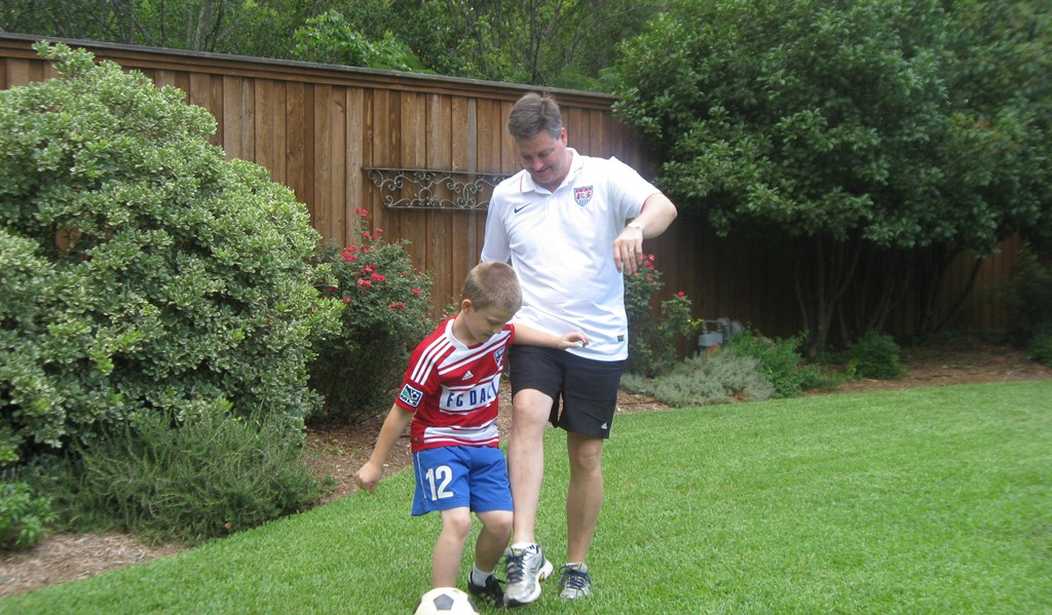
Playing soccer in the suburbs has been a rite of passage for kids for the last 40 years. But by the time these soccer kids reach high school, most of them have lost interest. Little girls love the women's national team, which, until recently, was far more popular than the men's national team. Having dumped much of the political correctness, the U.S. women are once again one of the top teams in the world. They will be one of the World Cup favorites in Brazil next year.
The men are better than they used to be, but they are still in the second or third tier of international excellence. This is insane. Billions of dollars go into youth soccer in America, and that might be the problem.
Landon Donovan — the finest player the country has produced — recently put the blame on American soccer’s youth system. His complaint centers on the win-at-all-costs mentality that seemingly grips the system. Parents and coaches, Donovan argues, “get obsessed with winning just as much as the coaches do because they’ve been told that’s what’s going to get their child to college and professional — and it’s all bulls**t”. In truth, of course, children don’t need to be the next Pelé in kindergarten; they just need to develop a feel for the game that scoreboards can’t reward.
It’s here where the money comes in. Youth sports in America are now a $40 billion industry — and private equity has quietly captured a great deal of it. Firms such as Juggernaut Capital have rolled up hundreds of local clubs into national conglomerates; 3STEP Sports, backed by Juggernaut, controls more than 1,500 events serving more than two million athletes a year. The tactics are the familiar ones of private-equity extraction: junk fees, long contracts, mandatory and expensive travel circuits. What was once an affordable neighborhood activity has been re-engineered into a maximum-extraction machine, with elite youth club soccer now costing many families upwards of $5,000 a year per child.
In Brazil, kids who live on or near garbage dumps play soccer all day, every day. Even in Europe, the game is constantly played by the poorest kids. All of them are hoping to catch lightning in a bottle and get noticed by a scout or youth coach who will take them under their wing and develop their skills. The very best, the very hungriest, and most talented kids are noticed early and brought along in youth programs that the U.S. will never be able to duplicate.
In America, soccer is a game played by suburban kids twice a week and in the occasional tournament. Even the millions of kids who love the game and have dreams of playing in the World Cup are stymied by a youth program that fails them.
Recommended: Poll: Democrats Willing to Throw Black Voters Under the Bus to Gain Power
Every World Cup, enthusiasts proclaim that soccer will take off and become as popular as football and basketball in the United States. They've been saying it since 1994, when the last World Cup was played here. It fails to happen not because soccer competes with other sports for attention. It's something far deeper, rooted in our self-image as a nation.
In 2001, scholars Andrei Markovits and Steven Hellerman published Offside: Soccer and American Exceptionalism. ”Nativistic Americans, the authors found, prefer individualistic and militaristic games that mirror the country’s political culture," writes UnHerd's Duncan Moench.
Markovits and Hellerman argued that American soccer developed along totally different lines from the country’s more mainstream sports. Given the tremendous strength of US nativism, early on soccer was seen as dubiously foreign: both in origin and application. (As late as 2014, Ann Coulter was arguing that the growing popularity of soccer reflected the moral decay of the country.) Yet as that early hipster fandom implies, the opposite ended up happening. Study-abroad trips are expensive, and far from becoming a blue-collar pastime like basketball, American soccer ultimately remained the purview of white suburbanites. Though the US has grown the technical capacity to compete at international soccer, those in charge of running our youth system have optimized the program to extract maximum revenue from bougie parents — hardly conducive to honing talent.
In other words, U.S. kids aren't poor enough or hungry enough to have that overweening drive to make it as professional soccer players. Plus, the game's appeal loses its luster when kids start playing football and basketball.
"The raw athletic talent is almost certainly lurking out there, in the immigrant neighborhoods and the public parks," writes Moench. "It’s just that we’ve built a machine to price those kids out."
Changing that culture is not high on the priority list of suburban parents who want their kids to get into a decent college, not chase a soccer dream around the world.
Editor's Note: President Trump is leading America into the "Golden Age" as Democrats try desperately to stop it.
Help us continue to report on President Trump's successes. Join PJ Media VIP and use promo code FIGHT to receive 60% off your membership.
Recommended
Trending on PJ Media Videos
The SPLC President Spat on Charlie Kirk's Grave and Instantly Regretted It