Hello and welcome to Monday, July 6, 2026. My calendar says it's National Fried Chicken Day, International Kissing Day, Umbrella Cover Day, National Air Traffic Control Day, and Virtually Hug a Virtual Assistant Day. How we are to accomplish this, I haven't a clue.
Today In History:
1535: English statesman Thomas More was beheaded for refusing to recognize King Henry VIII as head of the Church of England.
1785: The Continental Congress established the dollar as the official currency of the United States.
1885: Louis Pasteur successfully tested his antirabies vaccine.
1933: Major League Baseball's first All-Star Game was played at Comiskey Park in Chicago.
1942: Anne Frank and her family went into hiding in Amsterdam, an ordeal later chronicled in her diary.
1944: A fire tore through a Ringling Bros. and Barnum & Bailey Circus tent in Hartford, Connecticut, killing 167 people.
1944: Jackie Robinson refused to move to the back of a military bus, leading to his court-martial years before he broke baseball's color line.
1957: Althea Gibson became the first Black player to win the Wimbledon women's singles title.
1957: Paul McCartney met John Lennon for the first time at a Liverpool church event, setting the stage for the Beatles.
1964: Malawi (formerly Nyasaland) gained independence from Britain — observed today as Malawi's Independence Day.
1975: The Comoros Islands gained independence from France — observed today as Comoros Independence Day.
1976: The U.S. Naval Academy inducted its first female midshipmen.
1988: The Piper Alpha oil platform exploded in the North Sea, killing 167 workers in one of history's worst offshore disasters.
1994: Forrest Gump, starring Tom Hanks, opened in U.S. theaters.
1995: Bosnian Serb forces began their assault on Srebrenica, leading to the massacre of more than 7,000 Bosniak men and boys.
Birthdays Today Include: President George W. Bush; Sylvester Stallone; former First Lady Nancy Reagan; Merv Griffin TV host/producer; The 14th Dalai Lama, Tenzin Gyatso (Tibetan spiritual leader); 50 Cent rapper/actor; Kevin Hart comedian/actor; Eva Green actress; Allyce Beasley actress; Della Reese singer/actress; Jason Isaacs actor; and Michelle Kwan Olympic figure skater.
If today's your birthday too, happy birthday — you're in good company!
* * *
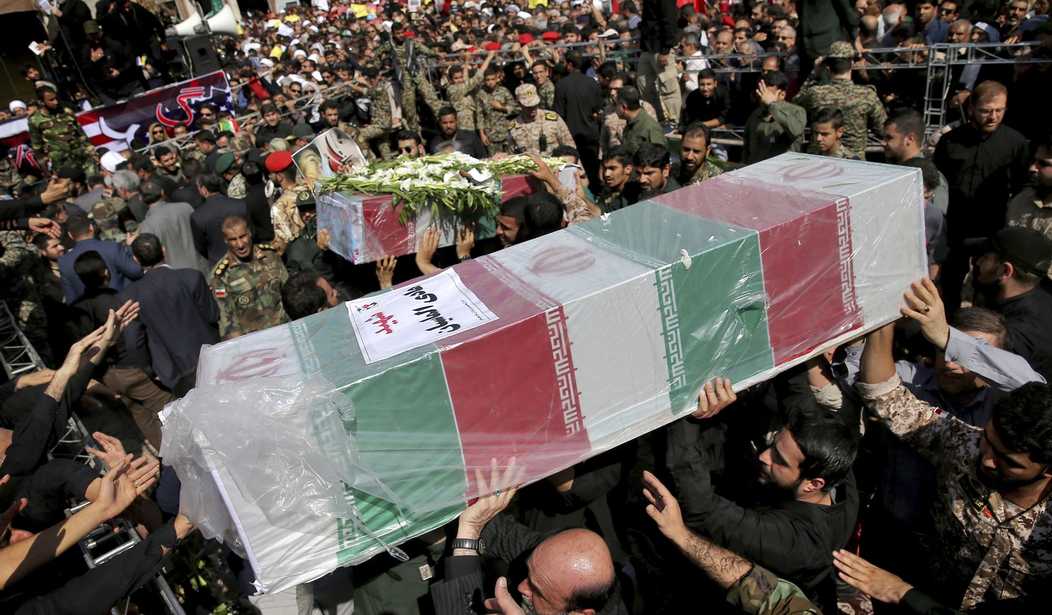
So the state funeral for Ali Khamenei — who exited via explosion, because subtlety was never really Iran's thing — kicked off today. It seems a good move to use the occasion to clear up some things people keep getting wrong about the dynamics involved in the Iran problem, and what to do about it all. I'm afraid there's no short-term answer for these questions. As I've said many times, problem-solving requires correct problem identification. So, here we go.
The first error most people make with Iran is in thinking that Tehran is like Washington with worse traffic. The truth is, Iran's leaders aren't politicians. They're clerics. Try not to forget that one, because it's the whole ballgame.
Khamenei spent his tenure as the final word on:
The military, including the Revolutionary Guard
Foreign policy
The judiciary
State broadcasting
Intelligence and security services
Who gets to be a senior judge or general
Since 1979, Iran cycled through a rotating cast of presidents — Ahmadinejad, Rouhani, Raisi, Pezeshkian, take your pick — all of whom operated on a leash held by the Supreme Leader. Impressive-sounding titles, but very limited authority. They were figureheads only.
Most governments make decisions the boring, predictable way: Weigh the economy, check the military, glance at the polls, try not to get voted out. Iran glances at all that too, then shoves it aside in favor of religious doctrine and revolutionary purity. If GDP and public approval were actually running the show, this regime would've collapsed ages ago. Instead, "what does Islamic law say" wins, every time.
This isn't a country with a state religion bolted on for flavor. It's a theocracy, full stop. There is a difference, you see, between religion being in the culture and the culture second-handedly driving some aspects of the laws of the country, and the more direct approach that Iran has as its basic makeup.
The president and parliament are set dressing. Actual authority sits with a senior Shiite cleric whose job description is "protect the Islamic character of the state and the 1979 revolution" — and every institution answers to him, not to voters.
That's the part Western policymakers keep tripping over. They keep assuming Iran's leadership can be bribed with incentives, scared with threats, or swayed by public opinion — like they're dealing with any other government. Sometimes that works. Often, it spectacularly doesn't, because the men making these calls don't answer to an election cycle or a quarterly earnings report. They think they're accountable only to Allah. So, as long as they’re breathing, that’s their priority.
It doesn't mean they're irrational, unfortunately — they're actually quite disciplined and patient, which is worse for anyone hoping they'll blink first. Their goals just aren't the ones secular governments chase. Preserving the revolution, exporting it, and resisting Western influence aren't talking points to them. They're gospel.
So naturally, "How do we fix Iran?" gets you a different answer depending on which capital you're standing in. Washington, Jerusalem, or Brussels all have their own pet theories, each with its own frailties, and none of them agrees with the others. Here’s my list of possibilities:
1. Maximum pressure (sanctions + military deterrence)
The theory: strangle the economy, keep the military threat looming, and eventually the regime either buckles or gets too weak to throw its weight around. Cute idea. Except, as established, it assumes Iran's leadership does cost-benefit math like a normal government instead of a body that thinks it answers to God. It nibbles at the edges — oil exports, proxy funding — but it has never once talked the clerics out of the theological mission, because that was never on the table. And after an actual war and a dead Supreme Leader, pressure is already pretty well maxed out. So what exactly is the next move, more sanctions on a country already sanctioned into the Stone Age? Certainly keep pressure on them, but don’t expect such pressure alone to solve the problem.
2. Diplomatic engagement (JCPOA-style deals)
The theory: dangle an economic off-ramp, let the "pragmatists" (yes, they technically exist, buried somewhere under the clerics) win some internal points against the hardliners. It occasionally works on boring technical stuff like enrichment levels. It does absolutely nothing to get Iran to abandon its regional proxy army or retire "Death to America" as a personality trait — because those were never bargaining chips. Their identity. You can't diplomatic your way out of someone's religion. There will be no lasting peace by way of negotiated settlement. And frankly, since 1979, has Iran ever abided by a diplomatic deal? As such, leaving the regime in place long-term simply kicks the can down the road.
3. Backing internal dissent
The theory: the regime is wildly unpopular with its own people — remember the actual street celebrations when Khamenei died, so back the protesters, carve out sanctions relief for reformers, flood the place with information, and let Iranians do the toppling themselves. Great in theory. In practice, the second Washington's fingerprints show up anywhere near it, the regime gets a free gift-wrapped propaganda win: "see, foreign stooges," which is exactly the founding myth this government has been running on since 1979. In fact so engrained into the knee jerk reactions of the regime are these ideas that even if Washington and Tel-Aviv have nothing to do with a particular event, they’ll still get the blame.
4. Containment/status quo management
The theory: give up on the fantasy of transforming Iran and just manage the mess — keep the Strait of Hormuz open, cap the proxy chaos, avoid round two of the war. It's deeply unsatisfying if you want a headline win. It's also probably a realistic option, given regime change's track record in this neighborhood is, generously, spotty but not particularly attractive, especially in the longer term.
5. Regime change explicitly
Some hawks look at a wounded, camera-shy, unelected new Supreme Leader hiding from public view and think: now's the moment, push harder, not softer. Critics correctly point out that toppling theocracies has a nasty habit of not producing democracies, just a power vacuum with worse people in it. See: several other regional experiments that didn't exactly end in parades, mostly because we didn’t have the will to see the plans through to fruition. We could do an entire series on that point.
None of these options are mutually exclusive, and no serious analyst thinks there's a magic lever sitting there waiting to be pulled. The infuriating truth is this: the exact same thing that makes Iran hard to deter also makes it harder to fix from the outside. A government that believes it answers only to Allah simply doesn't really have a pressure point that answers to the rest of us.
My own take is a series of moves that I see evidence of already being in motion:
Since you can’t fix this mess from the outside, backing internal dissent, leading to regime change, while containing the monsters and keeping the pressure on seems the best option.
The issue here has been that the Mullahs have been too powerful for internal dissent to have a chance. With the actions of the U.S. and Israel, that’s largely no longer true. Yes, they’re still a threat, but make no mistake; hurting as they are now, they’re certainly not the threat, even internally, that they were just a few short months ago. The riots in Iran show us that large portions of the Iranian people want the Islamic regime gone. And from our point of view, with that lesser military ability, containment is easier to accomplish. So our goal should in fact be regime change as brought about by the Iranian people themselves.
Even this, admittedly, isn’t a magic pill. It is true that thanks to President Donald Trump’s actions, the opportunity for regime change in Iran is bigger than it’s been since 1979. However, Iran’s Islamic regime is now a wounded animal. If you’ve ever seen a cornered raccoon fight to defend itself, you’ll understand the frailties in my suggestion. For one thing, the Mullahs are already whipping up the PR efforts against the U.S. and Israel. It is said that ideally for one's own ends, that one should appear weak when you're strong and appear strong when you're weak. Iran's current leadership seems to me fully invested in the latter. That's the very definition of their brand of PR.
Here’s the thing: hard questions become so, when there’s no way to predict the outcome of your answer to that question. There are no guarantees here.
Do not mistake me here; I totally agree with Trump’s actions in Iran. But they were only the first step toward a longer-term solution.
Thought for the day: The power of making war often prevents it. –Thomas Jefferson
VIP members, hit the heart and let's hear your thoughts on this topic. Your involvement makes a difference.
Take care today, gang. I hope to see you here tomorrow.
Editor's Note: Do you enjoy PJ Media's conservative reporting that takes on the radical left and woke media? Support our work so that we can continue to bring you the truth.
Join PJ Media VIP and use promo code FIGHT to receive 60% off your membership.

Eric Florack brings a total of 35 years of online political commentary to his writing, along with two decades of broadcast radio experience, computer support at a multi-national Bank, and many years as a cargo relocation specialist, (Truck Driver) as well as a stint as a Joke writer for Idi Amin. His blog, Bits Blog, is now in its 26th year.
Recommended
Trending on PJ Media Videos

The Battle for America's Future Takes Center Stage