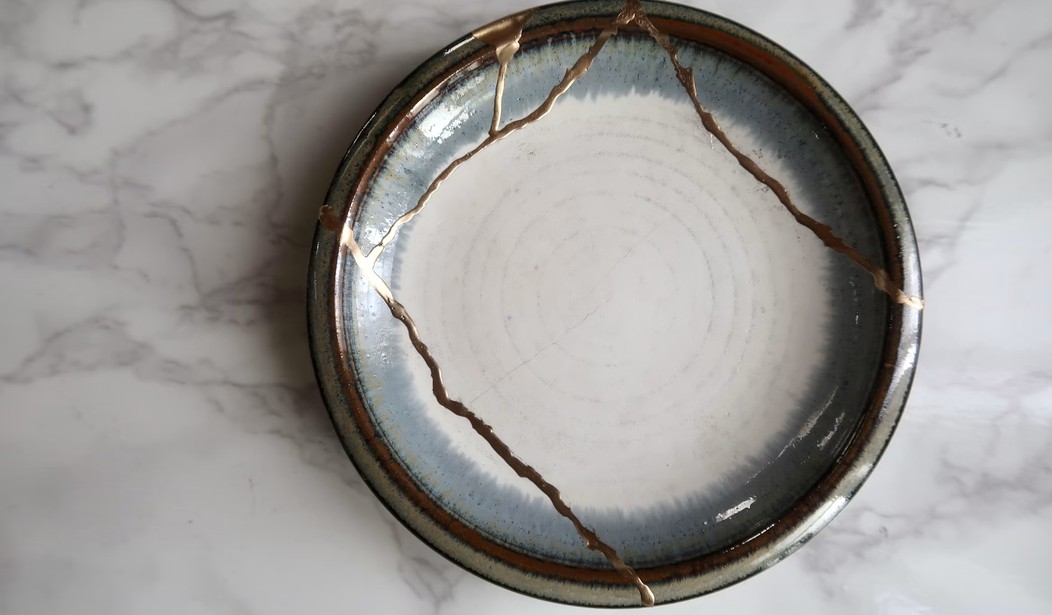
Kintsugi (golden joinery) is the Japanese art of repairing broken pottery with a lacquer mixed with powdered gold or other precious metal. The concept is to highlight the repair as part of the history of the object, rather than disguise it.
It is part of a wider class of aesthetics known as wabi-sabi. This term is difficult to translate because it is quite subjective. Wabi might be described as beauty in simplicity or austerity. Sabi refers to rust, as a reminder that all is transitory and fades. Picture in your mind the natural beauty of the full-blown cherry blossoms, which you enjoy all the more knowing that soon they will be gone. Richard R. Powell, author of Wabi Sabi Simple, described it as nurturing “…all that is authentic by acknowledging three simple realities: nothing lasts, nothing is finished, and nothing is perfect.” There can be no better understanding of material reality. It was said that wabi-sabi was introduced to the Japanese nobility by the construction of a teahouse with a door so low that anyone, even the emperor himself, would have to bow in order to enter. Reality is best understood by approaching it with humility and accepting change and fate with equanimity.
A related concept is mono no aware, which could be roughly translated as an appreciation of the ephemeral nature of things, which is tinged with gentle sadness. Mono no means “thing of…” and aware, some say, is like the non-verbal expression “Ahhhh…” It is often a Japanese theme in literature.
Our Declaration of Independence and our Constitution took account of reality, especially human nature, more than any other foundational documents in human history. Their underlying principles are to be contrasted with the Marxist view that what we consider reality is nothing but “bourgeois false consciousness,” and that the only truth lies in some Hegelian “dialectical materialism.” Although our founders dabbled in political philosophy, it was not their “day job.” They were farmers, soldiers, merchants, and lawyers who came face to face with the real world on a daily basis.
Bernard Bailyn wrote in the preface to the 50th anniversary of his classic The Ideological Origins of the American Revolution that the aim of our founders “…was to establish the source of all rights in the laws of nature and the fundamental endowments of humanity, beyond the reach of legislative powers and executive mandates. It was left for the future to identify exactly what such rights were and to enact them into positive law, a struggle that we now know to have no end.”
Our system, and our American spirit, recognize that conditions are transient, and that adaptability and repair are necessary preconditions for stability. The pace of Bob Dylan’s Times They Are a Changin’ has increased multifold since he wrote it.
Yes, our Declaration and Constitution had inherent flaws, unavoidable given the conditions of the time, that would eventually cause “the bowl to crack,” the foremost being slavery. The “repair” from 1861 to 1865 would cost more casualties than all our other wars combined. The neat rows of stones at places like Shiloh, Antietam, and Gettysburg are the “gold” that “repaired the crack.” We do not hide the flaw of slavery, nor the breakage it caused, despite claims by progressives who would have us look only upon the cracks and not upon the repaired bowl as a whole. This is also true of other dark pages of our history, many of which are undergoing repair to this day. America is constantly reinventing itself, filling in the “cracks” for a “bowl” of ever-increasing beauty.
How can we continue to repair our “bowl?” We must first take care to appreciate both its beauty and its fragility. We do this by helping our fellow Americans who have an open mind to understand the principles of our founding and what is incompatible with them. We should encourage a mindfulness of the cost, in blood, treasure and sacrifice, of the repairs that have kept the “bowl” unified, full of the liberty we enjoy like precious tea that is not to be had elsewhere in the world.
As for our enemies abroad, like the valued Japanese works of old, our “bowl” is guarded by the spirit of American Samurai, who, if you act against us, will hunt you down and show you just how transitory life itself can be.
Editor's Note: Do you enjoy PJ Media's conservative reporting that takes on the radical left and woke media? Support our work so that we can continue to bring you the truth.
Join PJ Media VIP and use promo code FIGHT to receive 60% off your membership.

David Churchill Barrow is a Massachusetts “Swamp Yankee” descendant of William Bradford and Myles Standish of Pilgrim fame, who grew up on a farm that has not been sold since first built in the early 1700s. In that farmhouse still hangs the commission of James Churchill as a captain in the Massachusetts militia signed by John Hancock, and the sword of Thomas Churchill, a Navy engineer who served in the Blockade of the Confederacy. David’s father, David Bradford Barrow, was a Marine gentleman farmer who commanded a flame-thrower tank in the Battle of Saipan in World War II.
David’s childhood was mostly spent in the woods and swamps of Southeast Massachusetts, building forts and pretending to be Daniel Boone, the Little Drummer Boy of Shiloh, or just an unnamed “Minuteman” making ready to “fire the shot heard round the world.” He has lived and breathed history since first opening his eyes.
He met his wife, MaryLu, in high school. They were married in 1979 and have three adult children. MaryLu is a former elementary school teacher. Today they live just outside Tampa, Fla. They are the authors of And Justice for All, Even Redcoats, and are working on their next novel about the Pilgrims.
Recommended
Trending on PJ Media Videos

California Election Fraud Explosion Catches Dems in the Act