‘Too Big to Rig’: Inside the Left's 2026 Election Machine.
The Left’s 2026 Election Machine Is Already Being Built.
Under the language of “democracy defense,” “election safeguarding,” and “misinformation response,” a network of progressive groups is building a 2026 midterm apparatus that goes well beyond ordinary voter turnout.
The public materials reviewed for this report describe millions of dollars in funding, more than 200 aligned organizations, youth campus hubs, poll monitors, legal hotlines, creator campaigns, social media monitoring, “prebunking,” ballot curing, rapid-response litigation, health-care voter prompts, election-official legal defense, and certification monitoring into December and January.
Subscribe for original reporting and investigations you will not find anywhere else.
Some of it is openly partisan. Movement Voter Project says it wants to fund local organizing in “every swingable Senate, House, and downballot race” to build the “biggest Blue Wave possible.” Other arms of the same ecosystem operate under 501(c)(3) language, calling their work nonpartisan election protection, democracy defense, or voter education.
Protect Democracy
Protect Democracy’s March 2026 report, “Executive Override,” is the clearest ideological document in the stack. The group was founded by Ian Bassin, associate White House counsel for the Obama administration from 2009 to 2011.
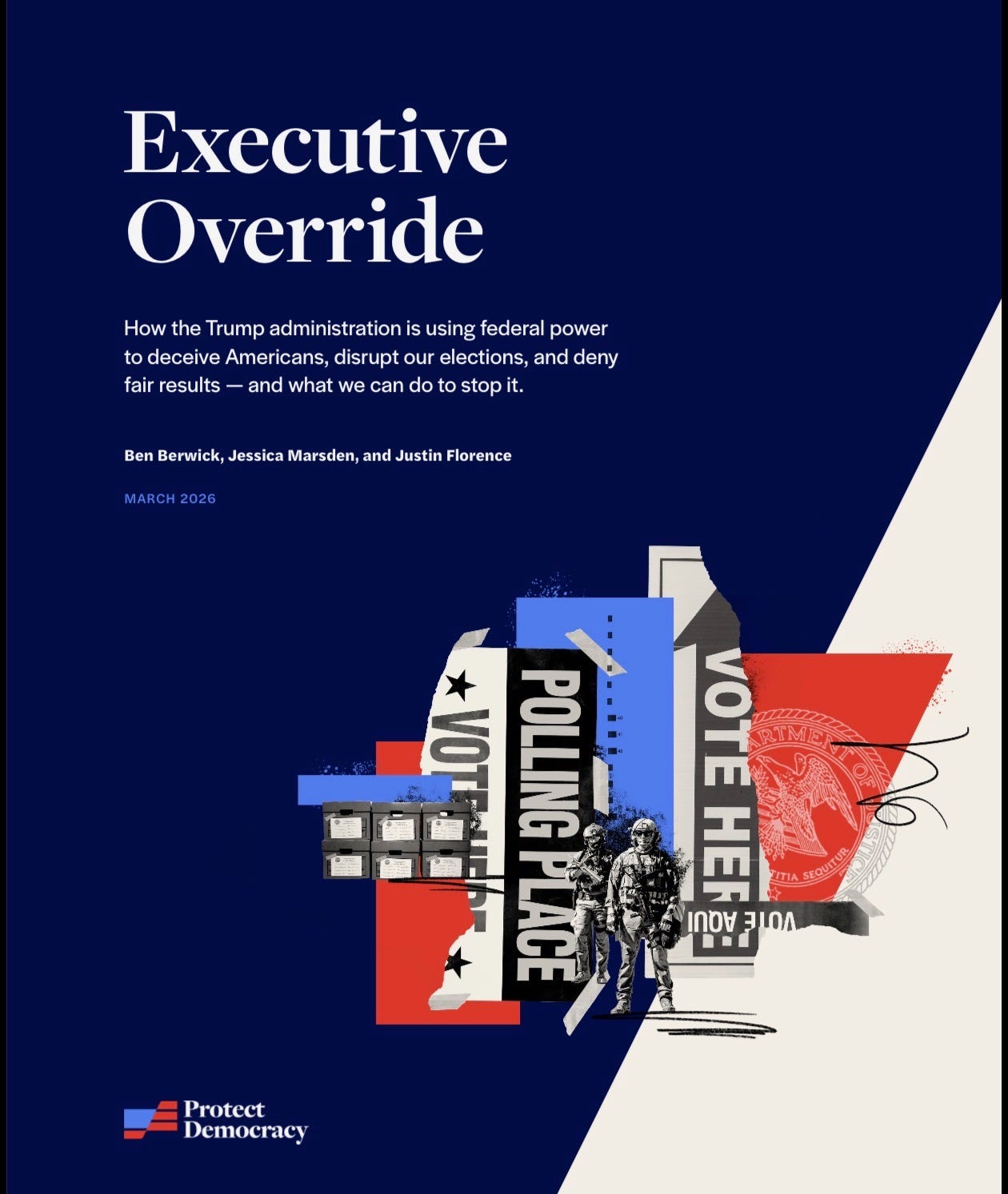
The report claims that “for the first time in modern American history,” the “machinery of the federal government” is being “turned against our elections.” It describes the alleged Trump administration strategy as “Deceive, Disrupt, Deny,” accusing the administration of using federal power to “deceive Americans, disrupt our elections, and deny fair results.”
The report says the administration is relying on a “fog of investigations, executive orders, disinformation campaigns, and legal maneuvers” that can appear legitimate in isolation, but together form what Protect Democracy calls a coherent strategy. It argues that election criticism, federal investigations, disputes over voter rolls, litigation, fraud claims, and certification conflicts are part of one campaign to delegitimize unfavorable results.
That framing matters because it turns normal election-administration disputes into a justification for a counter-mobilization.
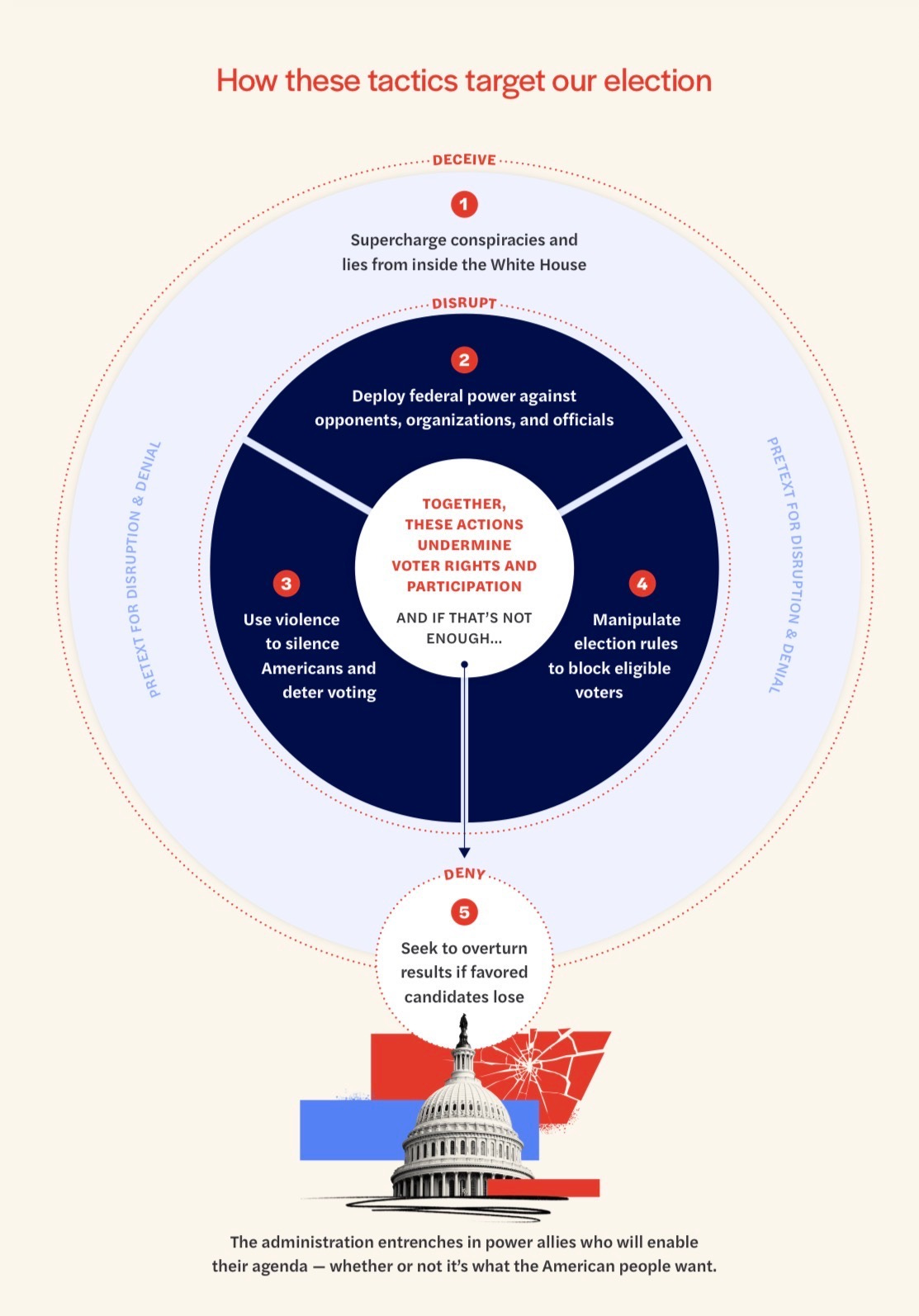
Protect Democracy does not simply warn readers. It assigns roles.
“Journalists, influencers, and creators” are told to establish protocols for covering government disinformation and to connect “specific abuses of power” to a “broader strategy.” Election officials and state and local leaders are told to “prepare now for likely threats,” understand the law, build response plans, and form solidarity networks. Private-sector and civil society leaders, including “business and labor,” “universities,” and “faith communities,” are told to “speak out, organize, and act in defense of elections.”
The legal community is told to coordinate legal responses and act as a check “particularly in the fast-moving post-election period.” The public is told to “counter disinformation,” volunteer as poll workers, and be ready to “mobilize peacefully” if officials or institutions face pressure around election results.
The Gen Z Election Defense Toolkit
Protect Democracy’s April 2026 “Gen Z Election Defense Toolkit” brings that framework directly to young voters, campus groups, youth organizers, and student leaders.
The document is described as “A Young Person’s Guide to Protecting and Participating in U.S. Elections.” It says it is designed for “youth-focused organizations and groups” that want to “educate young voters and build youth power.”
The toolkit tells users to distribute individual sections as handouts, work through the document from “pre- to post-Election Day,” and translate Protect Democracy’s analysis into “social media posts, infographics, presentations, advocacy materials.” It routes young people into tracks for “Direct Voter Education,” “Campus & Peer Organizing,” “Election Day Support,” and “Post-Election Integrity.”
The recommended actions include reporting “voter intimidation or disinformation,” joining peaceful protests, organizing voter registration drives on campus or online, volunteering as a “nonpartisan election observer,” and helping voters overcome barriers such as transportation.
The toolkit’s most revealing section is its speech-monitoring guidance.
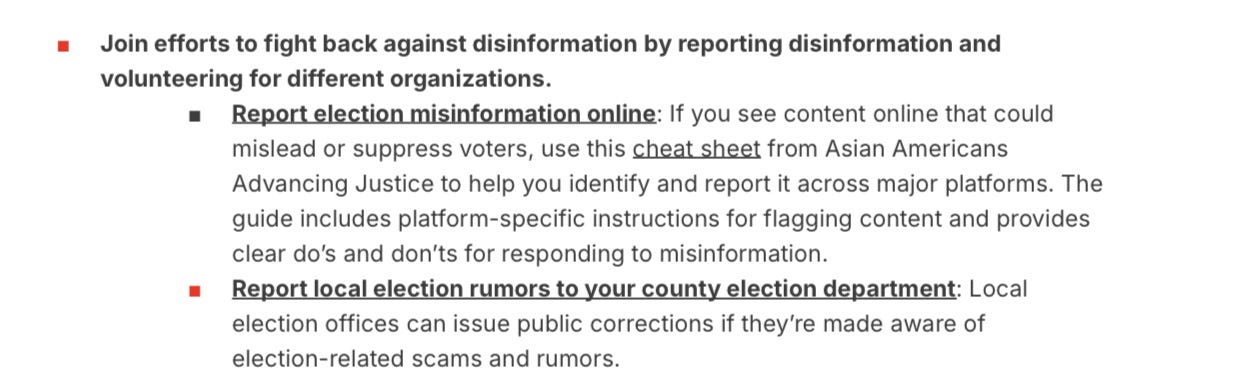
It tells young people to “track misinformation,” join efforts to “fight back against disinformation,” report election misinformation online, report local election rumors to county election departments, and support “anti-disinformation laws” so “disinformation spreaders can be held accountable.”
The toolkit’s partner list is also notable. It thanks Generation Vote, Rock the Vote, the Lawyers’ Committee for Civil Rights Under Law, the Students Learn Students Vote Coalition, and New Voters. One listed partner, New Voters, is described as a Gen Z-led nonprofit that mobilizes high school students to register more than 80,000 young voters.
Movement Voter Fund
Movement Voter Fund’s “Big Election Plan of 2026” provides the clearest organizing blueprint. The homepage of their affiliate group, Movement Voter Project, declares “Make 2026 Too Big To Rig.”
The document says 2026 is “our greatest chance in recent memory” to mount a “massive nonpartisan push for historic turnout and a safe and secure election.” It asks how to turn “grassroots resistance” into “voter engagement and durable civic power.”
MVF says the left cannot rely on “transactional paid canvasses” launched right before the election. Instead, it calls for “deeper relational organizing strategies,” both online and offline, designed to build “movement-wide capacity that extends far beyond the election.”
Its five-phase plan reads less like a voter-registration memo and more like an election infrastructure plan.
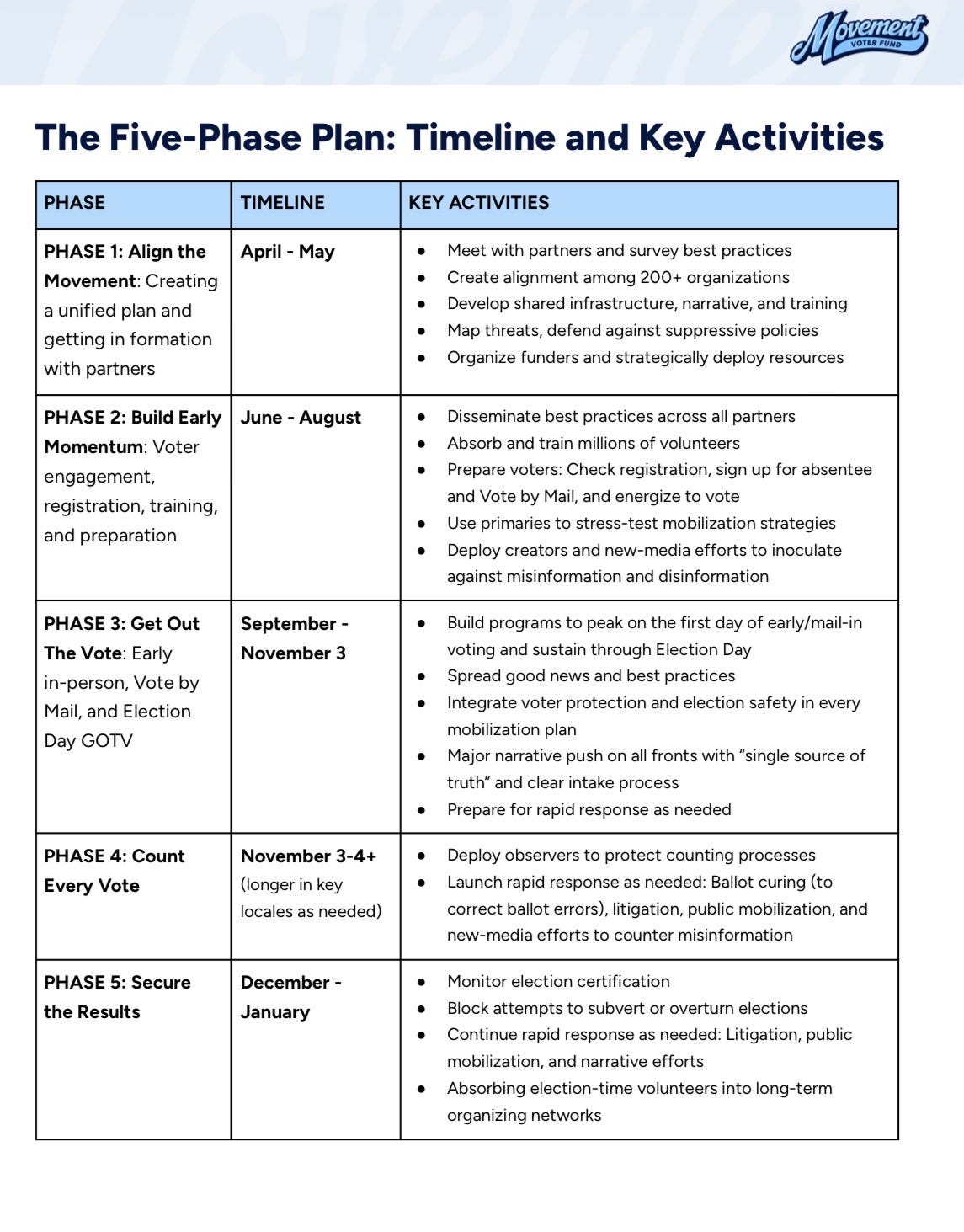
Phase 1 calls for alignment among more than 200 organizations, shared infrastructure, shared narrative, shared training, threat mapping, and strategic deployment of funder resources.
Phase 2 calls for absorbing and training “millions of volunteers,” preparing voters for absentee and vote by mail, using primaries to stress-test mobilization strategies, and deploying creators and new-media efforts to “inoculate against misinformation and disinformation.”
Phase 3 calls for integrating voter protection and election safety into every mobilization plan and launching a “major narrative push on all fronts” with a “single source of truth” and “clear intake process.”
Phase 4 moves into the count: observers, ballot curing, litigation, public mobilization, and new-media efforts to counter misinformation.
Phase 5 runs into December and January: election certification monitoring, blocking efforts to subvert or overturn elections, continued litigation, public mobilization, narrative work, and absorbing election-time volunteers into long-term organizing networks.
That is the important part. MVF is not merely preparing for Election Day. It is preparing for the entire election arc: registration, early voting, vote by mail, Election Day, counting, litigation, certification, narrative control, and volunteer retention.
Movement Voter Fund’s 2026 Democracy Defense Budget
MVF’s funding materials show the scale.
The group says its public figures represent only a “small sampling” of its 501(c)(3) democracy-defense budget, which is itself only part of a larger 2026 base-building and voter-mobilization budget.
The sample includes $3.15 million to “align and coordinate the democracy defense ecosystem,” $450,000 to train volunteers, poll monitors, election administrators, and organizational staff, $320,000 to “prebunk” false election narratives, $290,000 for “surround-sound” state-specific messaging, $1.57 million to build youth power, $3.15 million for get-out-the-vote work, and $3.07 million to “Count Every Vote and Secure the Results.”
The “prebunking” line is central. MVF says it wants to use digital media and online creators to prepare voters to recognize and resist alleged mis- and disinformation before they encounter it. It also plans state-based creator cohorts in places such as Michigan, Pennsylvania, and North Carolina to push geographically specific narratives.
The youth-power budget is just as important. MVF says it wants to train and mobilize thousands of students, establish campus organizing hubs that serve as rapid-response centers, deploy youth poll monitors and workers, coordinate youth-led public mobilizations, build young creators’ capacity, and drive youth turnout.
This is the NGO version of a political war room: coordination hubs, narrative operations, creator networks, poll monitors, student rapid-response centers, ballot curing, litigation, and certification defense.
ACLU Election Safeguarding
The ACLU is building its own 2026 election operation under the banner of “election safeguarding.”
The group says it is investing more than $24.5 million in its “largest ever election safeguarding initiative.” Its public page lists “80+ legal actions” and says 1 million volunteers are being trained to protect election results in their communities.
The ACLU says it has built responses to 25 election-threat scenarios and is ready to mobilize or launch urgent legal actions. Its program includes Know Your Rights trainings, poll monitoring, post-election monitoring, get-out-the-vote work, local rapid-response campaigns, mass mobilization, and litigation.
Common Cause Election Protection
Common Cause supplies the volunteer and monitoring infrastructure.
Its Election Protection program includes “deploying thousands of on-the-ground volunteers at polling places,” recruiting legal experts to staff the 866-OUR-VOTE hotline, and “monitoring social media for harmful election disinformation.”
Common Cause says it helps election officials handle problems in real time and notifies attorneys when a situation warrants legal intervention.
In practice, that means outside volunteers at polling places, a national legal hotline, online speech monitoring, coordination with election officials, and escalation to attorneys.
That is how “voter assistance” becomes a live election-intake system.
Vot-ER Community Civic Engagement Program
Vot-ER brings the election push into health-care settings.
Its Community Civic Engagement Program says community health centers are “deeply trusted messengers” serving up to 52 million people nationwide. The program offers grants ranging from $3,000 to $10,500 to community health centers and federally qualified health centers.
The grants fund voter registration and election-turnout prompts in electronic health record homepage banners and after-visit summaries. They also fund patient texting programs that send at least six voting reminder texts, including reminders tied to primary deadlines, Vote Early Day, and Election Day.
The full $10,500 grant includes electronic health record integration, texting, onsite voter registration drives, potential pharmacy integrations, and exploration of whether a health center can become a ballot drop box or polling location.
The deliverables include Vot-ER voter engagement links, monthly learning-community calls, staff voter registration reminder emails, Vot-ER badges for relevant staff, and facility materials.
CEIR Legal Program
The Center for Election Innovation & Research is building legal support around election officials themselves.
CEIR announced in May 2026 that it was launching a legal program to “protect elections and election officials.” The program is led by Tamar Hagler, a former chief of the Justice Department Civil Rights Division’s Voting Section. CEIR founder David Becker is also described by the group as a former trial attorney in the DOJ Voting Section.
CEIR says the program will work with law firms across the country to “foster and oversee a comprehensive legal strategy” serving elections and the professionals who administer them. The program complements CEIR’s Election Official Legal Defense Network, which provides pro bono legal help to election officials facing threats or harassment because of their work.
Maryland SB 141
Maryland has already passed the state-level censorship model.
SB 141, enacted as Chapter 444, requires the State Board of Elections to maintain a public portal where people can report election misinformation and election disinformation.
The law defines election misinformation as incorrect or misleading information regarding the time, place, or manner of an election, election results, or voting rights. It defines election disinformation as incorrect or misleading information on those subjects that is knowingly and deliberately disseminated.
If the State Administrator receives a credible report that election misinformation or disinformation is being communicated, disseminated, or distributed, the law requires corrective information. It also allows the administrator to seek an injunction for removal from an online platform and issue subpoenas for records related to dissemination or distribution, including information about the targeted audience.
The State Board, in consultation with the administrator, may file civil actions against a person, campaign, political action committee, or other legal entity under certain conditions. The law allows damages, court costs, and attorney’s fees based on clear and convincing evidence.
This is where the nonprofit “misinformation” apparatus meets state power.
Protect Democracy’s youth toolkit tells activists to report misinformation and support anti-disinformation laws. Common Cause monitors social media. MVF funds “prebunking” and “surround-sound” messaging. Maryland created a public reporting portal, correction process, injunction authority, subpoena power, and civil-litigation pathway.
That is not just counter-speech. That is an enforcement architecture.
Subscribe for original reporting and investigations you will not find anywhere else.