MSNBC’s Top National Security Reporter Attacked Trump’s China Warning. Records Show He Worked With CCP Propaganda Arm Buying ‘Favorable Coverage.’
Chinese Communist Party-linked influence organization the China-United States Exchange Foundation (CUSEF) didn’t simply seek access to American journalists—it set out to shape the way they covered China.
Foreign Agents Registration Act filings reviewed by this publication show CUSEF hired Washington lobbying firms to help “effectively disseminate positive messages” about China to “the media, key influencers and opinion leaders, and the general public.” The filings further describe one of the group’s objectives as generating “favorable” media coverage of China among influential American journalists.
Want to fight the censors? Subscribe for free to break their shadow ban and get real reporting.
One of CUSEF’s primary tools was privately organized delegations to China for members of the Western press — including journalists frequently appearing on mainstream networks like CNN and MS NOW.
This organization, however, is no ordinary nonprofit.
CUSEF was founded by Tung Chee-hwa, a vice chairman of the Chinese People’s Political Consultative Conference (CPPCC), which the U.S. government has identified as the “highest-ranking entity overseeing” the Chinese Communist Party’s United Front system. According to the U.S. government, the United Front works to “co-opt and neutralize sources of potential opposition to the policies and authority” of the CCP while encouraging foreign governments, media figures, academics, and business leaders to adopt positions favorable to Beijing.
The State Department has likewise described the United Front as one of the Chinese Communist Party’s “magic weapons” for advancing its political influence overseas.
Now-deleted articles identify current MS NOW correspondent David Rohde as one of the American journalists who participated in one of the organization’s China delegations.
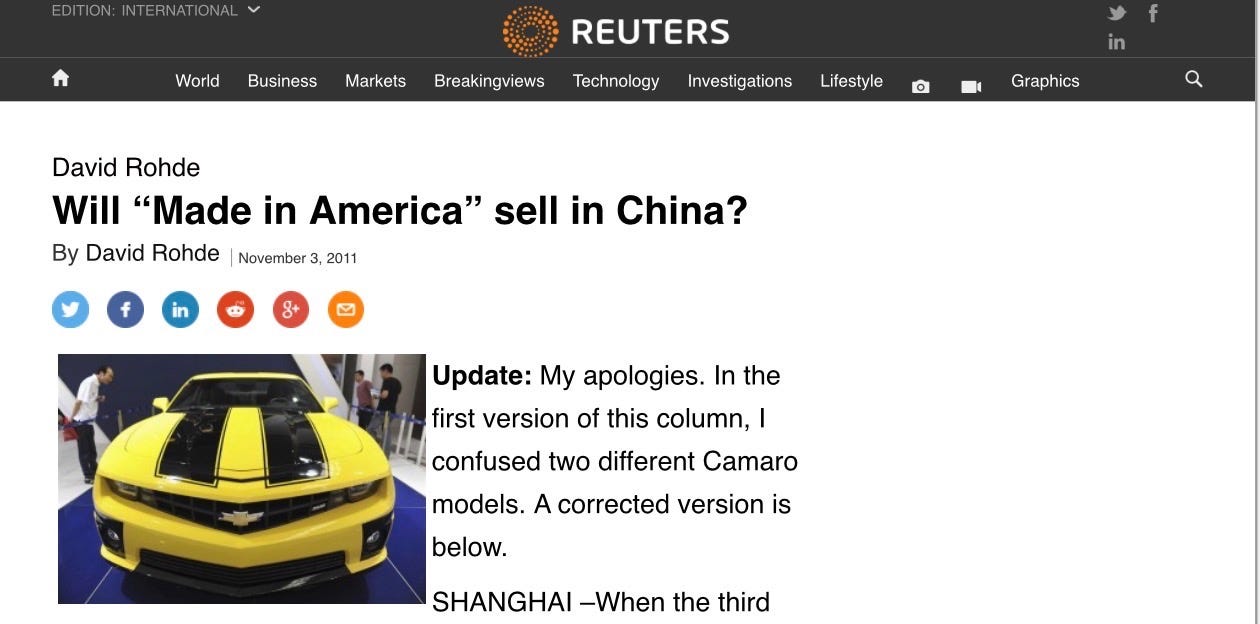 The link to this article is no longer active and can only be accessed by archived versions.
Rohde’s inclusion is particularly noteworthy given his recent criticism of President Trump’s remarks about Chinese influence operations targeting American journalists during a speech exposing Chinese intrusion into America’s election systems.
In an archived Reuters column published during the visit, he wrote:
“Four other journalists and myself are visiting China this week on a trip organized by the China-United States Exchange Foundation.”
He further described CUSEF as an organization “run by businessmen with close ties to the Chinese government.”
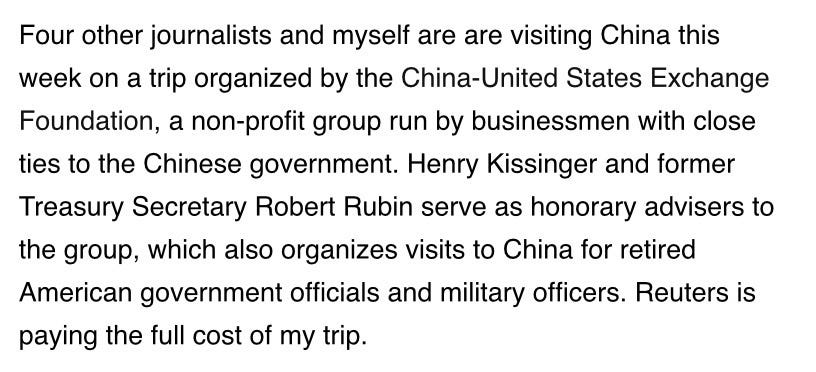 Rohde’s 2011 article excerpt.
Writing in The Atlantic, fellow trip participant Steve Clemons explained he was in China “as a guest of the China-United States Exchange Foundation” and identified Rohde as part of the traveling group, referring to him as “Thomson Reuters’ new acquisition the kidnapping-defying David Rohde.”
Writing from China during the CUSEF-organized trip, Rohde praised the Chinese government’s role in building its economy, writing that “the Chinese state has played a central role in creating, supporting and expanding businesses” through “cheap government loans and massive government-funded infrastructure projects.”
He also acknowledged that Beijing required foreign companies to enter joint ventures with Chinese firms, arrangements that “fairly or unfairly, allowed local companies to learn valuable manufacturing and business practices.”
Rohde then dismissed criticism of Beijing’s trade practices while emphasizing the opportunities China offered American corporations:
“Those successes show that, for all the attacks from American politicians on Chinese currency manipulation, American companies can find profits in China.”
He added that American officials should focus on finding “effective ways to support pioneering American companies” operating there.
Rohde went further, arguing that Americans should resign themselves to the permanent loss of major domestic industry:
“Americans, meanwhile, should accept that large-scale manufacturing will never return to the United States.”
He suggested that companies should keep low-skilled production overseas while retaining design, marketing and corporate headquarters in America, calling that arrangement “the best of a series of bad economic options for America.”
Rohde concluded:
“Innovative firms will find ways to profit from the rise of the Chinese and emerging market middle classes. The American middle class needs more ‘Bumblebees’ and PurePOWERS overseas, and less ideological babble in Washington.”Months later, Rohde again invoked the same China trip while arguing against a tougher U.S. posture toward Beijing.
“When I visited China last fall,” he wrote, “Chinese officials were infuriated” by Mitt Romney’s proposal to designate China a currency manipulator on his first day in office.
Rohde argued that formally applying the designation “could result in a trade war that would devastate the fragile American economy,” concluding that “getting tough with China is not as simple as it sounds.”
Those themes continued during President Trump’s first administration.
As President Trump escalated tariffs against Beijing in 2018, Rohde argued on CNN that China held the advantage in the trade dispute. Asked directly, “Who’s got more leverage, China or the U.S.?” Rohde replied, “I think China does,” warning that the confrontation posed a greater political threat to Trump because American manufacturers and farmers could be hurt. Rohde then criticized Trump for confronting China without coordinating with Europe, Canada, and Mexico, declaring: “It’s the tough talk. It plays to his base. It’s not working.”
The larger scandal is not one trip or one reporter. It is the ease with which a foreign influence group could gain access to elite American newsrooms, cultivate relationships with prominent journalists, and shape the terms of the China debate without triggering anything close to the scrutiny routinely applied to domestic political actors.
For years, Beijing benefited from a media class that treated Chinese influence as a conspiracy theory while repeating many of the arguments most useful to the Chinese Communist Party. Economic dependence was presented as inevitable. Deindustrialization was framed as irreversible. Tariffs were dismissed as reckless. Any serious confrontation with Beijing was cast as a greater threat to America than Beijing itself.
Now you know why they really hated President Trump’s speech.
Want to fight the censors? Subscribe to stay informed.