The Persecution of Tina Peters - Part I - Joe Hoft

Guest post by Tracy Osborne
After 606 days behind bars, Tina Peters is finally free!
ADVERTISEMENTPeters has become a chilling example of what should never happen in America: a public official punished not for abandoning her duties, but for fulfilling them. She uncovered vulnerabilities in our election system and illegal activity by the Secretary of State—and for that, she was investigated, prosecuted, publicly vilified, and ultimately locked away.
The real story of Tina Peters includes much more than the mainstream media was ever willing to tell—including a crooked DA, a possible kidnapping, and a tainted juror.
I first reached out to Peters in 2024 when she was housed in the Larimer County Correctional Facility in Fort Collins, Colorado. Since then, I’ve corresponded extensively with her through the jail and prison systems, spoken with her by phone, interviewed members of her inner circle, reviewed court records and sworn testimony, and met with her in person at La Vista Correctional Facility.
This account is based on those sources and aims to restore what the mainstream media has so often left out—Peters’ perspective.
ADVERTISEMENTTo fully understand what she has gone through, you first have to understand her backstory.
A Not-So-Brief RecapIn 2019, when Peters was sworn in as Mesa County Clerk and Recorder, she became the chief election official in the county. Part of her oath required her to preserve federal election records for 22 months and state election records for 25 months. She took her oath seriously. She studied everything—the statutes she swore to uphold, the laws, the policies, the playbook of being clerk.
“During elections, we were instructed to save any paper or piece of trash found on the floor of a polling center and to put it in a box labeled ‘trash’ and keep it for 25 months. I did that,” she said. “I saved trash in a box for over two years because I took the law seriously.”
Then, in May 2021—just one month after a city council election and six months after the 2020 presidential election—Peters received an email from Secretary of State Jena Griswold. It informed her that a member of the SOS’s office, along with a representative from Dominion—the company that supplied Mesa County with their election equipment—would be coming in to perform something called a “Trusted Build” on the election management server (EMS). The EMS was the central computer system Mesa County relied on to run its elections while Peters was clerk.
Griswold described the Trusted Build as a routine upgrade that would remove a QR code from the system and reset it for future elections. She instructed Peters to perform something called an “Elections Project Backup” on the EMS beforehand, explaining that it would preserve all election records, so there was nothing to worry about.
Peters was dubious. She had recently been alerted by concerned citizens that something may have been amiss with the Grand Junction city council election just a month earlier. Four Democrats had been elected in a deeply red area, and rumors circulated that the winners knew the outcome before the votes were in.
ADVERTISEMENTA group called Stand with the Constitution canvassed the area and reported several irregularities, including: votes cast in the names of dead or incarcerated people, voters who said they had not voted despite ballots being cast in their names, and voters listing addresses that were not their own. The group presented Peters with multiple affidavits outlining their concerns, and soon she was inundated with angry phone calls from constituents demanding answers.
“I realized these people had a lot of questions, and I didn’t have the answers,” said Peters. “I needed to get them answers, so I was looking at everything, trying to figure out what exactly happened in this municipal election, and that’s when Griswold emailed me to say they were going to delete something off the EMS. My first thought was ‘no one should be deleting anything.’ I had taken two oaths to preserve election records for 22 and 25 months, and I knew the federal oath carried a criminal penalty if violated. The buck stopped with me, and now Griswold’s insisting they delete something from the EMS just six months after the presidential election and just one month after this municipal election that people are very upset about? Yeah, I was concerned.”
Peters decided she needed more information about what the Trusted Build and the Elections Project Backup would actually do.
She started asking questions. First, she called David Stahl, a Dominion employee. According to her court declaration, Stahl told Peters the Trusted Build would delete not only a QR code but also operating system log files, audit logs, and access logs. Peters asked whether the Elections Project Backup would preserve that information. Stahl said, “No.” The backup would save the results of the election, but not the underlying data showing how those results were tabulated.
According to Peters’ court declaration, she then called Griswold’s office and spoke with a member of Griswold’s staff who confirmed what Stahl had told her. As Peters understood it, the Trusted Build would make it impossible to audit either the 2020 presidential election or the recent municipal election.
“At this point,” Peters said, “I was between a rock and a hard place. By asking me to take part in the Trusted Build, Griswold was forcing me to violate my oath of office. I had taken an oath to preserve election records, and here was the Secretary of State asking me to delete them. I knew I couldn’t stop the Trusted Build from happening, so I needed a plan.”
Peters asked around and learned about something called a “forensic image.” A forensic image is a bit-by-bit, unalterable (read-only) copy of a server. In simpler terms, it’s a way to preserve the data exactly as it existed at a specific point in time. Peters thought if she could take a forensic image both before and after the Trusted Build, she would be able to preserve the records and see exactly what the Trusted Build would do.
Peters consulted the law and policy books and learned that taking a forensic image did not violate any rule, policy, or law, nor would it damage the server or interfere with the Trusted Build in any way.
In Peters’ mind, this was a win-win: she could uphold her oath by preserving records, and Griswold and Dominion could move forward with the Trusted Build.
Peters first reached out to the county’s IT department to see if they could take the forensic images. She said that, despite the media characterizing her actions as nefarious, none of this was a secret. In her email to the IT department, she said she cc’d both the county attorney and county administrators, and no one raised concerns or attempted to stop her.
Unfortunately, the IT department declined to do the job citing a lack of experience and know-how, so Peters turned to the private sector.
“It was 100 percent legal for me to engage a consultant to take these images. One-hundred percent legal,” she said. “Not only legal but necessary to uphold my oath.”
An acquaintance of Peters’s, Sherronna Bishop—who had earlier brought her affidavits from the canvassing effort—connected her with a man named Gerald Wood, whom she knew through the Stand with the Constitution group. According to Bishop, Wood said he worked in the “tech space” and could take the forensic images.
Bishop later sent a group text to Wood and Peters that read, “This is our guy.” Wood replied, “That I am.”
Peters then emailed a county employee who handled onboarding for new staff, and asked him to issue Wood a name badge and computer login.
Unfortunately, like the IT department before him, Wood eventually realized he didn’t have the experience or know-how to take the forensic image, so he told them they would have to find someone else.
Undaunted, Peters kept searching for someone who could do the job. Bishop then introduced her to a man named Dr. Doug Frank, a physicist and prominent ally of Mike Lindell, who had been traveling the country speaking at election-integrity events. Frank told Peters he knew the exact person for the job—a man named Conan Hayes.
Hayes was introduced to Peters as a white-hat cybersecurity expert who had worked with the government on numerous occasions. There was just one problem: Hayes told her he had recently assisted the government in taking down a child-trafficking page connected to a website called “Backpage” and believed he was being hunted by the cartels. Hayes said he could take the images, but only if he could keep a low profile.
Peters asked Wood if Hayes could use his name badge. Wood agreed. Woods’ consent was later verified by text messages, witness testimony, and in a post-trial hearing.
Peters said during elections, access to the secured area is strictly controlled, but the Trusted Build was presented as a benign computer upgrade that wasn’t taking place during an election. She said name badges labeled “Temp 1,” “Temp 2” and so on were often issued for vendors and others who were not county employees but needed access to the area. As long as those people were supervised by a county employee, it didn’t break any rule, policy or law.
The SOS office asked who from the Mesa County clerk’s office would be present at the Trusted Build. One of Peters’ employees RSVP’d that Wood, Peters, and another employee named Sandra Brown would attend the Trusted Build.
The day before the Trusted Build, Peters in order to conceal Hayes’ identity—at his own behest—turned off the cameras that monitored the EMS. While uncommon, this too, was not against any rule, policy, or law. Peters then escorted Hayes to the EMS, and he took the first image.
During this time, Wood was texting both Bishop and Peters for updates on their progress. On May 24, 2021—just one day before the Trusted Build—Bishop texted Wood, “Things are looking great!” Wood replied, “I was glad to help out. I do hope the effort proves fruitful.”
The next day, an employee from the SOS office showed up to perform the Trusted Build. Peters introduced Hayes to the SOS employee as “Wood”—again, not to conceal anything she was doing, but because Hayes insisted no one could know he was there. After the Trusted Build was complete, Hayes took a second forensic image.
After the Trusted Build was completed, Peters sent the forensic images to a Texas-based cybersecurity firm, Allied Security Operations Group, for analysis. The result was a series of lengthy forensic reports that became known as the Mesa Reports.
The Mesa Reports Revealed Three Inconvenient Truths:
It is beyond the scope of this already too-lengthy article to fully examine the Mesa Reports (See reports at tinapeters.us). But readers who decide to go down this rabbit hole, shouldn’t stop when they get to DA Dan Rubinstein’s “debunking” of the reports. Peters’ legal team later produced a detailed rebuttal to Rubinstein’s analysis, titled Official Response to Mesa DA Investigation. It’s worth a read.
Peters vs. The Deep StateUnfortunately for Peters, about a month before the first Mesa Report was released, a computer hacker named Ron Watkins—better known online as CodeMonkeyZ—published the forensic images and partial passwords online without Peters’ consent or knowledge.
Peters believes Hayes—the only other person with access to the images—gave them to Watkins, knowing Watkins would post them online. When Peters later attended Mike Lindell’s Cyber Symposium in Sioux Falls, South Dakota, she passed Hayes on the stairs. He would not look at her.
Within days of the leak, Secretary of State Jena Griswold announced an investigation into Peters, claiming she had tampered with election equipment. A day later, Attorney General Phil Weiser joined the investigation, as did DA Dan Rubinstein, who deputized two senior attorneys from Weiser’s office—Janet Drake and Robert Shapiro—to assist.
By mid-August, Biden’s DOJ was involved, including Merrick Garland’s FBI. Other federal agencies that assisted included the U.S. Department of Homeland Security and the Cybersecurity and Infrastructure Security Agency, known as CISA.
This was a one-of-a-kind, all-hands-on-deck investigation. Rubinstein later said the “core” joint investigation with the Colorado AG was complete while asking that a parallel federal investigation continue.
In my review, I could not find another case in which DA Dan Rubinstein leveraged this same mix of local, state, and federal actors to prosecute anyone—let alone a nonviolent, elderly, first-time offender.
One day after launching the investigation, Griswold barred Peters from overseeing Mesa County elections and named Sheila Reiner to take her place. Reiner had served as Mesa County clerk before Peters and later as Mesa County treasurer. The Mesa County commissioners wanted former Secretary of State Wayne Williams to take over Peters’ role. After some political and legal jostling, Williams and Reiner agreed to share the post.
Here’s an interesting footnote journalists Erin Clements and Barb Hulet uncovered via the Colorado Open Records Act (CORA): According to their reporting, at the time Williams was helping fill Peters’ post, he was also serving as a senior advisor for Runbeck, the vendor that provides Mesa County with mail-in ballots. Similarly, Reiner had been employed by Dominion in 2020, just months before taking over Peters’ post, while simultaneously serving as county treasurer.
Williams did not respond to a request for comment. But Reiner defended her work for Dominion, calling it “routine temp work.”
As if replacing Peters with elected officials who were quietly taking second paychecks from election vendors isn’t bad enough, there’s more. Remember how the Mesa Reports revealed that the EMS was equipped with 36 wireless devices capable of connecting to the internet?
Guess who ordered those?
According to a December 2015 press release, Wayne Williams was Secretary of State when Colorado selected Dominion as its election-system vendor. Williams’ office ordered the machines with Wi-Fi capabilities. But according to the machine’s manual — published by both the SOS office and Dominion—he did not have to. Ordering the machines with Wi-Fi capabilities was optional.
Later, in a heated meeting with the county commissioners and Wayne Williams, Bishop asked Williams point-blank why he ordered the machines with Wi-Fi capability. Williams did not respond.
Here’s the main takeaway: when Griswold pushed Peters out, she did not replace her with neutral outsiders. She replaced her with politicians on the Runbeck and Dominion payrolls, one of whom was responsible for ordering the EMS with Wi-Fi capabilities in the first place.
To Tell the TruthWhile officials were moving to contain Peters, Peters was trying to alert the authorities. Just three weeks after the leak, Peters received the first Mesa Report. She immediately sent it—along with this sober letter—to the Board of County Commissioners.
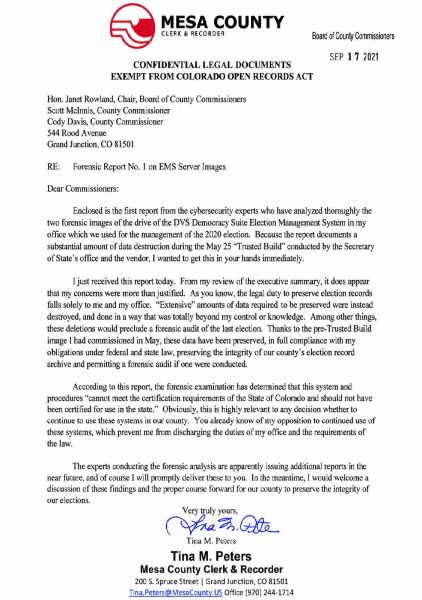
Griswold was never investigated by Colorado authorities for prematurely and illegally destroying 29,000 digital election records.
Instead, the board of county commissioners responded to Peters’ letter by saying they were cooperating with the investigation initiated by Griswold which alleged Peters tampered with election equipment.
Bad PressThe Deep State wasn’t the only machine coming at Peters. While federal and state officials pursued her in court, the media tried her in public.
Arguably, no one has written more about Tina Peters than Charles Ashby, a longtime reporter for the Grand Junction Sentinel. A search of the Sentinel’s archives—dating back to the day Griswold first launched the investigation—turns up nearly 1,100 articles on Peters, the vast majority of them written by Ashby, most of them negative in tone.
Ashby frequently framed Peters as a “conspiracy theorist” and often described her concerns about election irregularities as “false” or “debunked.” Those labels do powerful work on the reader. Before Peters’ arguments are fully heard, the reader has already been told how to understand them: as fringe, false, or unserious. In that way, calling someone a “conspiracy theorist” becomes a rhetorical censorship tool. It is a wink and nod to the reader: no need to weigh the evidence for yourself. No need to investigate. We’ve already done the critical thinking for you, and the verdict’s in: Peters is crazy—pay no attention to her.
When you consider the sheer volume of content Ashby produced on Peters, the scale is staggering. If the average news article runs between 600 and 800 words, and Ashby wrote roughly 1,000 articles mentioning Peters, even a middle-of-the-road estimate of 700 words per article puts his coverage at about 700,000 words. That is more than three copies of Moby-Dick.
Ashby’s reporting did not remain confined to Grand Junction. His articles and framing were picked up, cited, republished, or echoed by media outlets across Colorado and the nation, many of which relied on local reporting to shape the broader narrative of the case. In July 2022, Emma Brown, a reporter for The Washington Post, cited one of Ashby’s stories and praised it as “more great reporting from Charles Ashby at the Daily Sentinel,” a small but telling example of how Ashby’s coverage became part of the national conversation.
What is even more astonishing is that, for all the time, effort, and energy Ashby devoted to covering Peters, his stories do not appear to include a single fresh quote from her. Nor do they seem to contain the familiar line readers have come to expect at the end of contested stories: “Tina Peters did not respond to a request for comment.” According to the people who help manage Peters’ social media, there is a simple explanation for that: in all the years Ashby covered her, he never once reached out to ask for her side of the story—on any of it.
Imagine writing enough articles to fill three copies of Moby-Dick and never once asking the woman at the center of it all for her take.
The negative media saturation was so pervasive that it raises an obvious question: was this simply aggressive local reporting, or was there a broader network helping shape and amplify the narrative? One document points directly to that question.
Journalist Erin Clements discovered that between mid-August and the end of September—at the time Wayne Williams and Sheila Reiner were manning Peters’ post and overseeing elections—Williams billed Mesa County $31,283 for about six weeks of work. One of his line items included “Dinner with Lynn Bartels to enlist assistance in media matters.”
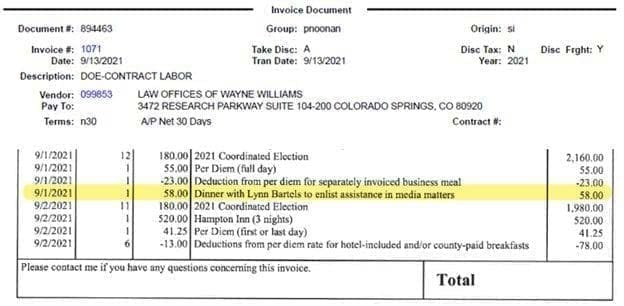
Bartels was not some random media contact. She was a longtime Denver Post political reporter who later became Wayne Williams’ spokeswoman during his tenure as Colorado Secretary of State. Then, in 2020, Bartels became a communications consultant. One of her clients was the Colorado Clerks Association, led by Matt Crane.
According to Clements’ reporting, Crane had his own connection to Dominion. His wife, Lisa, worked for Dominion for nearly a decade and was a close colleague of the infamous Dominion Vice President Eric Coomer.
That makes Bartels’ work for the clerks association relevant to the Peters story. She was not simply doing generic communications work; she was helping promote the public image of an organization led by someone with direct ties to the very election vendor at the center of so many public concerns. And she did it, at least in part, by placing clerk-friendly articles in newspapers across Colorado—articles that blurred the line between journalism and public relations.
Cory Hutchins, a reporter for The Colorado Independent, called out Bartels for placing articles in a dozen papers that carried the tone and authority of journalism but functioned more like positive PR for Crane’s office and the county clerks. What looked to readers like independent reporting was, in reality, little more than promotional material for the clerks dressed up as news. Another journalist, Jason Salzman, questioned on his blog whether Bartels’ work amounted to “state-sponsored” journalism.
Despite these few criticisms, Bartels is a darling in Colorado’s media and political circles. Her Facebook page reads like a who’s who of that world. The same names and faces appear again and again across her posts: Wayne Williams, Sheila Reiner, Matt Crane, John Hickenlooper, Phil Weiser, Charles Ashby—even Jena Griswold makes a couple of appearances!
These photos show people with deep personal and long-lasting friendships—people who have celebrated milestones together, shared private jokes, and traveled in the same circle for years. They look genuinely chummy—arms draped around one another, laughing easily, sometimes with beers in hand. In one post, Bartels makes fun of Williams for wearing purple jeans. In another Reiner appears to “photo bomb” a snapshot of Griswold and Williams.
Bartels appears especially close with Charles Ashby, whom she calls her “sessions husband.” In one post, she warns Ashby that she accidentally left the window open in the guest room he’ll be occupying later and worries it might be flooded with hail. In another, he can be seen helping fix her bathroom sink.
To be clear, there is nothing inherently wrong with any of these relationships. Grand Junction, Mesa County, and Colorado politics are relatively small worlds. Journalists, elected officials, county clerks, political operatives, and government employees inevitably cross paths, develop friendships, and often remain in one another’s social and professional circles for years.
But those relationships do provide important context. When many of the individuals involved in shaping the public narrative around Peters were connected through longstanding personal and professional ties, it raises fair questions about how that narrative was formed, who influenced it, and whether Peters was ever given a meaningful opportunity to tell her side of the story.
More pointedly: Did Wayne Williams use taxpayer money to enlist Lynn Bartels to orchestrate a smear campaign against Peters? And was Charles Ashby the tool she used to complete the job?
Lawfare Unleashed—Indicted on a LieWhile the media narrative hardened in public, prosecutors were building the criminal case behind the scenes.
A quick recap: Turning off the cameras was not against the law. Allowing Hayes access to the machines was not against the law. Taking the forensic images was not against the law. Even CodeMonkeyZ leaking the pictures online (including partial passwords) was not against the law. Having the images analyzed by a cybersecurity firm was not against the law.
An impartial District Attorney would have concluded that no crime took place. But DA Rubenstein was determined to pursue charges against Peters.
His challenge was how to get there.
Since the truth wouldn’t lead to a crime, Rubenstein needed more.
During the investigation, Wood’s home was raided by the FBI, no doubt a harrowing experience that would rattle anyone. While still shaken from the raid, agreed to testify before a grand jury and at trial that Peters stole his name badge—and without his consent or knowledge—gave it to Hayes to use.
A Quick Sidenote: Wood isn’t just a guy who works in the “tech space.” He’s also a pastor. You have to wonder whether Peters would ever have been indicted without Wood’s testimony.
Wood’s testimony eventually led to Peters being found guilty on four felonies. The first—Attempting to Commit Criminal Impersonation—was based on Wood’s claim—that Peters stole his badge.
The other three were for Attempting to Influence a Public Servant. One charge was for RSVPing to the SOS’s office that Wood would attend the Trusted Build. One was for sending an email to an IT employee asking him to onboard Wood with a name badge and computer login. And one for introducing Hayes as “Wood” to the SOS employee who performed the Trusted Build.
None of these charges followed a simple direct line from obvious crime to Peters. For example, Peters wasn’t even the person who sent the RSVP email to the SOS office, nor was she even cc’d on that email.
At the time she requested Wood be onboarded, Peters was fully intending to use him to take the forensic images. It was only later, when Wood admitted he couldn’t do the job, that Peters realized she needed to find someone else.
When Peters shut off the cameras and introduced Hayes as “Wood” to the SOS employee who performed the Trusted Build, she did so at Hayes’ request—because he wanted to keep a low profile—not because she was trying to conceal her own actions.
Because Rubenstein didn’t have a clear crime that led directly to Peters, he reverse-engineered his prosecution. In other words, he started with the pound of flesh he wanted—Peters—and built the charges to fit. This is the definition of lawfare, a clear perversion of the law—and Rubenstein knew it.
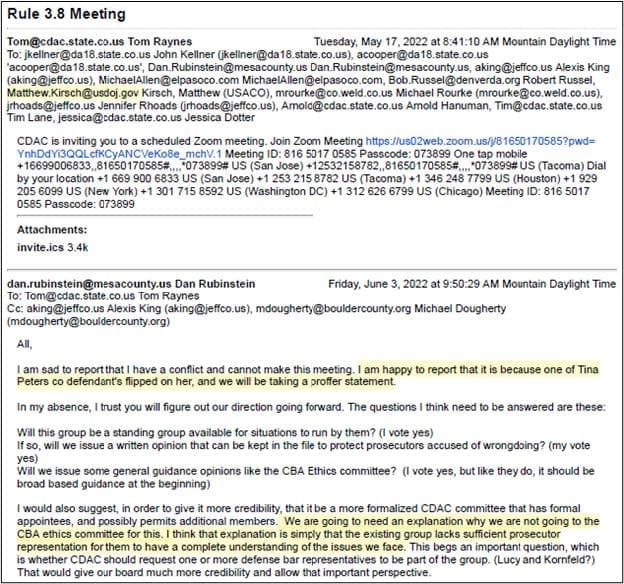
According to Clements’ reporting, Rubinstein “was having some trouble reconciling the prosecution of Tina Peters with prosecutors’ rules of professional conduct and had to call in the cavalry to help him brainstorm ways to avoid being ‘accused of wrongdoing.’”
The email Clements uncovered was sent by Rubinstein to United States Attorney for Colorado Matthew Kirsch and several district attorneys across Colorado. Its subject line was “Rule 3.8 Meeting,” an apparent reference to the rule of professional conduct governing prosecutors.
Credit: Erin Clements, Barb Hulett, Joe Hoft
Rubenstein writes: “I am happy to report that it is because one of Tina Peters co-defendent’s flipped on her, and we will be taking a proffer statement.”
Wood appears to give Rubenstein the leap of lawfare he needed. Without it, he would have been left with the truth, and that’s a much weaker case. Rubenstein could have still argued that state employees were misled, but he couldn’t base the whole thing on a case of stolen identity nor use that stolen-identity theory as the foundation for the remaining felonies.
Clements offers this analysis in her article:
“First, Rubinstein appears to recognize that there is no precedent for the prosecution he wants to undertake, as he expresses a desire that this group of legal minds start writing opinions and issuing guidance documents in the vein of the Colorado Bar Association (CBA) and the Colorado District Attorneys’ Council (CDAC). Without a coherent legal pathway for prosecution, it appears Rubinstein encouraged this course of action to give prosecutors cover.”
“Second, Rubinstein notes that it is problematic that they have no formal appointments from a government body to lay the groundwork to prosecute Peters.”
“Third, Rubinstein informs the group of their need to anticipate defending themselves as to why they didn’t seek an opinion on Peter’s case from the Colorado Bar Association Ethics Commission.”
Clements concludes:
Part II coming next“Rubinstein and his cronies appear to have succeeded in giving their efforts the veneer of legitimacy because three months after this email was sent, Peters was indicted by a grand jury.”