Louisiana Energy - Part 4: End the Legacy Lawsuit Litigation Lottery, Deliver Real Stewardship - Joe Hoft
Guest post by Danielle Walker, The State of Freedom and Brad LeBlanc, Geoscientist and President of Bradford Minerals Corp.
See Part I, Part II, and Part 3.
ADVERTISEMENTIn Part 3 we called out Environmental, Social, and Governance (ESG) demands for what they are: a non-kinetic Softwar campaign—Jason Lowery’s framework for power projection by other means—designed to constrain American energy production, inflate capital costs, and shift control upward. One of the key action items was this: build on recent legacy-lawsuit reforms with a final, principled resolution.
To be clear on the statutes: Act 312 (2006) is Louisiana’s legacy oilfield remediation law. It gave courts heavy control over cleanup standards and opened the door to damages well beyond actual restoration costs. Act 458 of 2025 (SB 244) is the major reform. Effective for cases filed after September 1, 2027, it shifts cleanup-plan approval to the Louisiana Department of Energy and Natural Resources (LDENR), raises the evidentiary bar, and begins to rein in the worst abuses.
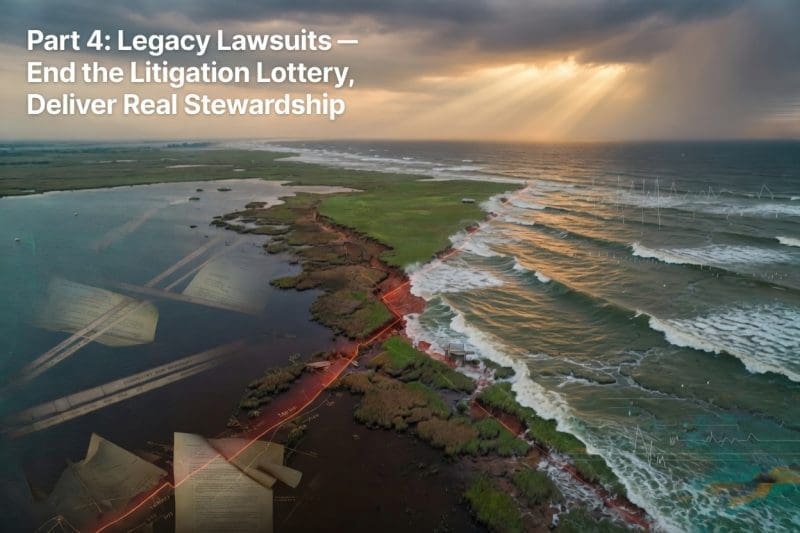
Governor Jeff Landry and Attorney General Liz Murrill have advanced Act 458, a clear step in the right direction. Yet they continue to support key coastal lawsuits alleging oil and gas companies “destroyed the Louisiana coastline.” The substantial geologic evidence strongly indicates otherwise: the real driver of land loss is natural subsidence driven by downward movement along surface-reaching faults. This fault-generated subsidence exposed the marsh to greater wave action and accelerated erosion. Dredging for drill sites was never the primary cause.
For decades, the widely accepted narrative in Louisiana has been that coastal land loss was primarily caused by oil and gas canals and dredging. The belief was that these canals allowed saltwater intrusion, which then eroded the marsh and turned it into open water. That story drove hundreds of legacy lawsuits and shaped public policy for years.
ADVERTISEMENTChris McLindon, President of the New Orleans Geological Society, has summarized a multi-university effort that put industry-supplied seismic data under rigorous review. Teams from UNO, Tulane, and the University of Texas at Austin analyzed more than 500 square miles of transition-zone seismic data to produce the Atlas of Surface Fault Traces in South Louisiana, presented at the Louisiana Coastal Geology Symposium. The patterns are unmistakable: land loss tracks active, surface-reaching faults with precision. Dredging canals for oil-field exploration and development was never the primary driver. Seasonal deltaic sedimentation continues to deposit fresh material that is distributed laterally, rebuilt, eroded, and rebuilt again—recharging the delta system even as it drives compaction and localized fault movement. Subsidence is a natural geologic process.
Hurricanes dramatically accelerate this process. Once fault-driven subsidence lowers the marsh platform below critical elevation, major storms cause rapid and catastrophic land loss. This raises the critical question of causation: Did poor management of marshes and barrier islands, along with canal dredging, cause greater subsidence that hurricanes then worsened—or were those features already doomed by underlying faults? The seismic data shows that the active growth faults came first. They created the fundamental vulnerability. Both industry decisions to cease routine maintenance and government policies that turned every canal into a potential liability made localized problems worse, but the geologic foundation set the stage. Hurricanes did not create the subsidence problem—they exposed and intensified it.
The time has come to move forward pragmatically and urgently: stop the litigation lottery, fund verifiable restoration through an industry-led trust, and preserve the wetlands, marshes, and estuaries we still can. This evidence aligns with the broader perspective of Western Washington University Professor Emeritus Don Easterbrook.
His decades of research on recurring climate cycles—detailed in works such as Evidence-Based Climate Science—show that Earth’s temperatures have fluctuated naturally for millennia, long before industrial CO₂ levels rose. Ice-core records reveal temperatures rising 600–800 years before atmospheric CO₂ followed after the last Ice Age—clear proof that CO₂ is largely a follower, not the driver, of climate change. Sea-level rise itself has been modest and steady at roughly seven inches per century, a natural geologic process. In the New Orleans area, the natural rate of subsidence is two to three times that of natural sea-level rise. The real crisis in coastal Louisiana is not this modest global rise, but the much faster relative sea-level rise caused by natural subsidence and the loss of new sediment supply—the very processes the fault atlas documents.
Critically, Louisiana’s actual flood-protection and coastal-restoration work is increasingly grounded in this same science. The Greater New Orleans Urban Water Plan, $14 billion in post-Katrina flood infrastructure, and the Coastal Protection and Restoration Authority’s (CPRA) Master Plan all draw heavily on university-industry collaborations. In Plaquemines Parish, 28 different faults were mapped—most reaching the surface—with several corresponding to “abrupt shifts from emergent wetlands to fully submerged areas of open water.” CPRA’s own presentations feature the Ironton fault trace near the proposed Mid-Barataria Sediment Diversion. These projects are being designed around verifiable fault and subsidence data, not around the claims driving the lawsuits.
The recent termination of the Mid-Barataria Sediment Diversion in July 2025 further validates this shift. Ballooning costs, suspended federal permits, and stakeholder litigation led CPRA under Governor Landry to cancel the politically charged mega-project and redirect funds to smaller, targeted alternatives. The decision aligns with the geologic reality McLindon documented: the Ironton fault crosses the site, and fault-driven subsidence would have undermined long-term land-building claims regardless of sediment volume. As McLindon warned in his 2019 Advocate op-ed, “Suing energy industry won’t help preserve N.O.,” the city’s lawsuit “tears at the fabric of this cooperative relationship” and could not have come at a worse moment for the science driving the 2023 Master Plan. Commercial fishermen, oystermen, and shrimpers stood united against the diversion, correctly seeing it as an immediate threat to their working waterfront.
ADVERTISEMENTGovernor John Bel Edwards chose confrontation instead of cooperation. In a 2016 Advocate interview he warned coastal parish presidents: sue the oil companies, or I will. This created such a toxic business climate that capital fled Louisiana for more predictable states like Texas. More than 300 legacy suits targeted the oil and gas sector. Instead, endless litigation delivered the opposite: lawyer fees, fleeing investment capital, loss of jobs and businesses in the service sector, and the problem of coastal land loss remained unresolved.
Act 458 of 2025 is a step forward. But partial reform is not victory, and the trial lawyers have been suing the industry with abandon for twenty years now. Last week’s announced agreement in principle with ExxonMobil to resolve coastal disputes and partner on orphaned wells shows that pragmatic resolutions are possible—though, as is customary in these cases, full terms remain under court seal.
The principled resolution is straightforward and long overdue:
This is not about letting anyone off the hook. It is about replacing the litigation lottery—which has generated far more billable hours than acres of restored marsh—with measurable, on-the-ground stewardship that actually protects the coast. Raising public awareness to the atlas of surface-reaching faults provides a roadmap to more appropriately address the issue; Easterbrook’s geologic cycles put the broader CO₂ narrative in its proper historical context; the trust provides the funding mechanism; and genuine liability certainty provides the capital trigger.
If Louisiana offers the oil and gas industry the regulatory certainty and production-focused incentives it needs, capital and jobs will come roaring back—while delivering real, science-based stewardship for the coast and its people. This is an all-ships-rise approach: no zero-sum tradeoffs detrimental to the coast, working families, taxpayers, or the industry itself (trial lawyers pursuing the legacy lottery excepted—they’ve had their day).
One additional note on the broader picture: Large-scale CCS injection carries documented geomechanical risks, particularly near active faults. High-pressure CO₂ can reduce effective stress on pre-existing faults, raising the chances of reactivation and accelerated localized subsidence—the very process already driving coastal land loss. Major producers should therefore drop support for unconstitutional CCS projects in Louisiana and double down on traditional expansion here, where the geology is known and the infrastructure exists.
Brad LeBlanc Frames the Economic Choice
Supporting real oil and gas is GDP+. You bring a valuable commodity that did not previously exist at the surface up from the ground, sell it for profit, and pay taxes on the product. The state and its people win again and again. Supporting CCS is GDP-. Taxpayer-funded subsidies stick CO₂ in the ground; there is no marketable product, no continual jobs, no recurring revenue stream—only permanent liability transferred to Louisiana and its citizenry after a few short years, and after 50 years permanent responsibility for any disasters that occur from CO₂ injection. Favoring tax incentives for a GDP- process while the state’s own energy heartland bleeds investment is backwards economics.
Europe, begging for American LNG while its own net-zero fantasies leave it exposed to every Hormuz shock and every adversarial Russian supply disruption, has zero standing to demand ESG compliance. Louisiana has even less reason to keep punishing the industry that built its once-great economy and its coast in the first place. On the contrary, we have every incentive to ensure they can be happy and highly productive here.
Danielle Walker Shares A Personal Perspective
I grew up, live, and fish in one of the areas of greatest noted subsidence in South Louisiana. I see it with my own eyes, and the devastation to the once-great inland fishing waters, bays, and estuaries is undeniable. This is not about forgetting the people, the livelihoods, or the homes of those who live and work on our beloved coast. It is simply about addressing the real root cause as we do everything possible to protect and restore what we can—and pray about the problems we cannot fix with human means alone. I don’t pretend to have all the answers here, but the fault atlas is public and deserves far more attention. The geologic evidence is public. The economic choice is public. We should work from reality—not political talking points or feel-good policies that simply waste time and money.
End the litigation lottery. Finish the Act 312 reforms. Deliver stewardship that works. Give producers the regulatory certainty and production-focused incentives they need to invest here—not in carbon credits or foreign markets. That is how Louisiana turns the Softwar campaign on its head and reclaims energy dominance on our own terms.
(The series continues with Part 5: Softwar on American Soil.)