Iran Walks Out for Kabuki Theater as the Peace Deal Stands on Shaky Ground
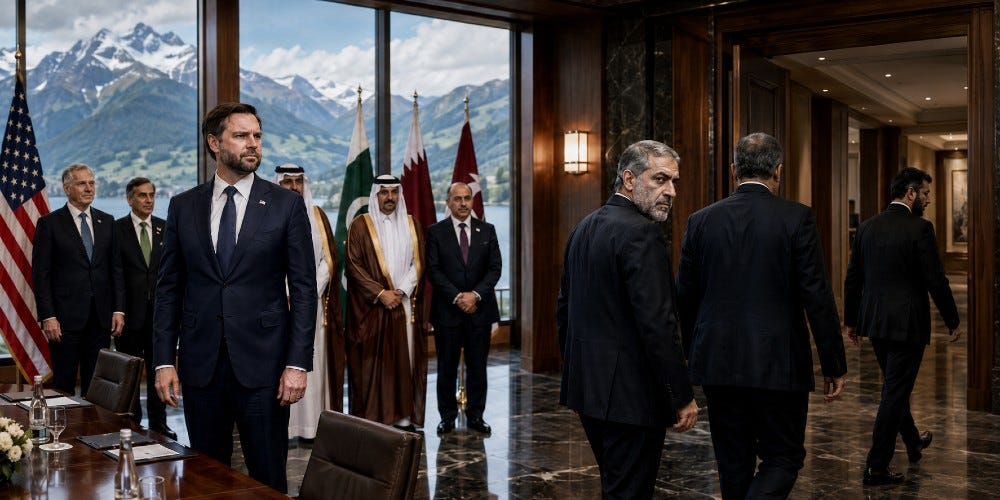
The setting was the Bürgenstock resort above Lake Lucerne, where the United States, Pakistan, and Qatar gathered for a quadrilateral meeting meant to advance the 14-point memorandum of understanding signed last week between President Donald Trump and Iranian President Masoud Pezeshkian. Vice President JD Vance led the American delegation alongside special envoys Jared Kushner and Steve Witkoff. The mediators arrived ready to praise. Iran arrived ready to leverage.
Pakistani Prime Minister Shehbaz Sharif opened by calling it “a great day that will lead to world peace” and thanking Trump for the diplomacy that produced the talks. Vance followed with his own tribute, crediting the president’s “leadership” and “willingness to see a Middle East that is much different 10 years from now than it was 10 years ago.”
Qatari Prime Minister Mohammed bin Abdulrahman Al Thani called the meeting “just the beginning” of a longer process. The choreography was seamless. The optimism was thick. And the Iranians would not stand in the picture.
According to Iran’s Tasnim News Agency, the regime’s delegation declined to join a group photo with the American side, Parliament Speaker Mohammad Bagher Ghalibaf refused to enter the room for the press conference, and the team eventually left the venue altogether in protest of Trump’s threats to resume strikes unless the Strait of Hormuz reopens.
Tasnim is the mouthpiece of the Islamic Revolutionary Guard Corps, so the spectacle was almost certainly broadcast on purpose. This is not a delegation that lost its temper. This is a delegation performing defiance for an audience back home.
Leverage dressed up as principleThe walkout cannot be separated from the chokepoint. On Saturday, Iran announced it was closing the Strait of Hormuz again, citing Israel’s continued operations against Hezbollah in southern Lebanon and accusing Washington of failing to enforce the first clause of the agreement. The IRGC navy warned vessels that their security would be “at risk” if they approached.
American officials disputed the closure outright, with CENTCOM insisting Iran does not control the waterway and reporting that 55 commercial vessels and more than 17 million barrels of oil moved through it Saturday. Vessel-tracking data, however, shows no tanker crossings since Tehran’s announcement, which means the threat carries real teeth regardless of who technically commands the strait.
This is the entire Iranian strategy in one weekend. Sign the memorandum to lock in the benefits, then weaponize a fifth of the world’s seaborne oil to extract more. Ghalibaf made the posture explicit on X, warning that “the more they talk, the more we act” and that Iran’s armed forces were prepared to respond. A regime that wanted peace does not threaten to mine a shipping lane on the morning it sits down to negotiate one.
A ceasefire that isn’t holdingThe administration’s confidence runs ahead of the facts on the ground. Vance told reporters the United States had “done more to stop the conflict in Lebanon than any government anywhere in the world,” and insisted that “despite the headlines, things are actually getting better there.”
Yet dozens of Lebanese have been killed in Israeli strikes over the past two days, marking some of the worst bloodshed of the conflict, and an emergency session on the Israel-Hezbollah fighting had to be bolted onto the first day of talks. Prime Minister Benjamin Netanyahu, for his part, declared flatly that Israel is not bound by the US-Iran ceasefire and will keep military pressure on Hezbollah for as long as it takes. Neither Israeli nor Hezbollah representatives were even in the building.
So the structure of this peace is plain. Israel will not be constrained by it. Hezbollah keeps fighting through it. Iran uses every breach as a pretext to choke global oil and stage walkouts. And the American vice president stands at a podium thanking the president for a moment that the other side openly refuses to honor.
Editorial honesty requires admitting the deal may yet produce something durable over its 60-day window. Sober judgment requires admitting nothing about Sunday suggested it will.
Scripture warned about exactly this kind of counterfeit. Psalm 28:3 pleads, “Draw me not away with the wicked, and with the workers of iniquity, which speak peace to their neighbours, but mischief is in their hearts.”
That is the Tehran regime in a single verse. It speaks peace into microphones and hides mischief in the Strait of Hormuz, and no amount of resort-summit goodwill changes the heart doing the negotiating.
The men in Switzerland want a different Middle East ten years from now, and that is a worthy thing to want. But wanting it does not make Iran an honest broker, and a partner that will not stand for the photograph should not be trusted to keep the promise.
The administration would do well to negotiate as though it already knows that, because Iran spent Sunday making sure everyone did.