Ben Shapiro, the Lavon Affair, and Facts Withheld from the American People
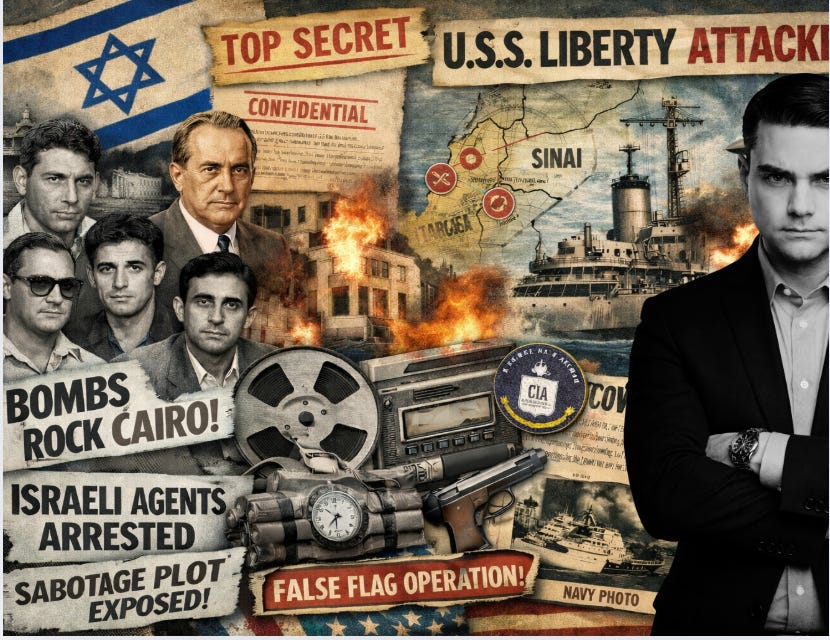
Warning: The facts you’re about to be given in this article are something you’ve likely never heard before. And once you hear about it, you can’t go back. That’s because Americans have been trained to believe that skepticism toward official narratives is dangerous, unserious, or extremist. That training emerged from repeated, documented episodes in which the U.S. government fabricated attacks to justify wars, suppressed attacks to preserve alliances, and enlisted the media to enforce silence rather than accountability.
The USS Liberty reveals how American lives have been subordinated to the interests of Israel without consequence. But an event you’ve likely never heard of known as the Lavon Affair matters most of all because it confirms that what was once dismissed as conspiracy was, in fact, a real false flag operation carried out to manipulate Western powers, including the United States, to attack Israel’s enemies who are no enemies to us. It exposes a form of managerial faux-conservatism that protects institutions, Israel, and the Industrial War Complex by narrowing the range of permissible inquiry.
When the trans-national Industrial War Complex wants to go to war, it manufactures attacks. And when it wants to preserve a military alliance, it buries them. This is not a cynical slogan or a partisan talking point. It is an observable pattern, documented across decades of American foreign policy, and it explains far more about our current distrust of institutions than any social media algorithm ever could.
The Gulf of Tonkin is now taught as a case study in deception. The American public was told U.S. ships were attacked by North Vietnamese forces, creating the moral justification for a massive escalation in Vietnam. Later investigations revealed that the alleged second attack never occurred, and the first was wildly exaggerated. This was not confusion in the fog of war. It was a political narrative constructed to unlock congressional authority and public consent. The lie was not incidental to the war. It was the war’s ignition system.
That precedent matters because it reveals how the American state behaves when it wants something badly enough. The public is not informed but managed, and the media becomes the transmission belt for a story whose utility matters more than its accuracy.
The uncomfortable truth is that the same machinery operates in reverse. When an event threatens a favored alliance or strategic narrative, the response is not escalation but erasure. Instead of invented attacks, we get suppressed ones. That inversion brings us to the USS Liberty
 IF YOU PREFER TO LISTEN ON SPOTIFY, CLICK HERE.
THE USS LIBERTY AND THE DISCIPLINE OF SILENCE
The attack on the USS Liberty was not a rumor, a meme, or an internet myth. It was a sustained military assault on a clearly marked American naval vessel, resulting in dozens of American casualties. Survivors have testified consistently for decades about the duration of the attack, the clarity of the ship’s markings, and the aftermath that followed. What happened afterward matters more than any argument over intent.
The surviving sailors were instructed to remain silent. Testimony was constrained. Investigations were abbreviated. The incident was rapidly declared closed. Reparations were paid without any admission of guilt, and the matter was officially categorized as resolved. This sequence alone should disturb anyone who claims to care about American service members and national sovereignty.
Accidents happen in war. That is not controversial. What does not happen accidentally is a coordinated effort to prevent American sailors from speaking publicly about an event that killed their friends. What does not happen accidentally is the political decision to treat an attack on a U.S. vessel as an inconvenience rather than a crisis. Even if one grants the most generous interpretation of events, the response that followed was a betrayal of the men involved and an insult to the public.
This is where recent dismissals of the USS Liberty become revealing. When Shapiro argues that the incident is irrelevant because it happened long ago, he is not making a historical argument. He is making a moral one, and it is a bad one. Time does not selectively erase obligations. Age does not nullify accountability. If it did, vast portions of modern moral discourse would collapse overnight.
Shapiro argued that reparations settled the matter. That claim misunderstands the nature of justice. Reparations without confession are not reconciliation. They are a transaction designed to end discussion. No criminal accountability followed. No independent investigation was permitted. No public reckoning occurred. The sailors received money, and the country received a directive to move on.
That directive was enforced not only by the government but by the media. Coverage faded. Questions became suspect. Interest was reframed as obsession. The public learned a lesson, whether consciously or not. Some stories are encouraged. Others are discouraged. Some victims are eternal. Others are disposable.
 Join JD Hall’s subscriber chatAvailable in the Substack app and on webJoin chat
DISMISSAL AS DOCTRINE AND WHY IT BACKFIRES
When the USS Liberty is waved away as murky, old, or irrelevant, the goal is not to clarify history. The goal is to close the file. The posture is impatience and annoyance that the question was asked at all.
In that posture, the hierarchy of concern becomes visible. Historical suffering is treated as permanently urgent when it aligns with preferred narratives, and permanently settled when it complicates them. The blood of Jews is allowed to cry out across generations, while the blood of American sailors is instructed to whisper and then forget itself entirely. This is not an accusation of secret loyalty. It is an observation of stated priorities and reflexive behavior.
The irony is that this approach produces the very skepticism it condemns. Americans are told they must trust official narratives, even as those narratives are repeatedly revised, retracted, or quietly abandoned. They are told conspiracy theories are dangerous, even as history confirms that some of the most consequential events of the last century were built on deception. They are told to stop asking questions, even as the record shows that asking questions is often the only way truth eventually emerges.
The problem is not that Americans believe too many conspiracies. The problem is that institutions have earned disbelief through demonstrated behavior. When officials demand silence rather than transparency, they teach the public that silence serves power, not truth. When media outlets treat some historical crimes as sacred and others as untouchable, they reveal that moral concern is being rationed.
The USS Liberty is not brought up because it is unique. It is brought up because it is illustrative. It sits at the intersection of military sacrifice, political expediency, and narrative enforcement. The outrage is not that mistakes happen in war. The outrage is that American lives can be subordinated to foreign policy optics without consequence, and that anyone who notices is told to stop noticing.
If the USS Liberty unsettled you, it should. It was meant to. What comes next will explain why you were never taught the rest.
THE LAVON AFFAIR AND THE CONSPIRACY THAT TURNED OUT TO BE TRUE
There is a reason most Americans have never heard of the Lavon Affair. It is not obscure because it is insignificant. It is obscure because it is devastating to the mythology that surrounds modern alliances and intelligence work. The Lavon Affair was not an allegation, a rumor, or an internet fever dream. It was a confirmed false flag operation carried out by Israeli intelligence in the 1950s, designed to manipulate Western perceptions and sabotage diplomatic relations between the United States and Egypt.
The operation involved Israeli operatives planting bombs at American and British civilian targets in Egypt, including libraries and cultural centers. The goal was spectacle and blame. The attacks were intended to be attributed to Egyptian nationalists or communists, thereby creating a diplomatic crisis that would harden Western attitudes toward Egypt and disrupt its growing independence from Western control. In other words, it was an intelligence operation meant to manufacture reality.
Israeli officials initially denied responsibility, then quietly acknowledged it internally. Political fallout followed within Israel itself, including resignations and recriminations. The historical record is clear. This happened. It was not speculation. It was not antisemitic fantasy. It was not a misunderstanding. It was a deliberate attempt to deceive the United States and its allies by staging attacks on Western interests.
This matters because it permanently alters the burden of proof. Once a state has been caught conducting false flag operations to manipulate American foreign policy, claims of implausibility lose their force. The phrase “they would never do that” stops functioning as an argument. Prudence replaces presumption. Skepticism becomes rational rather than pathological.
The Lavon Affair is not raised to claim that every subsequent controversy must follow the same script. It is raised to establish precedent. States behave in patterns. Intelligence services develop habits. Political cultures normalize certain tools. When an ally has already demonstrated a willingness to plant bombs at American facilities in order to steer U.S. behavior, it becomes irresponsible to treat later incidents as unthinkable simply because they are uncomfortable.
This is why the Lavon Affair is almost never mentioned in mainstream discussions about Israel, intelligence operations, or conspiracy theory. It destabilizes the moral asymmetry that governs acceptable skepticism. It proves that some conspiracies are not only real but documented, and that their suppression is often as revealing as their discovery.

PATTERNS OF MANIPULATION AND THE MYTH OF INNOCENT ALLIANCES
Once the Lavon Affair is acknowledged, the conversation changes. The USS Liberty no longer sits in isolation as a singular controversy surrounded by competing narratives. It becomes part of a broader pattern of behavior that includes deception, narrative management, and the prioritization of strategic outcomes over transparent truth. The question shifts from whether something like the Liberty could have been intentional to why so many people insist it could not be.
This is where institutional instincts matter more than individual events. Governments do not operate on moral abstractions. They operate on interests. When interests align, narratives converge. When interests are threatened, narratives are disciplined. The United States learned this lesson in Vietnam through the Gulf of Tonkin, where a fabricated or exaggerated attack was used to justify war. The lesson did not end there. It simply changed direction.
In the case of favored allies, the machinery does not invent outrage. It suppresses it. Investigations are narrowed, language is softened, and media attention is redirected. Victims are compensated quietly and instructed to move on. Public memory is managed through omission rather than fabrication. This is not conspiracy thinking. It is institutional analysis grounded in observable outcomes.
The Lavon Affair demonstrates that Israeli intelligence was willing to manipulate Western publics through staged violence. The USS Liberty demonstrates that when American lives are lost under inconvenient circumstances, the United States government is capable of choosing alliance preservation over accountability. Together, they expose a reality that many prefer not to confront. Alliances are not built on shared values alone. They are maintained through power, leverage, and narrative control.
This is where the Industrial War Complex enters the frame. Modern warfare is not sustained solely by weapons and budgets. It is sustained by stories. The public must be persuaded that violence is necessary, justified, and unavoidable. When persuasion fails, deception fills the gap. When exposure threatens legitimacy, suppression becomes policy.
The media plays a central role in this ecosystem. It is not that journalists conspire in smoke filled rooms. It is that professional incentives reward conformity and punish deviation. Stories that challenge foundational assumptions about allies are treated as fringe. Stories that reinforce them are treated as responsible. Over time, this produces a landscape where certain facts are technically available but practically unknown.
The result is a public that senses dishonesty without always being able to articulate it. This is the soil in which conspiracy thinking grows. Not because citizens are irrational, but because institutions have proven themselves untrustworthy
LET’S PAUSE FOR A MOMENT. I HAVE SOME QUESTIONS FOR YOU.
Let’s pause the argument for a moment and ask a different kind of question, not about policy or history, but about introspection. What does it actually feel like to realize you were never told about an incident in which a foreign power, described endlessly as an ally, carried out a sustained, hours-long attack on an American naval vessel? What does it feel like to learn that this was not a brief exchange or a tragic mistake, but an assault that began with attempts to disable communications, continued through repeated air and naval strikes, and ended with American sailors dead in the water?
What does it feel like to discover, years later, that survivors testified to life rafts being fired upon with .50 caliber machine guns, an act that violates the laws of war and removes any remaining pretense of confusion or accident? What does it feel like to realize that these men were then ordered into silence by their own government, compensated without justice, and effectively written out of the national memory because their story complicated foreign policy priorities?
Now add another layer. What does it feel like to learn that this same nation was later caught orchestrating a false flag operation, planting bombs at Western targets with the explicit intent of manipulating the United States into confrontation with its enemies? What does it do to your understanding of the world when you realize this was not an allegation, but a documented historical fact, quietly acknowledged and then buried?
Sit with that discomfort for a moment, because it matters. It matters not only for how you view the past, but for how you process claims in the present. If a government has demonstrated a willingness to fabricate attacks to start wars, and if an ally has demonstrated a willingness to stage attacks to redirect American power, then the demand that you treat all future suspicions as illegitimate begins to look less like prudence and more like conditioning.
So here is the harder question. How does this information affect you when you consider that credible voices have argued that the official story of September 11 leaves significant questions unanswered? How does it affect you when you recall that the wars which followed aligned neatly with the strategic goals of foreign states that had long lobbied for American military intervention against their regional enemies? Does learning about suppressed history and confirmed deception add weight to those questions, even if it does not answer them?
No honest person has to leap to conclusions. But no honest person can pretend this context is irrelevant. Does it not at least enter the calculation? Does it not make outright dismissal feel premature? Does it not, at the very least, make some claims seem less unthinkable than you were previously instructed to believe?
This is not about certainty. It is about permission. Permission to think, to weigh evidence, to update assumptions, and to refuse the infantilizing demand that some questions are off-limits forever. Once you understand how often the public has been misled, the real mystery is not why people doubt official narratives, but why anyone is surprised that they do.
If you appreciate my free articles, you’ll love the paid content (like the rest of this article). Act now to get 20% off and continue reading with full access to the complete archives.
If you don’t do subscriptions, consider a one-time gift of your choosing by clicking below.