'Go At It Boldly': Sunday Reflection
This morning’s Gospel reading is Matthew 10:26–33:
Jesus said to the Twelve:
“Fear no one. Nothing is concealed that will not be revealed, nor secret that will not be known. What I say to you in the darkness, speak in the light; what you hear whispered, proclaim on the housetops. And do not be afraid of those who kill the body but cannot kill the soul; rather, be afraid of the one who can destroy both soul and body in Gehenna. Are not two sparrows sold for a small coin? Yet not one of them falls to the ground without your Father’s knowledge. Even all the hairs of your head are counted. So do not be afraid; you are worth more than many sparrows. Everyone who acknowledges me before others I will acknowledge before my heavenly Father. But whoever denies me before others, I will deny before my heavenly Father.”
Advertisement
What does courage mean? What role does fear play in it?
The Bible has many reflections on both fear and courage, with the 'fear' of God emphasized particularly in the Old Testament. In the New Testament, thanks to the nature of the foundation of a pilgrim church, the emphasis feels more on courage than fear. Today's readings give us glimpses of both, but perhaps some insight into how courage and fear are complementary rather than opposites, and why Jesus emphasizes where both should be placed.
Fear and courage are themselves foundational concepts. In terms of human civilization, they play a stronger role than love itself does – the very affliction that Jesus comes to resolve in the fallen world. Civilizations form through people banding together, an act that takes some courage, to both flourish and to protect themselves from what they fear, usually other tribes or civilizations. As a result of this foundational quality, the cultures produced by civilizations focus strongly on qualities of courage and of necessary fear. The art, the poetry, and the mores will produce heroic archetypes for their aspirational value, and to remind people of the necessity of courage for survival.
The Bible demonstrates this as well. In the Ignatius Catholic Bible I prefer, the word "fear" appears almost 600 times. Thankfully, "love" appears far more often (885), but fear is a significant theme in the scriptures. "Courage" appears 125 times, but there are other synonyms for courage used in scriptures, such as "brave" (18), "strength" in some contexts (298, but many of those are about the Lord's strength), and so on.
Advertisement
The Lord and the prophets all understand the nature of fear and the large role it plays in the lives of individuals and of nations. Fear of the Lord is a virtue, but fear in other contexts undermines our other virtues and leads us into sin. Fear can lead us into envy and idolatry; what was the root of disobedience in the Garden of Eden, for instance? Adam and Eve feared that they were missing out on godhood. Why did the Israelites make a Golden Calf at the foot of Mt. Sinai? They feared that the Lord had abandoned them and wanted to create their own idol to replace Him. Why did the kingdoms of Israel fall? They saw the wealth of other nations and feared that they would not measure up, and abandoned the mission of the Lord to instead pursue material wealth and strength.
However, fear properly placed and oriented toward the Lord can forge courage into its most virtuous form. If we do not fear at all, then courage has no claim on our actions. Only the most foolish person has no fear at all, for there are rational and even virtuous fears that can guide us toward salvation. We should fear temptation, for instance, enough to avoid it at all times. Jesus taught us that in the one prayer He left with us, and we have prayed "lead us not into temptation but deliver us from evil" for two millennia. There are dangers in the world for which fear is a proper survival response, a gift to us from the Lord so that we can fend for ourselves in the fallen world.
Denying danger is not courage. Courage is acting in the face of danger, and overcoming fear to act properly and rightly to achieve a righteous outcome. When we act with courage to serve the Lord, we do not stop fearing but rather set it aside and offer it up to the Lord. Our first reading from Jeremiah demonstrates this, in which the prophet has been persecuted and isolated for his service to the Lord. Nonetheless, Jeremiah continues his mission with courage in the face of his tormentors, knowing he serves the Lord, and asks the Lord for vindication:
Advertisement
“I hear the whisperings of many: ‘Terror on every side! Denounce! let us denounce him!’ All those who were my friends are on the watch for any misstep of mine. ‘Perhaps he will be trapped; then we can prevail, and take our vengeance on him.’ But the LORD is with me, like a mighty champion: my persecutors will stumble, they will not triumph. In their failure they will be put to utter shame, to lasting, unforgettable confusion. O LORD of hosts, you who test the just, who probe mind and heart, let me witness the vengeance you take on them, for to you I have entrusted my cause. Sing to the LORD, praise the LORD, for he has rescued the life of the poor from the power of the wicked!”
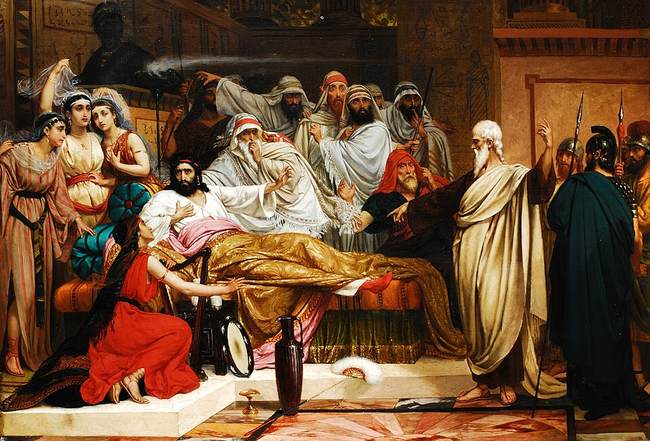
The Lord had tasked Jeremiah to prophesy about the coming fall of Jerusalem to the Babylonians, condemning the idolatry and other practices in the southern kingdom. His preaching prompted murder plots, imprisonment, beatings, and other miseries. Jeremiah certainly had a rational fear of the forces arrayed against him, and lamented to the Lord about them on more than one occasion. However, this fear forged Jeremiah's courage in continuing his service to the Lord, and it made him a comfort to the captive people of Judea when the Babylonian conquest finally took place. Jeremiah carried the Word of the Lord to the captives, and promised them an end to their suffering.
In today's Gospel, Jesus tells the disciples to "fear no one," but then goes on to qualify it: "And do not be afraid of those who kill the body but cannot kill the soul; rather, be afraid of the one who can destroy both soul and body in Gehenna." Fear is not the problem, but the orientation of fear is important. The battle is not for this world but for the next, and Jesus wants His disciples to be oriented to the proper mission. It is not material life that matters, but eternal life, and only the work of salvation matters. The Lord will take care of His 'army' for that battle.
Advertisement
Jesus is warning the disciples that they will face the same kind of battles Jeremiah did, from the people the Lord sent Jeremiah to save. It will take real courage to fulfill that mission, which must be conducted in the light and on the housetops. They will need to form their courage around the fears that first caused Jeremiah to question his calling at the start of his ministry. Jesus promises that the Lord will be with them on that journey, if they can muster the courage to take up the call.
Basil King, a Canadian clergyman, expressed this in his 1921 book The Conquest of Fear: "Go at it boldly, and you'll find unexpected forces closing round you and coming to your aid." The "unexpected forces" are not just the Holy Spirit, King suggests, but the many of the church who undertake Jesus' Great Commission. "I am not a free agent. Those with whom I am associated are not free agents," King writes later in the same book. "God is the one supreme command. He expresses Himself through me; He expresses Himself through them; we all." As King also writes, we may not individually accomplish the whole mission, and trying is as far as we can go, but "even trying is productive of wonderful results."
This is the Church, which Jesus founded and for which He formed his disciples in today's teachings. We are the forces who submit ourselves to the Lord's will and set aside our fears to do so. That itself is an act of courage, one that doesn't pretend dangers don't exist but instead, puts them in their proper perspective in relation to the mission of salvation. That is the ultimate act of faith and trust in the Lord.
Advertisement
Addendum: I had thought that the quote was, "Be bold, the mighty forces will be with you," but that was a misquote, one misattributed to Goethe. I normally try to track down quotes and sayings, and in this case, I'm glad I did, because the original quote from Basil King is squarely within Christian theological thought. It's the first time I'd heard of King or The Conquest of Fear, so I assume the Holy Spirit pointed me in that direction.
Previous reflections on these readings:
The front page image is "The prophet Jeremiah prophesies the fall of Jerusalem to King Zedekiah" by Joseph Stallaert, c.19th century. Via Wikimedia Commons.
“Sunday Reflection” is a regular feature that looks at the specific readings used in today’s Mass in Catholic parishes around the world. The reflection represents only my own point of view, intended to help prepare myself for the Lord’s day and perhaps spark a meaningful discussion. Previous Sunday Reflections can be found here.
Editor's Note: Our Sunday Reflections are free to all readers, but our VIP members help keep this platform going for everyone. Join the effort by using the promo code FIGHT to get 60% off new memberships and upgrades to VIP Gold and VIP Platinum!