REVIEW: ‘Toy Story 5’
How the mighty Pixar has fallen!
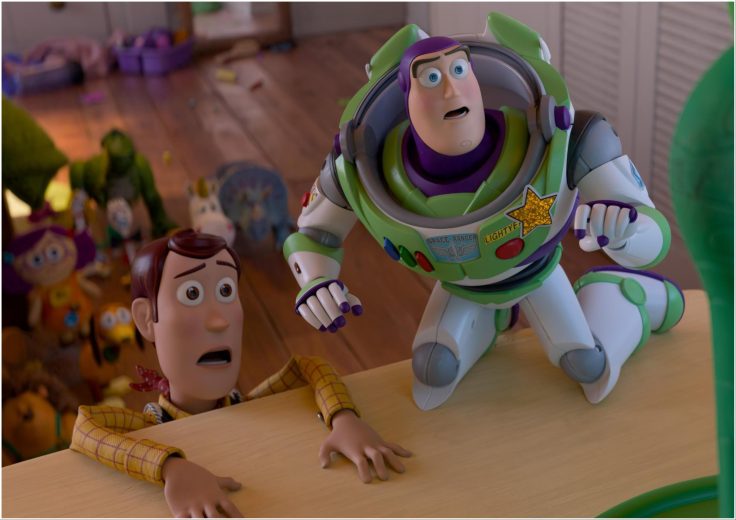 Toy Story 5 (IMDb)
The original Toy Story is not a movie about children. It’s about envy, status anxiety, and a workplace that threatens to become toxic. The boss happens to be a little boy, the workplace is his room, and the envy and status anxiety are the tribulations of Woody the Cowboy. His standing as the little boy’s favorite toy, and therefore the most important worker in the room, is threatened by the introduction of Buzz Lightyear, the boy’s new Christmas present. Bombastic and humorless, Buzz does not know he is a toy, and yet he enchants everyone in the room besides Woody—who undertakes a plot to get rid of Buzz that leads the others to believe he is a murderer.
Yes. This was the actual plot of Toy Story, and I bet you’ve forgotten it. In my 1995 review of Toy Story, I observed that it was "an example of cinematic storytelling we never get to see these days, because it is about the failings—moral and spiritual—of its characters." Toy Story is one of the greatest cinematic comedies ever made, full stop, in part because true "comedy demands that characters as vain, self-regarding, and self-deluding as these two be stripped of their illusions and forced to confront the truth about themselves." I pointed out that while Tom Hanks was happy to be the voice of Woody, he would never in a million years have played such a part in a live-action movie because he was the biggest star in Hollywood at the time—and stars will play villains and monsters but will never, ever play the fool.
There was nothing even remotely conventional about Toy Story. It was the first fully computer-animated film, and so it looked different from everything that came before it. And though it was a cartoon, nobody sang the way characters always did in Disney pictures. Pixar’s first full-length movie was something entirely new, and wonderfully fresh. The movies that have followed it in the subsequent three decades stopped featuring plots about the conflicts between the characters and rather became about the threats posed to them by the real world—especially, the effect of a toy owner’s approaching adulthood, which the startlingly emotional third Toy Story depicts as a terrifying death in a fiery furnace.
So now we have Toy Story 5, and it’s a charming piece of work. But over the three decades since the release of the original, Pixar has undergone many changes, among them the realization that its movies had lost their connection to younger audiences. By the time Pixar made Soul in 2020, about a middle-aged music teacher who never had the career as a jazz musician he wanted and deserved and then actually dies, this cartoon-making company had become the nation’s leading cultural mouthpiece for baby boomer solipsism. It began a process of renovation and reform, and Toy Story 5 is an important part of its effort to get itself back on track as the most reliable provider of animated entertainment for all ages.
Alas, in doing so, the franchise has become so defanged in its approach and so determined to be winsome that it has lost its punch. That’s too bad, because director Andrew Stanton has come up with an inspired idea at its center: He literalizes the danger posed to childhood itself by internet devices in the form of a tablet dubbed Lilypad. It is gifted to a very shy little girl and immediately takes the place of the toys that formerly provided her solace and an outlet for her imaginative play. The toys need to find a way to save her from becoming a screen-addicted zombie.
Smart, right? The problem here is that Stanton and his cowriter Kenna Harris really chicken out when it comes to exploring the theme—which is perhaps understandable, as Pixar was largely the handiwork of Steve Jobs, the person most responsible for the hypnotic power the iPhone and iPad have over all of us. Pixar lecturing us about how we let our kids drown themselves in their screens is a little like a tobacco company attacking a vape pen. It turns out that Lilypad just wants the little girl to make friends and soon sees the error of her ways—then ends up becoming part of the gang that saves her.
When Pixar had nothing to lose, it made a great and unsentimental comedy called Toy Story. It followed that with Monsters, Inc., Finding Nemo, WALL-E, and The Incredibles—each of them a masterpiece. Then it began stumbling. And now that it has everything to lose, Pixar has gone and made a decent and false work of sheer sentimentalism called Toy Story 5. I’m sure it will make a billion dollars. I’m also pretty sure Pixar will never again make anything remotely resembling a masterpiece.