REVIEW: ‘The Odyssey’
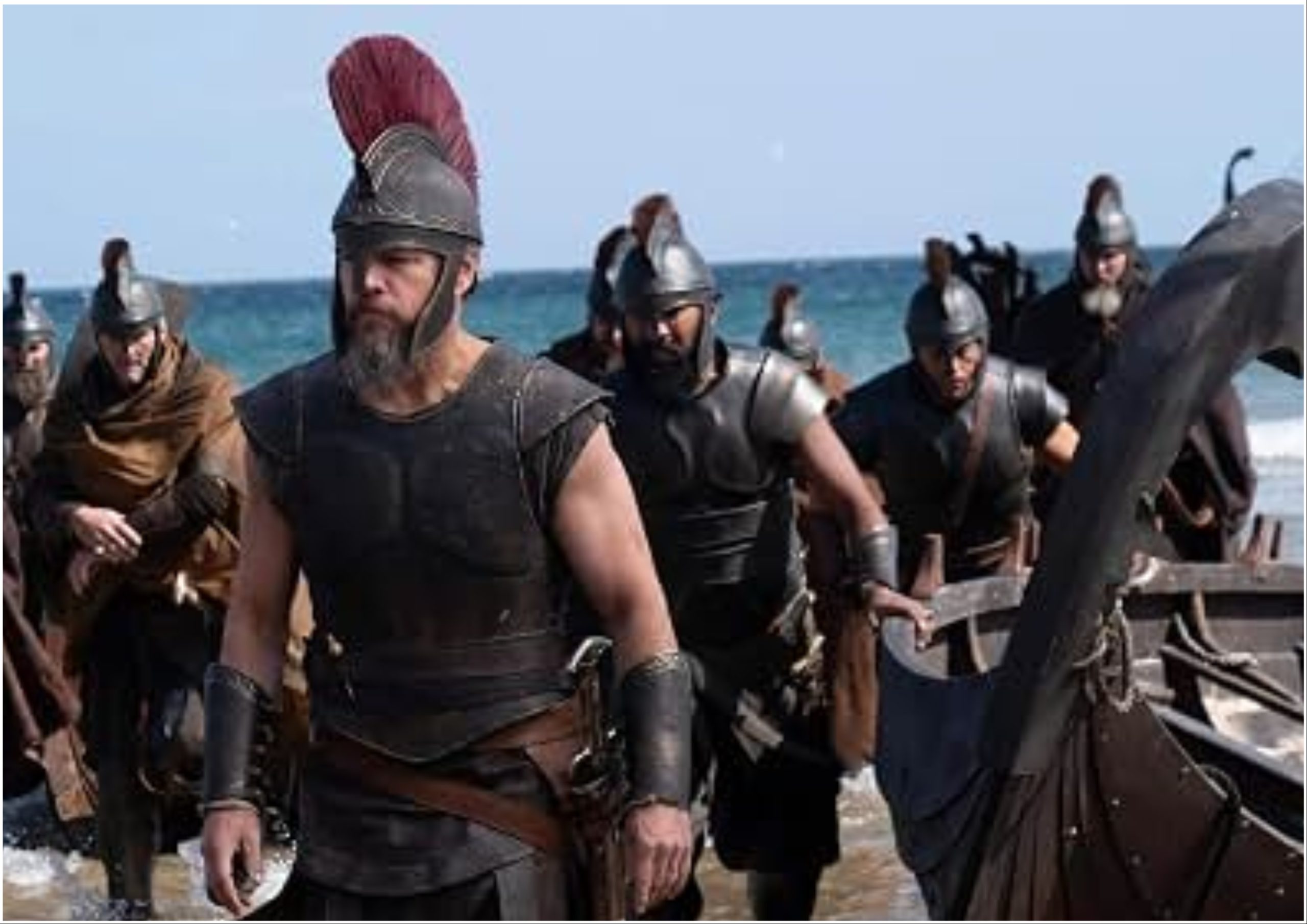
Christopher Nolan does something extraordinarily nervy in his overwhelming new film, The Odyssey. He has made as faithful a version of Homer’s poem as could possibly be made in the course of a three-hour running time—all while turning its worldview inside out.
The thing is, detail by detail, The Odyssey is not just faithful, it’s absolutely inspired. It’s possible that this is the single-greatest cinematic adaptation of a great work of literature in the 113-year history of the motion picture as a popular art form.
Nolan hits every story beat, makes staggering visual poetry out of Homer’s oracular poetry, and even finds a way to evoke the twisty-turny narrative through which Homer reveals the story of Odysseus’ 10-year journey home from the Trojan War and the crisis his absence has created in his home kingdom of Ithaca.
But Nolan’s great reveal, at the end of the film, is nowhere to be found in Homer. It offers a very modern psychological explanation for Odysseus’ lostness. I’ll get to that in a bit, and I’m warning you: I will get very fancy when I do it. First, let me just say of this movie:
Wow.
I mean, wow. The Odyssey is something you watch with your jaw hanging open for three hours. I’m not sure I have the vocabulary to offer some "to be sure" petty criticisms of its failings.
I’m not even sure it has any failings.
As a movie, The Odyssey somehow manages to travel through dramatic genres as Odysseus travels the seas. Three amazing sequences are just straight horror. There’s a lot of straight-out seafaring adventure, along with some men-in-rooms conspiracy stuff. Moving love scenes with two of the most beautiful women on earth (Charlize Theron and Anne Hathaway) share space with action of every possible kind—from battles to John Wick-like hand-to-hand combat in which a lone man dispatches dozens.
There isn’t a bad or even mediocre performance, and some are revelatory—among them, John Leguizamo as the faithful near-blind goatherd Eumaeus and Jon Bernthal as the surprisingly self-satisfied Menelaus, whose rage at his wife Helen’s cuckolding him with the son of the Trojan king was the inciting incident of the war. Tom Holland, best known as Spider-Man, gives us a Telemachus (Odysseus’ son) who makes a startlingly subtle journey from confused adolescence to the kind of manhood befitting one who deserves to wear a crown.
Robert Pattinson continues to show he is one of the best actors of his age with a sensationally smarmy portrayal of Antinous, the Machiavellian suitor who leads the band of gangsters that take over Odysseus’ palace and refuse to leave until his wife Penelope marries one of them. Anne Hathaway, the recipient a decade ago of a really repulsive and entirely unwarranted degree of social-media hate, is unforgettable in her depiction of Penelope’s self-contained rage and grief.
And speaking of unwarranted internet hate, let me just take a minute to dispense of the idiotic controversy that launched a thousand tweets.
The gorgeous Lupita Nyong’o plays Helen for about three minutes and uses those three minutes to create an utterly dazzling character even though she has very little to work with. This tiny bit of wonderment won’t shut up moron racists or tweet whores or Matt Walsh—but then, I repeat myself. Probably nothing short of a bribe from Qatar will.
The one quality Matt Damon lacks in his otherwise utterly commanding lead performance—a turn of astounding physicality and sheer presence that is the capstone of Damon’s career—is Odysseus’ impish cunning. That is not his fault. We know from his 30-year career onscreen that Damon is very good at garrulousness and spirited amusement. But Nolan isn’t. As was the case with his masterful Oppenheimer three years ago—another movie Nolan wrote and directed and for which he received the Oscar he will without a doubt win next year for The Odyssey—you must strain yourself to find a single moment of levity here.
Nolan shows rather than tells. But Homer’s Odysseus is famous as a teller of tales, a strategic and tactical liar who seems to delight in his own wit and occasionally causes harm because he indulges in it. Damon’s Odysseus lies and deceives his loyal men, but always out of good motive; he knows some must be sacrificed to the whims of the gods if others are to live.
The whims of the gods are central to understanding Homer’s view of the world and nature itself. Indeed, Odysseus’ adventures and misadventures provide us with the greatest and deepest portrait of the fundamental chaos of pagan civilization. It is dominated by capricious gods with voracious sexual appetites that lead to the creation of half-human, half-divine magic wielders and monstrosities who bedevil ordinary folk.
Free will in Homer’s universe is an illusion; as Shakespeare’s (also pagan) Earl of Gloucester says in King Lear, "like flies to wanton boys are we to the gods; they kill us for their sport." Odysseus may be the most intelligent and most cunning man on Earth, but even he is only intermittently able to come up with stratagems that help him survive his 10-year journey. Without the constant intercession of the goddess Athena and the occasional assistance of Zeus, Odysseus wouldn’t make it a day, let alone a decade.
Here is where Nolan’s transfiguration of The Odyssey comes in. (This is kind of a spoiler alert, since it doesn’t appear in the poem, so be warned if you don’t want to be influenced by my interpretation of the ending.) In Nolan’s telling, Odysseus is the unconscious author of his own inability to get home to Ithaca. What we learn toward the end of the movie is that Odysseus knows he is personally responsible for an unprecedented moral calamity that begins the decline and fall of the Greek civilization of the time ("our Bronze Age is over," Odysseus says in an uncharacteristic bit of anachronistic dialogue near the film’s end).
The calamity is the result of his successful scheme to penetrate the otherwise impregnable city of Troy with the construction of a gigantic golden statue of a horse whose insides are full of Greek soldiers. Once the horse is brought inside, Odysseus leads his squad to the gates of the city and opens them to the invading army.
This may have been a tactical masterstroke that won the Greeks the war after a decade-long standoff, but Nolan portrays it as a monstrous breach of divine command. By tricking the Trojans with a false gift, Odysseus breaks what Nolan (and not Homer) calls "Zeus’ law." Nolan’s Zeus has ordained that there is a civilized way to treat people whose lands or cities you enter—and this isn’t it. Odysseus opens a Pandora’s box by breaking Zeus’ law, and he immediately understands the evil he has done as he watches the savage sacking and untrammeled destruction of Troy.
So here’s Nolan’s twist: Without conscious knowledge, it is Odysseus himself and not the gods who is responsible for his decade of exile. He is administering his own punishment because he is undeserving of the domestic pleasures of home.
Nolan’s Odyssey is a story of guilt and the awareness of guilt. For their part, the Greeks were consumed with honor and shame. How someone like Odysseus might feel about himself and his actions toward others was immaterial—in part because the gods would do with them whatever they wished no matter what they did. The guilt Odysseus feels in this cinematic masterpiece is the product of an entirely modern perspective, a perspective that is in some sense anti-Homeric.
There is a tradition in Jewish thought called the midrash, an expansion or retelling of a biblical incident that provides a moral lesson not specifically preached in the Bible itself. The Odyssey of Christopher Nolan is a very, very brilliant secular midrash—but like many midrashim, it is, shall we say, a stretch.