Sovereignty or Sabotage? The EU's High-Stakes Gamble on American Tech
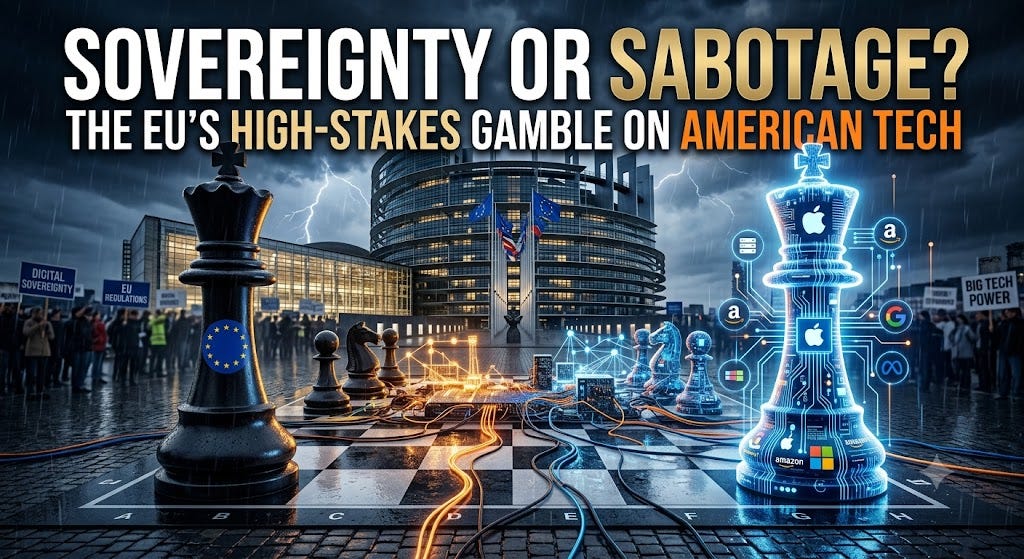
Amid the ongoing trade disputes between the United States and European Union (EU), U.S. tech industries have become the biggest target of the European regulators. Their newest report against U.S. tech companies continues a pattern of actions by attempting to limit their ability to provide services in European markets.
Thanks for reading! Subscribe for free to receive new posts and support my work.
The European Commission released its report on June 26, announcing their preliminary position that Amazon Web Services (AWS) and Microsoft Azure (Azure) would be redesignated as “gatekeepers” and have a six month period to challenge its decision before they would be designated as such under the Digital Markets Act (DMA). Since being signed into law in 2022, the DMA gives regulators the power to challenge “gatekeepers” in the market and empower a “fair market” that prioritizes smaller local tech companies. The move also marks a notable expansion of DMA’s reach, which previously focused on messaging apps, search engines, and app stores.
“The designation under the Digital Markets Act would impose a set of obligations and bans on the world’s two largest cloud providers,” Reuters reports, “including limits on self-preferencing and requirements to ensure interoperability and data portability.”
Washington Reporter journalist Matthew Foldi summarizes the consequences well. As he reports, consumer advocates and national security experts are warning that it is “designed to expressly make it harder for American tech and telecommunications companies to operate in Europe. European officials have said these rules and regulations are designed for American companies to [feel] the pain.”
As Public Policy Solutions (PPS) argues, this is part of an effort to push protectionist policies designed to disproportionately tax and regulate U.S. companies and place them at a disadvantage by promoting “digital sovereignty.” Alongside the General Data Protection Regulation, the Digital Services Act, and the Digital Network Act, it is one of many EU efforts to “impose a full suite of crushing rules and regulations” that will “lead to higher costs for companies and to hamstring innovation.” These one-sided rules create an imbalance, as Europe retains unfettered access to the U.S. market.
The Commission announced early last month that its goal was to avoid giving the U.S. and China a “kill switch” by diversifying their tech sector with domestic alternatives for semiconductor production and cloud computing. The problem is that European competitors lack the public and private sector funding, capacity, and cloud computing infrastructure to execute this vision, which hampers efforts to replace AWS and Azure.
As PPS argues, this amounts to an “extraterritorial shakedown,” with the European Commission “manipulating the digital market to hamstring U.S. companies to give themselves a competitive advantage.” Similarly, former Trump policy advisor Joe Grogan affirmed “they have no way to fund this plan and their draconian regulatory regime has prevented them from developing their own domestic champions capable of supplying the infrastructure for AI and cloud services.”
President Trump seemed to condemn the DMA designation, shortly after the announcement posting on social media that European “digital service taxes” will be met with a “100% TARIFF on any and all Goods sent to the United States of America.” Other leading American trade experts, including USTR Jamieson Greer, FCC Chairman Brendan Carr, Treasury Secretary Bessent, and Commerce Secretary Lutnick, have condemned the EU’s tech regulations, while Assistant Secretary of State Jacob Helberg recently condemned the Europeans’ push for so-called “digital sovereignty” as a threat to innovation and a display of “synchronized mediocrity.”
As China-hawk and State Armor CEO Michael Lucci points out, the timing couldn’t be worse for the EU to “pick yet another unnecessary fight with the U.S.” The U.S. and Europe are currently in the final stages of approving a new trade deal with a deadline this month, in which tech and telecom remains a sticking point for a “fair and reciprocal” deal. As Lucci argues, “by unfairly targeting and ultimately alienating U.S. technology providers, European policymakers risk creating conditions that increase dependence on Chinese alternatives.”
If the EU fails to fund and build reliable domestic technologies, who will fill the gap of U.S. tech companies? What would greater Chinese reliance mean for espionage and data security?
As Grogan argues, this “scheme” amounts to “little more than a half-baked ploy to target American companies.” The EU’s efforts to undermine U.S. tech are already weakening the “path forward to resolve the ongoing trade dispute.” Digital service taxes, the Digital Networks Act, and other laws that are used to extract fines or “usage fees” will only “hurt the EU in the long term.”
-30-
Thanks for reading! Subscribe for free to receive new posts and support my work.