Pentagon Could Be Getting Into Private Equity Game
Newly proposed legislation includes a clause that could allow for a Department of War office to acquire a stake in private companies.
The language is in Section 1051 of the Senate version of the 2027 National Defense Authorization Act (NDAA) titled “Authority for equity investments by Office of Strategic Capital,” which could create a new bank account in the U.S. Treasury to manage the funding and financing of these investments. This would allow the Office of Strategic Capital (OSC), a Pentagon office, to purchase stock, shares, preferred equity or other ownership stakes in private companies.
Section 1051 would allow the OSC to make equity investments up to $500 million, according to the proposed legislation. (RELATED: The Iran War Is Reportedly Bleeding The Pentagon Dry)
“No company receives preferential treatment. The War Department always looks for solutions to benefit the warfighter, not any pre-selected entity,” a Pentagon official told the Daily Caller News Foundation. “Outside affiliations, investors, or political connections play absolutely no role in the Department’s funding decisions.”
The DOW and the OSC are not allowed to maintain board seats or hold a majority stake in any company, according to the proposed bill.
Also, any proceeds generated from these investments will not be given to the Department of War (DOW). They will be immediately redistributed into the U.S. Treasury.
The House and Senate versions of the 2027 NDAA also include proposals to make it easier for DOW officials to lobby for defense manufacturers, grant the right to repair U.S. military equipment, and provide $2 billion for foreign interests.
The OSC and the White House did not respond to a request for comment.
Following The MoneyThe OSC was established in December 2022 to attract and scale private capital for national security priorities, according to the DOW.
Section 903 of the 2024 NDAA codified the duties of the OSC, including “implementing capital investment strategies,” according to a Congressional Research Service report from May 4.
The Senate version of the 2027 NDAA changes the picture by creating an Equity Investment Account and authorizing the OSC director to make equity investments in entities tied to critical minerals, materials, chemicals and batteries.
There are several downsides of allowing the Pentagon to get into private equity, including the politicization and influence of a private firm’s decision-making, preferential treatment of companies in which the federal government is invested, stock market distortion and high financial risks for the U.S. government, according to the Congressional Research Service.
Supporters of the program say that the OSC bolsters the strength of U.S.-based companies that create critical tech and weaponry for the U.S. military.
“With this Notice of Funding Availability, OSC establishes itself as a credible lending partner for U.S.-based companies that manufacture and produce critical technology components,” the Department of War reported on Sept. 30, 2024, citing Deputy Secretary of Defense Kathleen Hicks. “This demonstrates that DoD is dedicated to using every tool in our toolbox to secure America’s and our military’s enduring technological advantage.”
DOW investments in private entities could strengthen the supply chains of critical U.S. resources.
“DOD’s strategic investments are building capability at multiple stages of the rare earth supply chain and will provide a clear signal to private capital that the time is right to build additional resiliency,” the DOW reported on March 11, 2024, citing Danielle Miller, acting deputy assistant secretary of defense for industrial base resilience.
Not all U.S. legislators are quick to support the new legislation.
“The Department [of Defense] lacks the safeguards necessary to prevent conflicts of interest in the Office of Strategic Capital (OSC) … I am concerned that this is resulting in a conflation of interests that creates clear conflicts,” Democratic Massachusetts Sen. Elizabeth Warren said in an open letter to the former Under Secretary of Defense for Research and Engineering on July 9, 2023.
Warren’s concerns could now become reality as the Senate Armed Services Committee quietly shut down a proposed amendment to the 2027 NDAA that would have prevented the OSC from investing in any companies that “top executive branch officials or their immediate family members hold a significant ownership stake,” NOTUS reported, citing Warren.
Warren’s office did not respond to a request for comment.
Vulcan Elements, a North Carolina startup linked to Donald Trump Jr., received a $620 million DOW loan on Nov. 21, 2025. One Democratic congresswoman was concerned that Trump Jr. may have profited from the loan.
“Vulcan has developed an industry-leading rare earth magnet manufacturing capability for critical defense and commercial applications and is the only magnet company with a supply chain independent from China down to the material, technology, IP, software, and ownership,” a company spokesperson told the DCNF. “The company received its first three Pentagon contracts in 2024 and has delivered on 100% of its contracts and projects on time and on budget. After a year of diligence by multiple government agencies, Vulcan was selected by the Pentagon for an investment to build the largest magnet plant in the world outside of China.”
“Donald Trump Jr. must be made to answer whether the president’s son illegally profited from his father’s presidency,” Democratic Oregon Rep. Maxine Dexter said during a House Committee on Natural Resources meeting on March 25.
Vulcan is linked to Donald Trump Jr. because 1789 Capital, the venture capital firm where Trump Jr. is a partner, took an equity stake in Vulcan Elements in August 2025, according to a press release from Democratic California Rep. Jared Huffman.
House Democrats attempted to subpoena Trump Jr. to testify about the deal, but were blocked by Republicans, according to Huffman’s press release. One Republican politician claimed that it was a partisan effort to attack the Trump administration.
“It just seemed like a shot at the president, but the NDAA is for serious stuff,” NOTUS reported, citing Republican South Dakota Sen. Mike Rounds. “We keep all the cheap shots out, and we think the president and most of the other members would have considered that a cheap shot, and that’s not what the NDAA is all about.”
Despite the concerns surrounding nepotism and high financial risks, this program does have an important purpose. It aims to help the U.S. government to jump ahead of China in the high-stakes rare earth minerals race.
The “critical mineral” supply chain is a key component of U.S. national security, the Assistant Secretary of War for industrial base policy Michael Cadenazzi Jr. said during a Senate Armed Services Committee hearing, according to the DOW.
The loan with Vulcan would “directly support the production of advanced rare earth element separation, metallization, and magnet manufacturing capabilities in the United States,” according to the DOW.
The loan with Vulcan is not the only recent deal to support the critical mineral supply chain. The Pentagon purchased $400 million in stock from MP Materials, a rare earth mining company, CNBC reported on July 10, 2025.
The White House and the Department of War did not immediately respond to a request for comment regarding Vulcan.
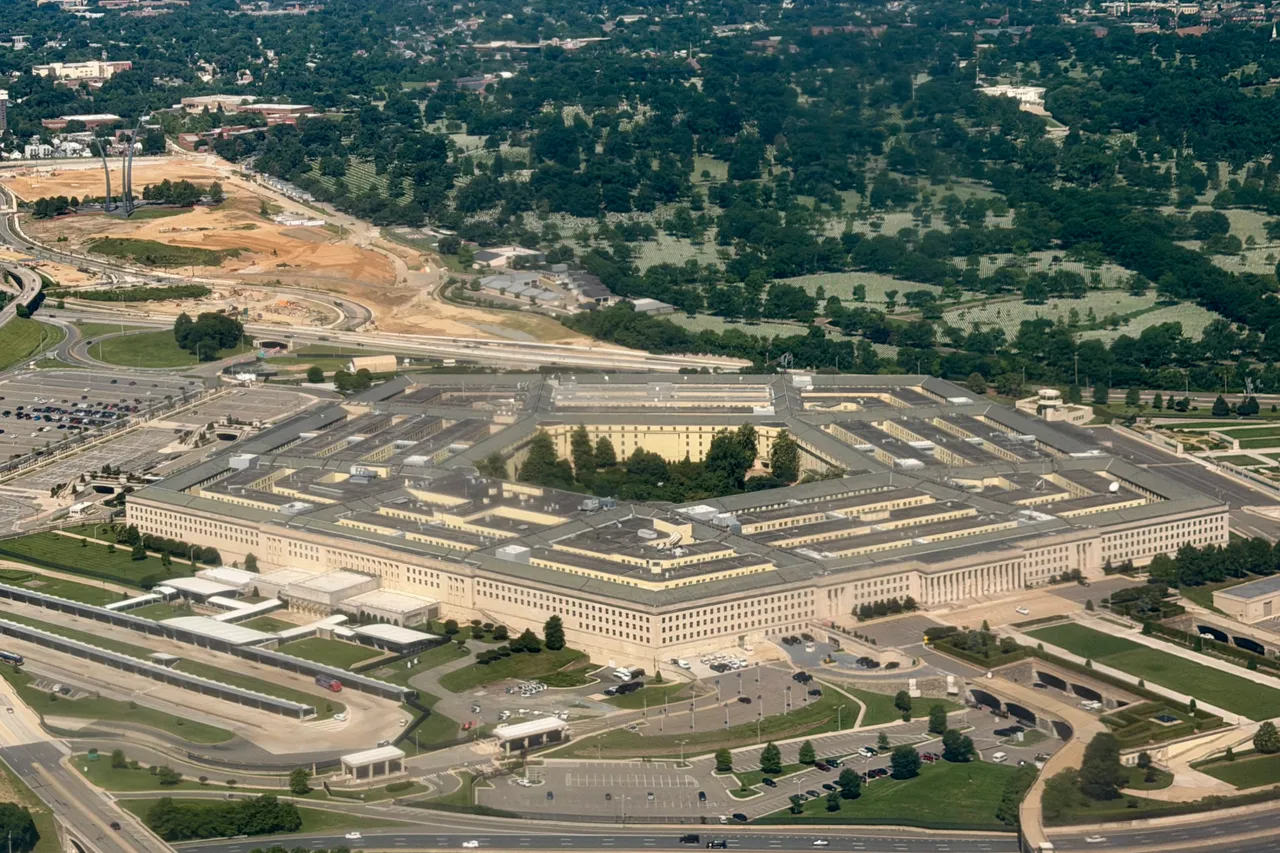
An aerial view of the Pentagon, which houses the US Department of Defense headquarters, in Arlington, Virginia, on May 31, 2026. (Photo by Daniel SLIM / AFP via Getty Images)
“This is to improve cooperation, support up-and-comers, and to streamline acquisition for selected items or lines,” Heritage Foundation visiting fellow and former Pentagon official Steven Bucci told the DCNF. “The money-making potential is incidental. I do not think the government is ever very good at that.”
The proposed legislation also makes it clear that foreign involvement is restricted in these investments in Section 1052 of the 2027 NDAA.
The director of the OSC would “assess any direct or indirect foreign ownership interest in the entity, including the ability of any foreign person to exercise control or influence over the management, governance, operations, or technology of the entity,” according to the 2027 NDAA.
Language in Section 1052 also calls for the director to identify all individuals and interests that hold at least a 5% stake in any entity that the OSC would like to invest in. It also calls for an assessment to find conflicts of interest between the federal government and any executives, advisory boards and board members in these entities.
‘Do Not See Any Risks’Bucci pointed out that similar practices are already performed by the intelligence community in its sphere of influence.
“I do not see any major risks. This is akin (but probably larger) to the Intel Communities’ forays into the private sector,” Bucci told the DCNF. “It will allow the Department to help smaller and high-potential firms while not restricting its interaction with the bigger companies through the normal processes.”
Investments by the intelligence community have played a key role in creating industry giants like Palantir.
“In-Q-Tel (IQT) is CIA’s venture capital firm which was created in 1999 to help identify private sector innovations that may be beneficial to CIA’s core mission,” according to the Central Intelligence Agency (CIA) website.
Palantir was one of In-Q-Tel’s first investments, CIA whistleblower John Kiriakou explained on the Nov. 18, 2025, episode of the Julian Dorey Podcast.
“In-Q-Tel’s very first investment was not a lot. It was like I can’t remember if it’s a million and a half. I think it’s a million and a half to Palantir,” Kiriakou said. “And now Palantir is a trillion-dollar company.”
The real investment was likely larger than $1.5 million. In-Q-Tel invested about $2 million into Palantir, The Wall Street Journal reported on Sept. 4, 2009.
Palantir was a part of its portfolio; however, the status is currently listed as “exited,” according to In-Q-Tel’s website.
Palantir did not respond to a request for comment.
“In addition to having significant impact on the missions of our government partners, our work has helped build many iconic companies such as Palantir,” In-Q-Tel’s careers page states.
“The CIA now is in the venture capital business for a profit, which is illegal,” Kiriakou said on the podcast. “Not if you’re writing the laws,” Dorey replied.
All content created by the Daily Caller News Foundation, an independent and nonpartisan newswire service, is available without charge to any legitimate news publisher that can provide a large audience. All republished articles must include our logo, our reporter’s byline and their DCNF affiliation. For any questions about our guidelines or partnering with us, please contact licensing@dailycallernewsfoundation.org.