California Lets AI Determine Prisoner's Fates Without Telling Anyone
California state officials on Friday acknowledged utilizing several high-risk artificial intelligence systems they previously failed to disclose, CalMatters reported on Monday.
State officials had previously concluded that no government agency was using high-risk automated decision-making systems, CalMatters reported in June 2025. California’s Department of Technology has now determined in a legislative report that it is currently utilizing six different automated systems that can be used for tasks such as predicting the likelihood that incarcerated individuals will reoffend after their release, according to the outlet. (RELATED: Top Law School Declares War On Student Use Of Artificial Intelligence)
California’s Department of Technology did not immediately respond to the Daily Caller News Foundation’s request for comment.
The Golden State is also using some automated systems to assess whether unemployment insurance claims are possibly fraudulent, conduct remote exams for California State University students and detect when college students rely on AI tools for assignments, CalMatters reported.
“The [California Static Risk Assessment (CSRA)] is a validated risk assessment tool being utilized by [California Department of Corrections and Rehabilitation (CDCR)], as required by the CCR, Title 15, Division 3, Section 3768.1. CSRA utilizes a set of risk factors which are most predictive of recidivism,” according to the report. “The tool produces a risk number value that will predict the likelihood that an offender will incur a felony arrest within a three-year period after release to parole. Risk factors utilized include, but are not limited to, age, gender, criminal misdemeanor and felony convictions, and sentence/supervision violations.”
The CSRA analyzes several “static” factors about the offender which do not change, including age, gender and criminal history in order to “assign a risk level from 1 (Low) to 5 (High Risk Violence),” per the report.
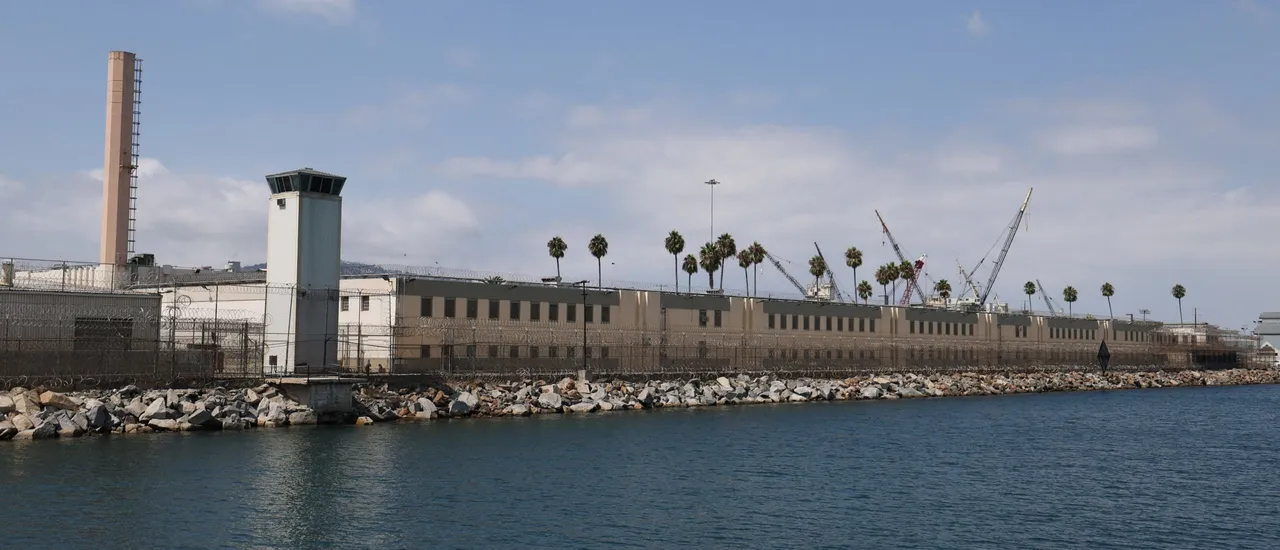
A guard tower stands on the waterfront at Reservation Point behind security fencing at the Federal Correctional Institution (FCI) Terminal Island, a low-security federal prison for men operated by the Federal Bureau of Prisons at the harbor entrance to the Port of Los Angeles in Los Angeles, California on September 13, 2025. (Photo by Patrick T. Fallon / AFP) (Photo by PATRICK T. FALLON/AFP via Getty Images)
“By identifying high-risk individuals, the CDCR can focus its limited rehabilitation resources where they are needed most to have the maximum positive impact on public safety,” the report suggests.
The department’s report also notes that CDCR staff could “manually perform the CSRA evaluation” instead of relying on AI tools. The report also highlighted six separate systems which were originally flagged as being high-risk but were subsequently determined not to be, per CalMatters’s report.
Some critics have warned that inadequate government oversight of similar AI systems may leave the public facing a lack of transparency about how automated tools are impacting key decisions, Newsweek reported on Tuesday.
All content created by the Daily Caller News Foundation, an independent and nonpartisan newswire service, is available without charge to any legitimate news publisher that can provide a large audience. All republished articles must include our logo, our reporter’s byline and their DCNF affiliation. For any questions about our guidelines or partnering with us, please contact licensing@dailycallernewsfoundation.org.