How Trump's Psychedelic Drug Research Push Could Shake Up US Healthcare
The Trump administration’s recent push for psychedelic drugs in mental healthcare may significantly shake up the industry.
President Donald Trump issued an executive order in April aiming to “accelerate innovative research models and appropriate drug approvals to increase access to psychedelic drugs that could save lives and reverse the crisis of serious mental illness in America.” While some experts have touted the antidepressant effects of psychedelic-assisted mental healthcare treatments, others have raised concerns about potential ethical issues and gaps in psychedelic research. (RELATED: Trump Signs Executive Order Speeding Up Research On Using Psychedelics For Mental Health)
“Speeding [up] access is welcome,” CATO Institute Senior Fellow Jeff Singer told the Daily Caller News Foundation. “But psychedelic-assisted treatment is neither conventional drug therapy nor conventional psychotherapy, and decades of Schedule I restrictions have left most clinicians with little training in it. The challenge is to build a framework that reflects that reality.”
“The potential upside is significant for patients with conditions like [post-traumatic stress disorder (PTSD)] and depression who haven’t responded to existing therapies,” Singer added. “The downside is that regulators may focus so heavily on controlling access and on who may provide treatment that they make these treatments unnecessarily expensive and difficult to obtain.”
Singer also noted that these types of therapy are “neither traditional pharmacotherapy nor traditional psychotherapy.”
“Decades of Schedule I restrictions kept much of the field outside mainstream medicine, raising questions about who should provide treatment and how they should be trained,” he stated. “Policymakers should also consider whether the [Food and Drug Administration (FDA)] approval framework developed for conventional drugs is appropriate for therapies that depend so heavily on set, setting, and guided support.”
Psychedelic therapy, also known as psychedelic-assisted psychotherapy, uses substances such as MDMA, LSD and psilocybin — the key ingredient in “magic mushrooms” — to help promote psychological healing, according to Palo Alto University. Unlike traditional forms of drug therapy, psychedelic therapy is generally conducted in a carefully controlled clinical setting.
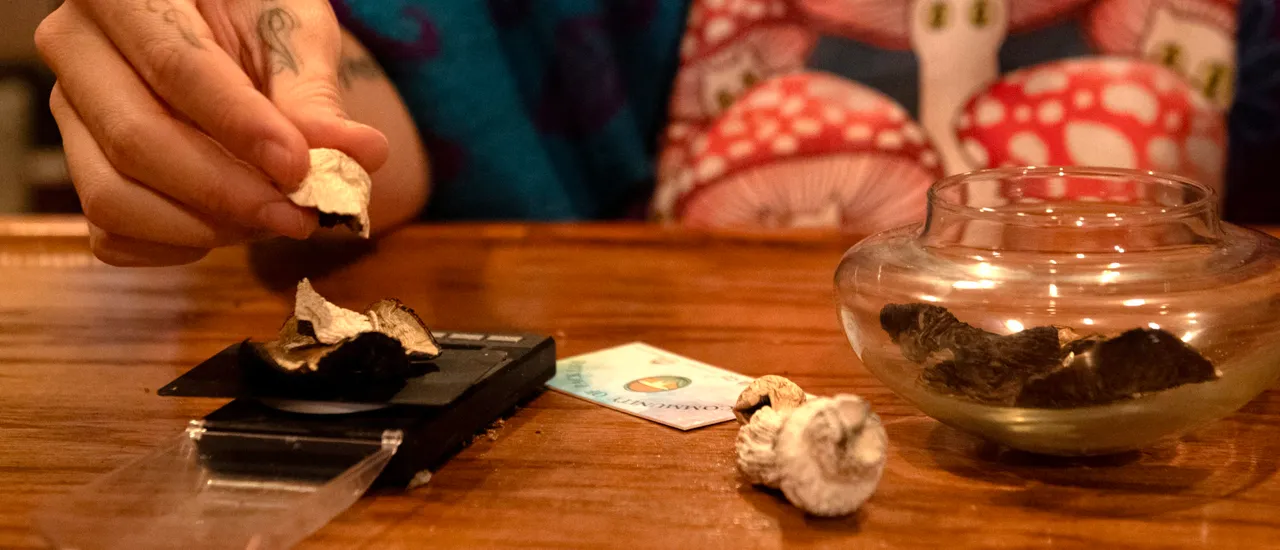
Benji “Teopixqui Dez” Dezaval, founder of The Community of PACK Life, which serves as Colorado’s first psychedelic church, weighs a psilocybin mushroom as he prepares a weekly communal gift of two grams for a congregant while in the basement of his home on February 18, 2025, in Colorado Springs, Colorado. (Photo by JASON CONNOLLY/AFP via Getty Images)
A 2013 University of South Florida study shows that psilocybin may promote the growth and repair of brain cells in the hippocampus, the brain’s center of emotion and memory, according to New York University Langone Health. The study also found that mice treated with psilocybin showed a greater ability to overcome fear conditioning than those given a placebo, which supports the hypothesis that psilocybin could help break the trauma cycles of patients with PTSD.
“We very much welcome the Trump administration’s executive order,” Compass Pathways Chief Patient Officer Steve Levine told the DCNF. “We [see] this as a clear signal that President Trump and the White House recognized that there are millions of Americans who are suffering, who are not well served with options they have today. And they recognize the therapeutic potential of psychedelics, and are supporting further research of them.”
“Starting with the pros, and I guess starting by just repeating some of what I said previously, this is a very promising new class of treatment, and one that is mechanistically different,” Levine continued. “They work differently in the brain and the body, and otherwise are actually new, as opposed to, you know, supposedly new treatments that have been developed in psychiatry previously, but really are very similar to what’s already existing. This is potentially a whole new paradigm of care, one that has very promising science behind it, and a few companies like compass pathways have already primarily met the evidentiary kernels, the requirements necessary for a regulatory review, and hopefully an approval.”
Though, Levine noted that there is currently a lack of evidence showing the concrete benefits of using psychedelics to treat mental health issues.
“The [main] potential con is that that level of evidence hasn’t been generated from psychedelics yet,” he said. “And so we very much support rigorous science, making sure that the same standards apply for the potential approval of these new products, because we owe that to patients, to ensure that everything is science backed [and] safe.”
Psychedelics can heighten the risk of exacerbating psychotic disorders in some individuals, according to True North Psychology. Some patients may also face difficult after-effects from psychedelic therapy, such as existential distress and mood difficulties, per the report.
Three U.S. states have legalized some form of psychedelic medicine and 19 others are currently considering legislation, according to a September 2025 report from Yale University’s Institution for Social and Policy Studies.
Informed consent is highly challenging in psychedelic-assisted psychotherapy scenarios, according to Psychiatry Online.
All content created by the Daily Caller News Foundation, an independent and nonpartisan newswire service, is available without charge to any legitimate news publisher that can provide a large audience. All republished articles must include our logo, our reporter’s byline and their DCNF affiliation. For any questions about our guidelines or partnering with us, please contact licensing@dailycallernewsfoundation.org.