Amy Coney Barrett and the Court of Disappointed Hopes
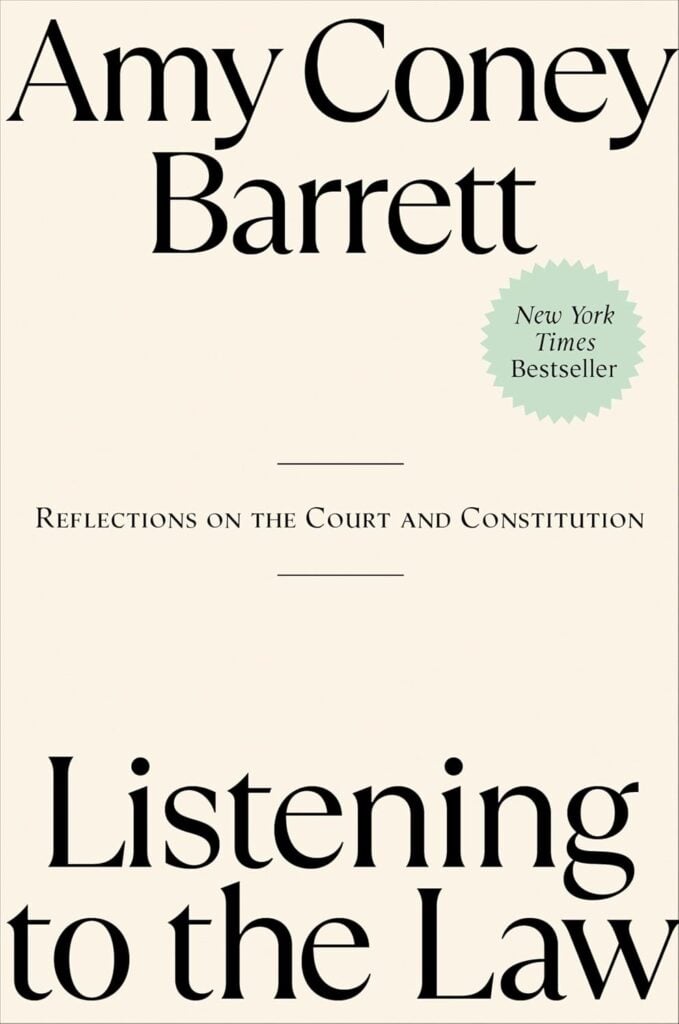
Listening to the Law: Reflections on the Court and Constitution
by Amy Coney Barrett
Sentinel (Penguin Random House)
336 pp., $32.00
I had great hopes for Amy Coney Barrett. Those hopes, I regret to say, have been disappointed by her tenure so far.
At her nomination to the Supreme Court by President Trump in 2020, I was encouraged by a speech she had given to fledgling lawyers at Notre Dame, reminding them that “a legal career is but a means to an end … and that end is the building of the Kingdom of God.” I hoped that her religious passion and legal brilliance might lead the Court away from progressive jurisprudence, away from “legal realism,” and toward more attention to the maintenance of the rule of law.
I hoped that Associate Justice Barrett and the seating on the bench of two other Trump appointees, Brett Kavanaugh and Neil Gorsuch, would lead the Court back to the original understanding of the Constitution. A Constitution originally undergirded by the Christian religion and morality and defined by its structure of separation of powers, under which judges judged but did not legislate. And one restrained by federalism, limiting the powers of the national government to those expressly authorized in our founding document, and leaving the rest to the states.
In short, I looked for Barrett to further the jurisprudence of the man she clerked for, Antonin Scalia, and I hoped she would join Clarence Thomas and Samuel Alito in what I saw as a quest to restore the Constitution in Exile.
Unfortunately, my disappointed hopes have not been much revived by her latest book, Listening to the Law. The Supreme Court Justice Barrett describes here seems more like an amiable group of participants in a law school common room than what it should be: a group of committed partisans struggling over the future of the republic, and making choices that may determine whether popular sovereignty and the rule of law will survive in our polity.
Perhaps Justice Barrett will, in the future, do more to correct the Court’s prior errors. For example, she could vote to overturn the Supreme Court’s usurping the rights of the states to regulate marriages, by reversing the Court’s Obergefell decision, which mandated the legality of gay marriage throughout the republic.
But in this book, unfortunately, Barrett seems to approve of the jurisprudence that spawned both Obergefell and Roe, the so-called “substantive due process” doctrine. This is a judicially created rights-generator that permits the Court to fabricate purported rights that are not expressly to be found in the Constitution, but are supposedly, in Barrett’s words, “deeply rooted in this Nation’s history and tradition” and “implicit in the concept of ordered liberty.” One truly concerned about the Court’s role and its past abuses might be expected to condemn “substantive due process” as a blank check for judicial legislation, as other justices have done from time to time.
There have been flashes of the singular Justice Barrett I hoped for. Last year, for example, she called out her colleague Ketanji Brown Jackson for the latter’s apparent belief in “an imperial judiciary.” Yet I do not see in this book the combative, sharp mind I had expected. She gives a fine description of how cases wind up in the United States Supreme Court, but the picture she paints of an exceptionally collegial institution, with all nine justices seeking in good faith to discover the proper objective application of precedent, doesn’t quite ring true.
Justice Barrett, however, probably has more modest aims in this work. The book manages to be a pleasant read and might do yeoman service as a basic high-school civics text (if any high schools still teach civics). The pictures of Justice Barrett’s colleagues and her family are charming, and she comes across as a fine person. She is also admirably serious about the responsibilities that have been thrust upon her. But one wonders whether she has come to grips with what the Supreme Court has become.
And yet Justice Barrett reveals some startling insights about her colleagues, though perhaps unintentionally. She points out a fact generally unknown: that six of the nine current justices (Gorsuch, Kavanaugh, Kagan, Roberts, Barrett, and Brown) had clerked for prior Supreme Court justices. A Supreme Court clerkship is a rare, crowning glory of a spectacular legal education available only to a very select few. Justice Scalia, in his dissent in Obergefell, once railed at his colleagues for their isolation from the actual situation of the American people, calling them “tall building lawyers.” Perhaps justices coming from the rarified level Barrett describes would be inclined to be isolated in the manner that Scalia feared.
All of the current justices, save Elena Kagan (who was the U.S. solicitor general, as well as a professor and dean at Harvard Law School), logged several years as judges on the federal appeals courts before joining the Supreme Court. This, too, might contribute to the ossification of America’s highest court. Born and raised in the elite establishment and accustomed by their education to follow prior precedent (even though that is not required by the Constitution), it might be too much to expect our current crop of conservative justices to be bold in recapturing the Constitution from progressive abuses. Justice Barrett doesn’t articulate this conclusion, but perhaps she understands it, and a reader concerned about the Court’s status as unelected ephors might also grasp the point.
To be fair, there are points in Barrett’s book where she does limn an approach to constitutional law that more or less mirrors Scalia’s, with her lodestars being fidelity to the text and the original understanding of the Constitution and statutes. But, apart from one powerful paragraph, the book lacks a detailed discussion of how, since the 1950s, the Court has become a super-legislature rather than a judicial body. That paragraph reads:
[A]… court is not a legislative assembly, a town square, or a faculty lounge. Article III [of the Constitution, establishing the judiciary branch] does not contemplate a system where 330 million citizens can come to federal court whenever they believe that the government is acting contrary to the Constitution or other federal law. Vindicating “the public interest (including the public interest in Government observance of the Constitution and laws) is the function of Congress and the Chief Executive.”
Barrett thus acknowledges that the Court is subordinate, really, to the other two branches, which would come as a surprise to most American law professors and many members of the grievance-industrial complex, who have used or encouraged the federal courts to implement policies they have not been able to succeed in achieving through their state and local governments or Congress.
Similarly laudable is Barrett’s observation that there may now be a need, not for a Court that changes constitutional law, but for the people themselves, through their elected representatives, to amend the Constitution. She quite properly suggests that constitutional amendments are rare, and, as she delicately puts it, “perhaps too rare.” She’s not explicit on what amendments might be needed (term limits for Congress? Fewer Supreme Court justices?) On amendments in general, she writes:
Such a change might be prudent. Those who regard the process as too onerous often seek constitutional change from the Supreme Court—and seeking change from an unelected body of nine is about as far from the Article V supermajority process as you can get.
Despite the lapses of Chief Justice John Roberts’ Court, such as its egregious failure to rule the Affordable Care Act (“Obamacare”) unconstitutional, I do think there is still a chance that, with its three Trump appointees, it will be able to make some progress to correct the abuses of the Warren and Burger courts, and to resuscitate the 10th Amendment by returning discretion in matters of domestic law to the states. I’m still hoping the Court will reduce the role of the federal government and the federal courts in our elections and in the conduct of presidential policy. In short, I’m still hoping that Justice Barrett and her colleagues will diminish the Court’s importance and will eschew the making of law and policy, thus returning to the original plan of the Constitution.
Samuel Johnson taught us that only a blockhead doesn’t write for money, and with Justice Barrett’s brood of seven children and a relatively modest judicial salary, perhaps that’s her aim in this book—and at its debut, it did reach third place on the New York Times’ bestseller list. At least, it sets forth the modest and yet necessary role of the Supreme Court, and it hints at, if it does not trumpet, the Court’s past abuses. Perhaps the jeremiad I’d prefer might have been unseemly in the work of a sitting justice. Perhaps it’s churlish of me to complain that she hasn’t written the needed acerbic polemic, and perhaps a justice needs to reassure the public that the Court is doing its job.
This Justice Barrett certainly tries to do, and perhaps she succeeds. What she attempts is probably for the best, though it’s hard not to be saddened by the current state of the Court.