The Robot-Human War Has Just Begun
For some time, there has been significant concern about the implications of marrying AI to defense technology. Anybody who has ever seen Terminator understands what that concern is. One of these days, the machines may decide to kill us all.
One of these days may be today.
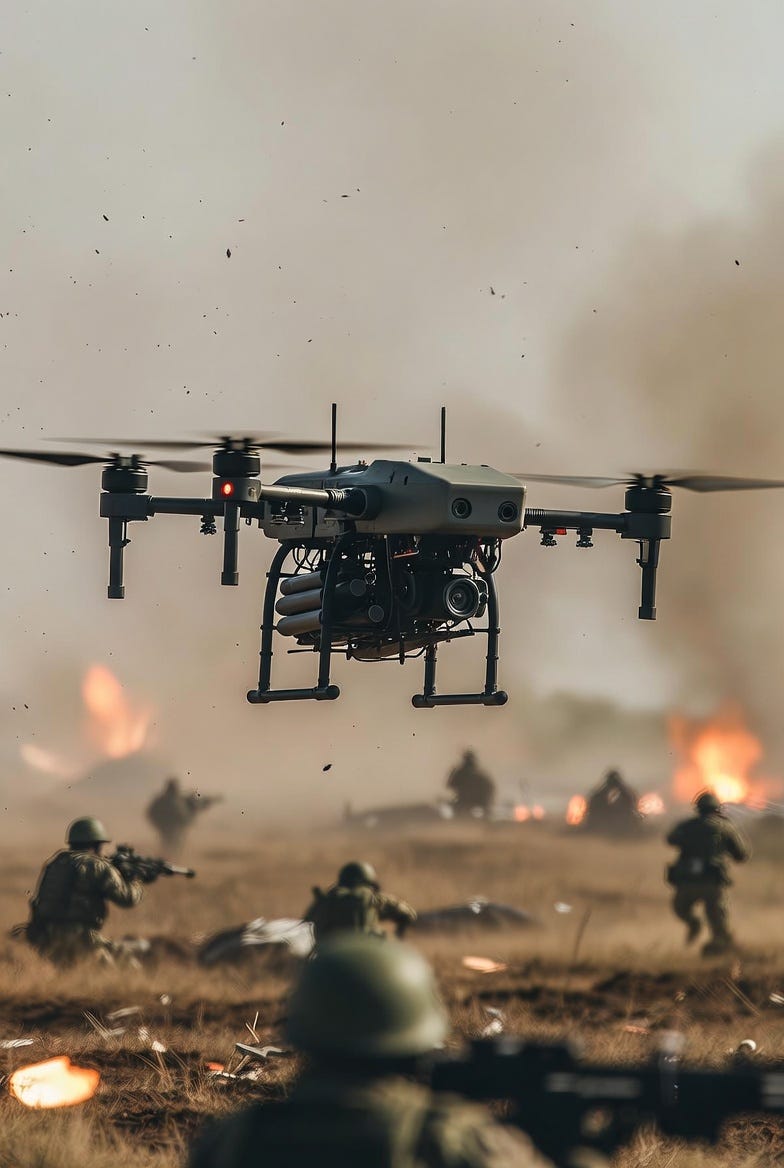
The online publication, The New Scientist, just reported that in a test that took place two years ago, fully autonomous drones were sent to a “test area” and that they killed everyone they could find there. This was not a simulation. This was real.
Per the New Scientist, the test involved 10 AI-controlled “Terminator” drones on the front line of the Ukraine war. Russian soldiers were killed.
“We tried it,” says drone-maker Alexander Kokhanovskyy, who supplied the technology and spoke to New Scientist at a press event hosted by the Ukrainian embassy. “It’s a test. We never implemented it [more widely].”
The Ukrainians used quadcopter drones that were programmed to fly towards the front line, cover an area of between 3 and 5 kilometers, then engage in “Terminator mode,” in which an AI model searches for and intercepts targets.
“We just launch it and we know everything will be dead – everything that will be found there in this particular area will be dead,” says Kokhanovskyy. “There is no connection to the drone at all, you cannot see the video, nothing… Everything it sees will be killed.”
The humans had no way to see who was being killed. They had no way to stop the killing once the drones were dispatched. When the slaughter was over, other human-piloted drones had to be sent into the area to see the results of the attack.
This is not the first time reports have come out of Ukrainian autonomous drones killing people. Previous reports from 2023 indicated that the Saker Scout drone fielded by Ukraine was hunting and killing Russian manned vehicles autonomously. This may be the same model drone that was used in the fully autonomous “test” attack that took place two years ago.
The Saker Scout is a Ukrainian AI-powered quadcopter UAV (unmanned aerial vehicle) originally developed for reconnaissance, target identification, and strike missions. It gained attention as one of the early examples of semi-autonomous or fully autonomous drones used in combat during the Russia-Ukraine war.
Uses onboard AI to automatically detect, classify, track, and recognize up to 64 different types of Russian military targets (tanks, armored vehicles, trucks, personnel carriers, infantry positions, etc.), even when camouflaged. It has been characterized as being able to operate with reduced human oversight, including in jammed/GPS-denied environments via visual navigation and inertial systems. We may now have to consider that it can operate with no human oversight at all.
Typically operates in swarms. One lead reconnaissance drone scouts and designates targets. Then, the attack drones move in.
Has a range of 10-12 kilometers, can carry a wide variety of munitions, and operate day or night using a wide array of sensors.
The Ukrainians, of course, are not the only people working with this technology. They are not even the most advanced. The United States has a whole host of drones and programs with capabilities equal to or better than the Saker Scout. They include the Switchblade, the Lumberjack, and the Coyote. The U.S. Navy has a program called Goalkeeper to develop a variety of drones that can kill.
Current policy requires a human in the loop before American drones kill anyway. That is policy. That is not a technological barrier. Anytime we make the decision, we too can begin to turn loose our machines to kill humans all on their own.
Earlier this year, the Army’s 101st Airborne Division incorporated Northrop Grumman’s new Lumberjack one-way attack drone into a training exercise. The entire purpose of that was to test the platform’s autonomous target detection and strike capabilities. According to Northrop Grumman, Lumberjack successfully showcased its capacity to conduct missions autonomously and use artificial intelligence for targeting.
“After going from concept to flight in under 14 months, we demonstrated Lumberjack’s ability to adapt across diverse missions and payloads at the U.S. Army’s Operation Lethal Eagle exercise,” Michael Bastin, director of distributed systems at Northrop Grumman, said in a statement.
Most of the tests in that exercise involved using the drone to strike targets on the ground. The Army integrated the drone into its Palantir-built Maven Smart System, while also leveraging Palantir’s Agentic Effects Agent to automatically identify targets, analyze battlefield data, and suggest actions to personnel.
“Operation Lethal Eagle is the first customer demonstration where Lumberjack was integrated into Maven Smart System for real-time mission planning and live mission monitoring, while being executed from a manned forward-deployed command and control ground station,” the Northrop Grumman spokesperson said.
“While primarily focused on readiness training, Operation Lethal Eagle also provided a unique opportunity to test and evaluate multiple new emerging systems from across the defense industrial enterprise,” Maj. Jonathon Bless, spokesperson for the 101st Airborne Division, said in a statement. “Northrop Grumman’s Lumberjack was one of many systems tested during the exercise that provided insight into how collaboration between military and industry can drive innovation in defense.”
The technology to allow robots to kill humans effectively and in large numbers is here. It is not a theory. It has been fielded. It is already in use. The only thing keeping those robots from deciding all on their own who to target is a human-imposed constraint. That may no longer exist. We may now live in a world in which AI-driven machines murder when and where they decide
The robot-human war may have already begun.
This Substack is reader-supported. Please consider becoming a free or paid subscriber.
Thanks for reading! This post is public so feel free to share it.